Plas-y Ial
Owain Glyndŵr hero of Wales was said to have rested here and hid to avoid a party of English soldiers during his fight with Baron Grey de Ruthyn that eventually led to the Welsh revolt from 1400 to 1415. The Ials or as we would say today the Yales descended from Owain, making it as one Welshman explained a most Welsh family. (The line of descent is actually from Owain's brother Tudor ap Griffith (Tudor ap Glyndŵr))
I came about understanding this after my grandmother passed away. I recovered from her estate an old book called the Yales and Wales. First published in 1908 it was written and researched by Rodney Yale. This book was a remarkable feat of research for the time and included I assume a visit to Wales when the accompanying photographs were taken.
The book lists my grandfather Cushman Morse and proceeds to document the family back to its arrival in America in 1637 (aboard the small ship Hector) and then further back to David Yale who owned Plas Y Ial and back further to Owen Glyndŵr.
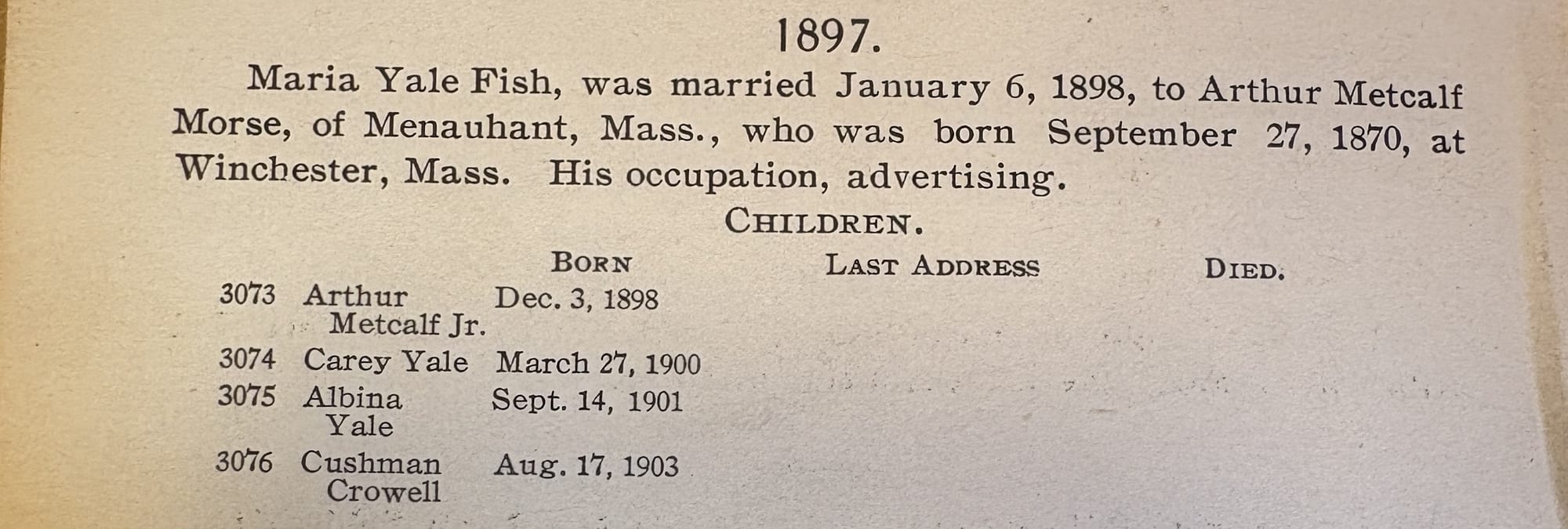
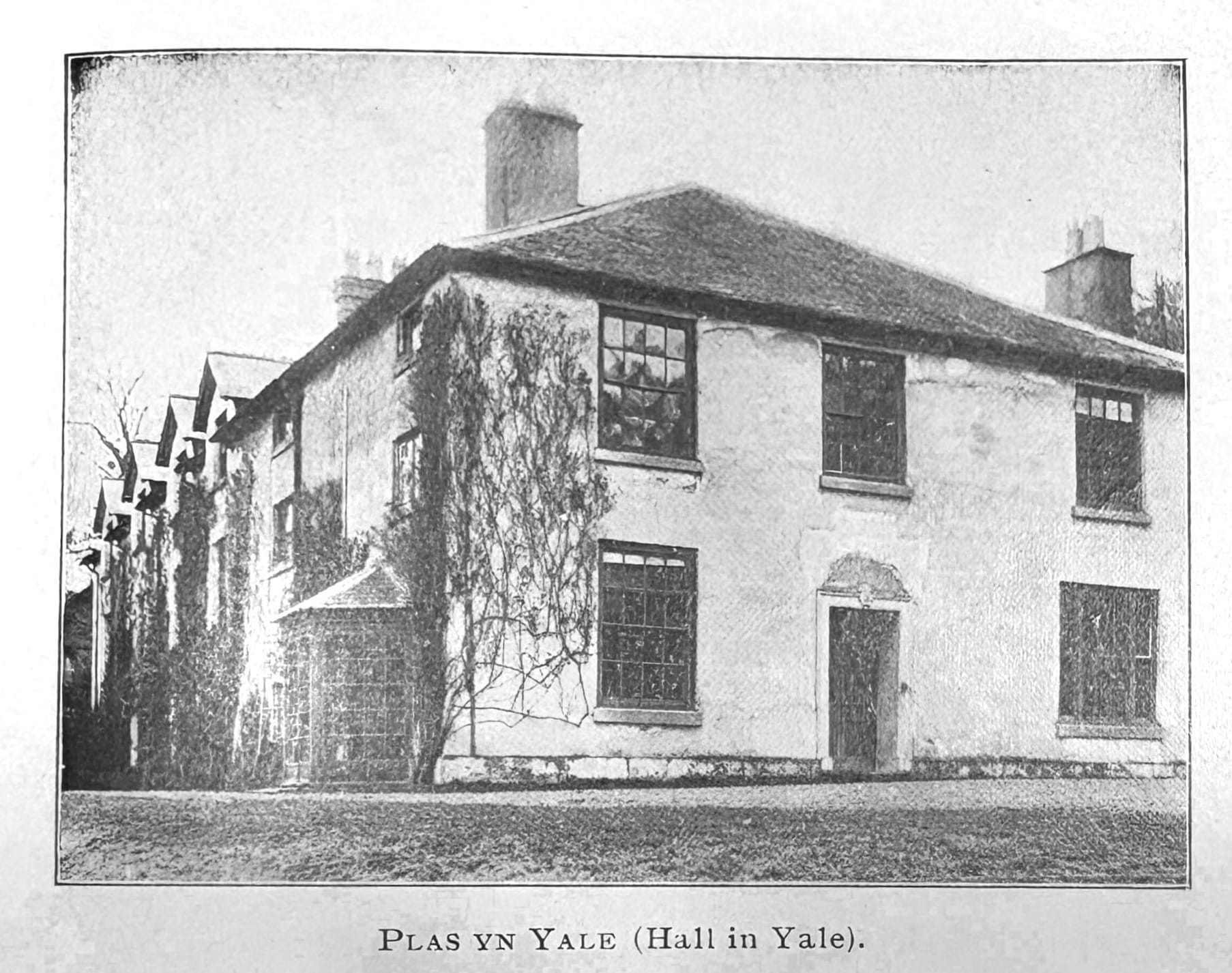
Rodney had included a few photos he took in Wales during his research and one included Plas-y Ial. I reread the book in 2017 when I lived in Britain and googled the name and found it had become a self-catering cottage. Comparing photos from the cottage website and the photos from Yales and Wales it was clear it was the same building. My wife and I decided to stay a couple of nights and learn what we could of the old place.
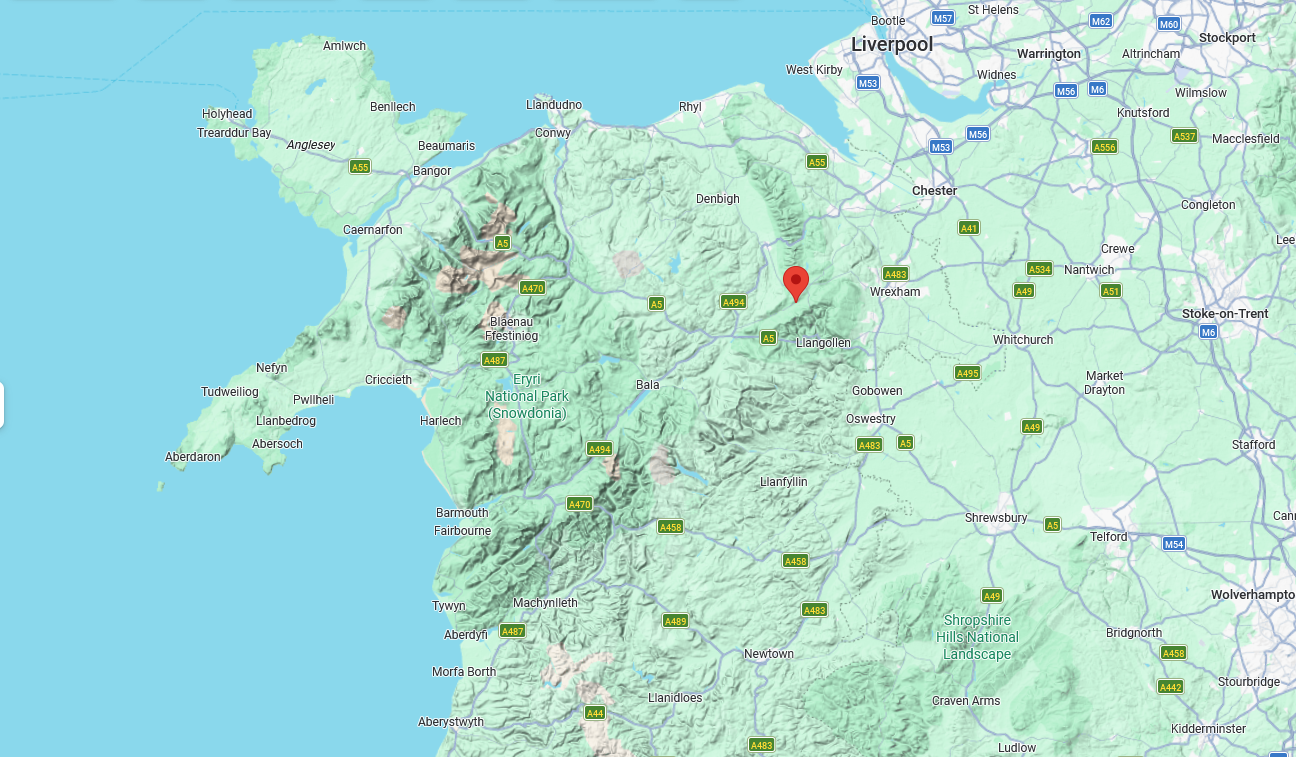
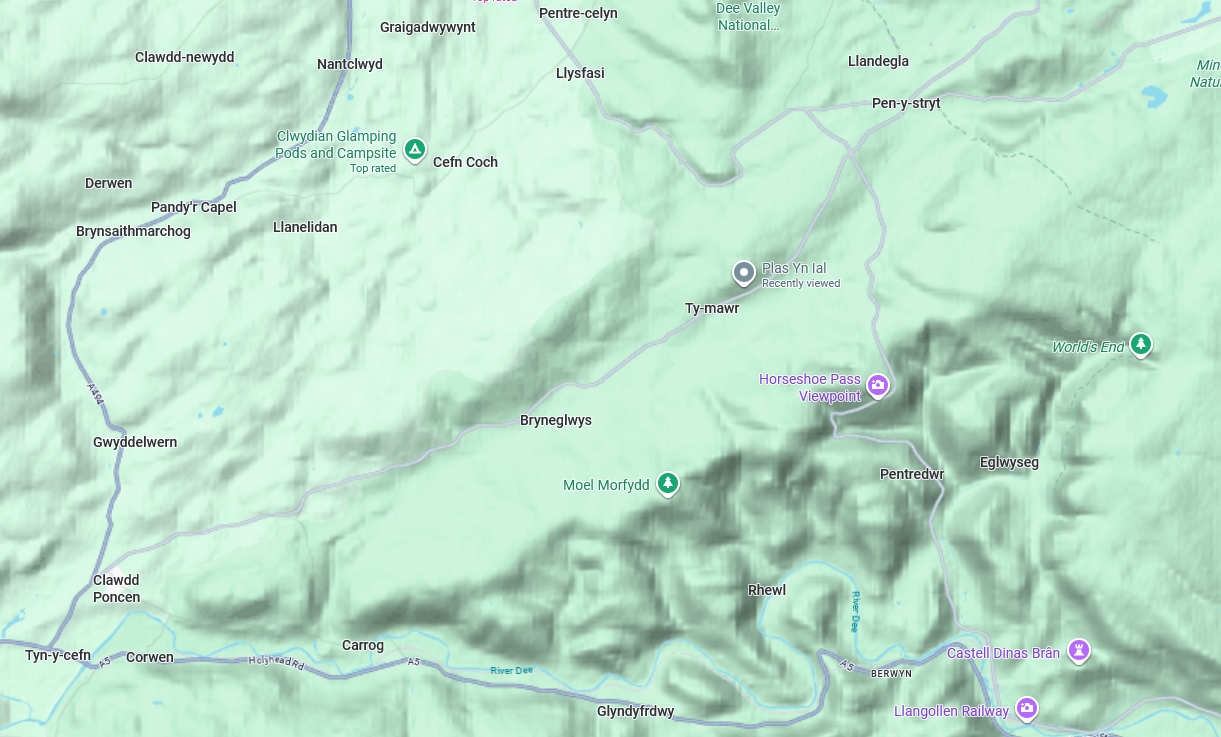
Plas-y Ial is in North Wales not far from the industrial city of Wrexham. The maps below will orient the reader. It resides on the south facing slope of a gentle green valley of the river Alyn (Afon Alyn in Welsh).
The word ial in Welsh means fertile upland or pasture. The family adopted the name of the place in the 16th century as the new English habit of surnames came into fashion. It was common to adopt the name of where you were from as your new surname. Prior to that Welsh names were usually in the form of Tudor ap Griffith which is Tudor son-of Griffith to emphasize patrilineal descent.
I should probably preface at this point that I find this interesting, but I also find it of no real consequence. I do not hold to some of the current ideas about how American someone is or how entitled they may be to live here based on ancestry. I also do not think this reflects on my character positively or negatively. Still there is a latent interest in one's roots and these are as I say, interesting, at least to me. Where this stems from I cannot say.
Gordon Sherratt a 20th century chronicler of the Yale estate says.
It is therefore plain that so strategic a site, situated as it is in the heart of Yale country, could not fail to play a significant part in the unsettled days of Welsh history. The Llewellyns and Owen Glyndwr raised their standard here, and men moved stealthily in the night from as far away as Caernarfon to 'Place in Yale," to them the "rallying place in Yale". In those times the alternative name "Allt Llwyn ar Draig Goch" (Hill Grove of the Red Dragon) would indicate clearly to the familiar with the Nation Emblonic Banner that armies were wont to mobilise here, and a tired Glyndwr (whose conjunction with the house we will later learn) was to rest the tattered remnants of his once proud army, after an unsuccessful assault on Ruthin town. Whilst regaining wind and seeking reinforcements, the Welsh lay low in the afore-mentioned gulley, while the enemy English, see all to be seemingly quiet here, passed by on the ridge of the hill.
Gordon goes on to inform us the original dwelling of which little is known, was thought to be destroyed by fire in 1415. In 1450 Ellis ap Griffith (the son of Lowrie, niece of the celebrated Owen Glyndwr) built a new house at Yale. This was the first house made from stone for the region. This is supposed to have been incorporated into the southeast corner of the present building. Thomas Yale in 1575 left money to his brother John Yale for the repair of the house though it appears the work did not start for another 40 or 50 years.
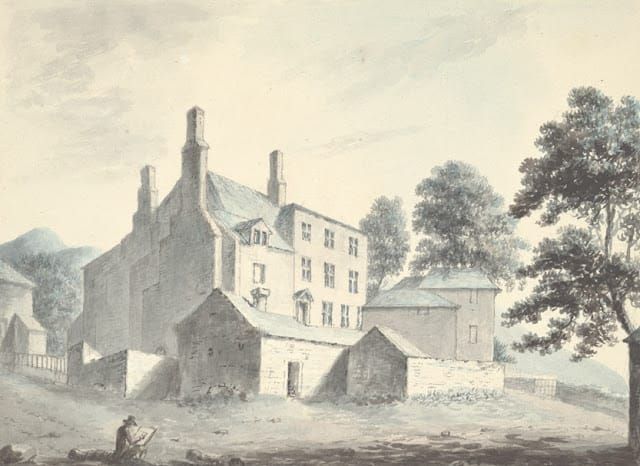
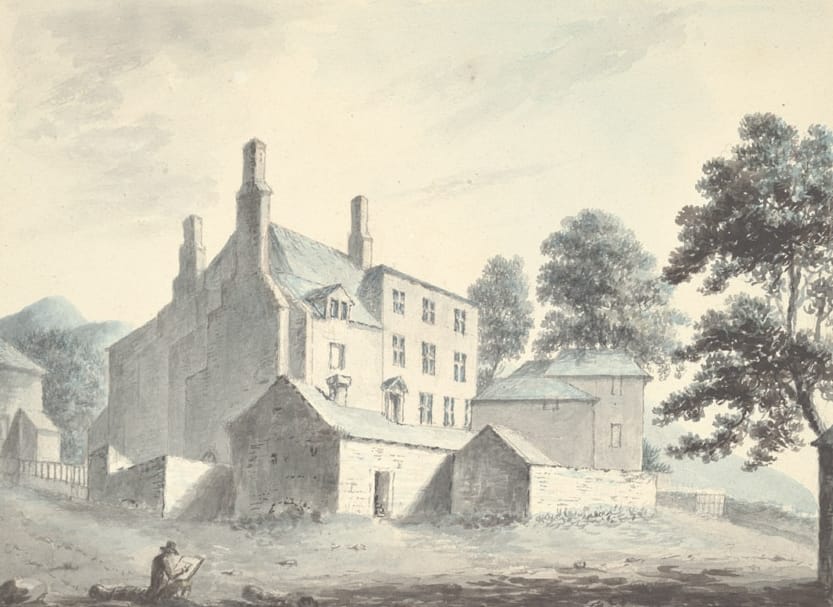
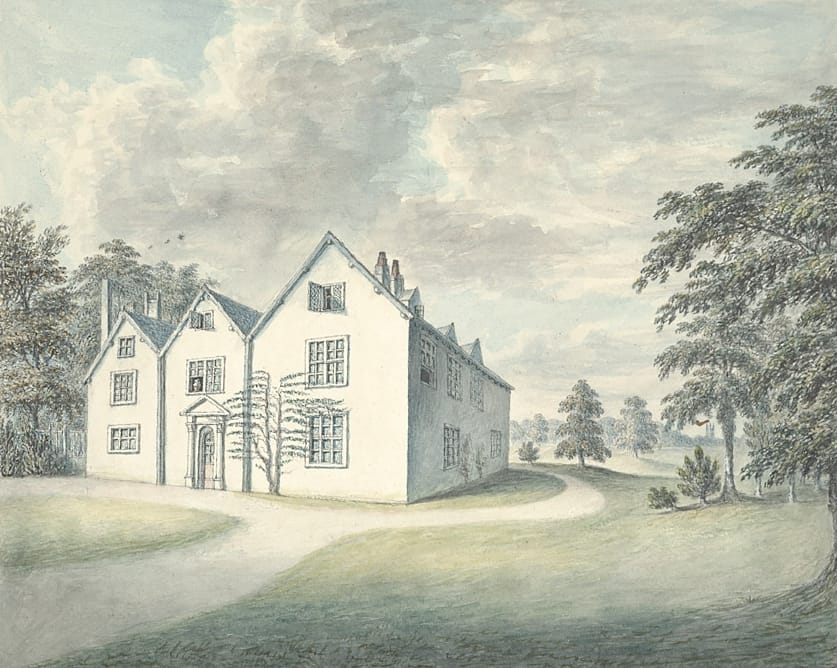
In 1795 John Ingleby a Welsh painter made some watercolor painting of important houses in Wales. Amongst them is this painting of Plas-y Ial. It is hard to see the present house in this given all the renovation since this time.
A new farm was built on the estate, and things remained this way for a few hundred years. In 1820 Sarah Yale passed away and without a husband or children, she bequeathed the estate to Col. William Parry Jones-Parry who in accordance with her wishes adopted the surname and coat of arms of Yale. (It was at this point the property had passed from the hereditary Yale line.) (Gordon Sherratt the writer of this history of the house was a descendant of Col. William Parry Jones-Parry.) And with this change of ownership came money and renovation.
Col Jones-Parry made a series of renovations that followed the style for country houses at the time, of a Georgian exterior. Dominated by large windows and fine sense of symmetry the front of the house was in many places a facade.
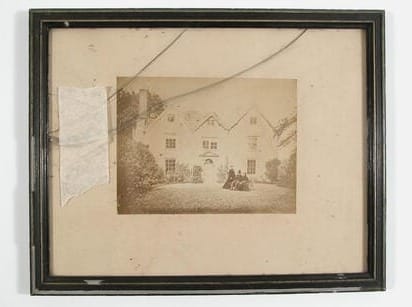
I photographed a photograph in the Ial cottage that probably shows it in its best state, perhaps shortly after the renovation was complete. This seems to be somewhat earlier than the photo that Rodney Yale published in his book in 1908 as that photo shows the growth of ivy on the building. (The apartment we rented is where the small, windowed conservatory is located and the rooms above in the corner closest to the photographer).
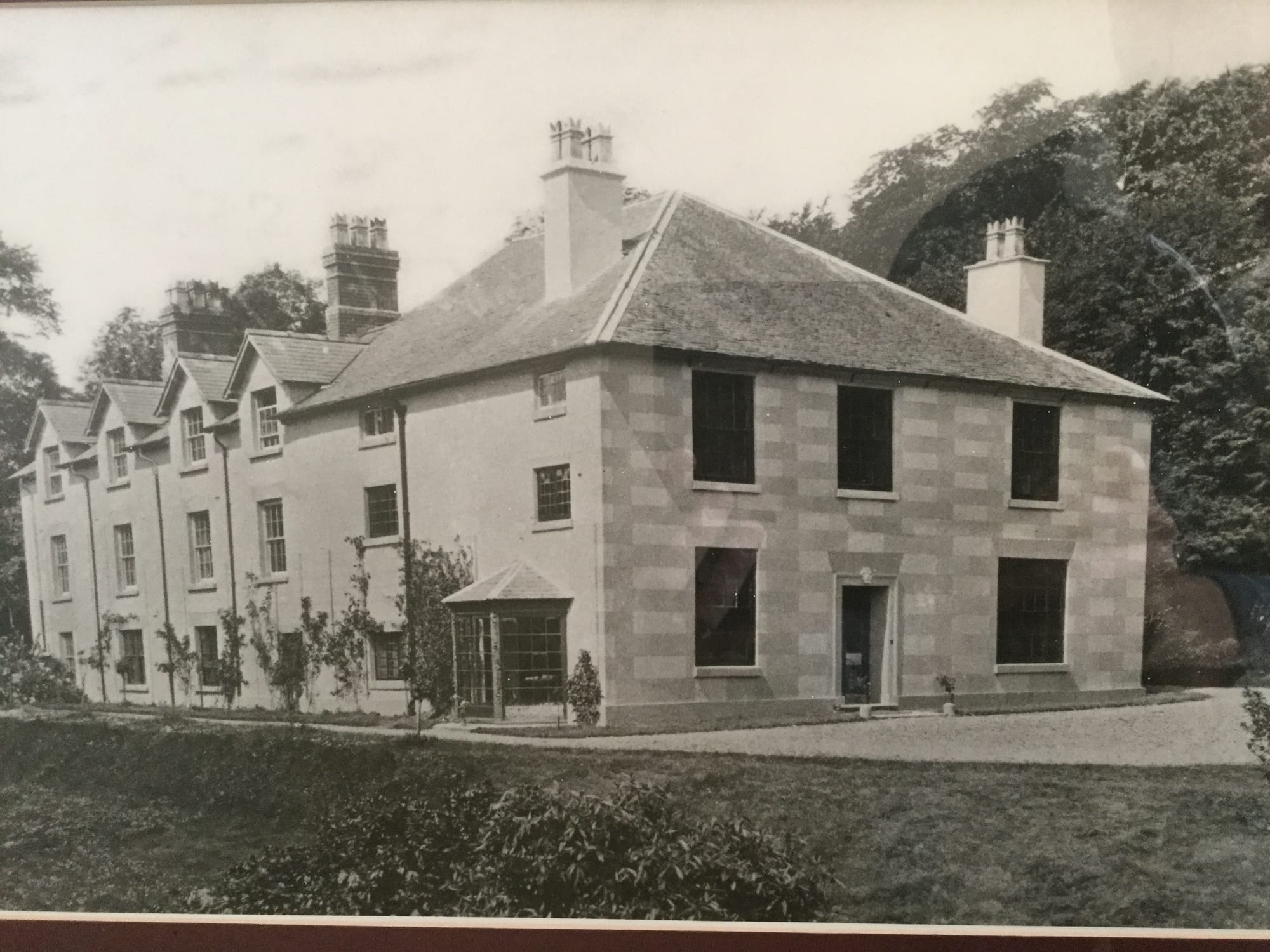
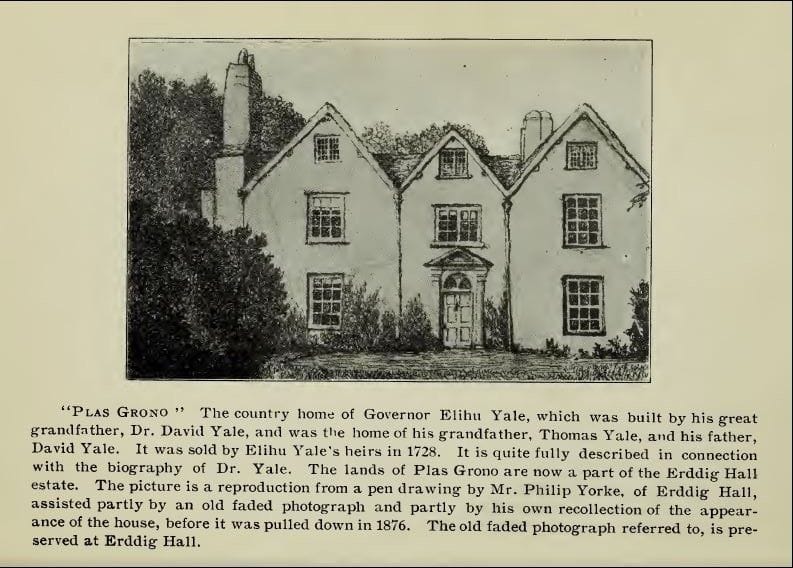
The four-gabled section to the rear of the building were added after the original Georgian front was made. On the front the upper left window is a sham window fitted with a window frame but being blocked up. This was because the original building occupies this nearest corner and its ceiling and floor levels did not accommodate the Georgian proportions. Below is the photo from the Rodney Yale book (1908).
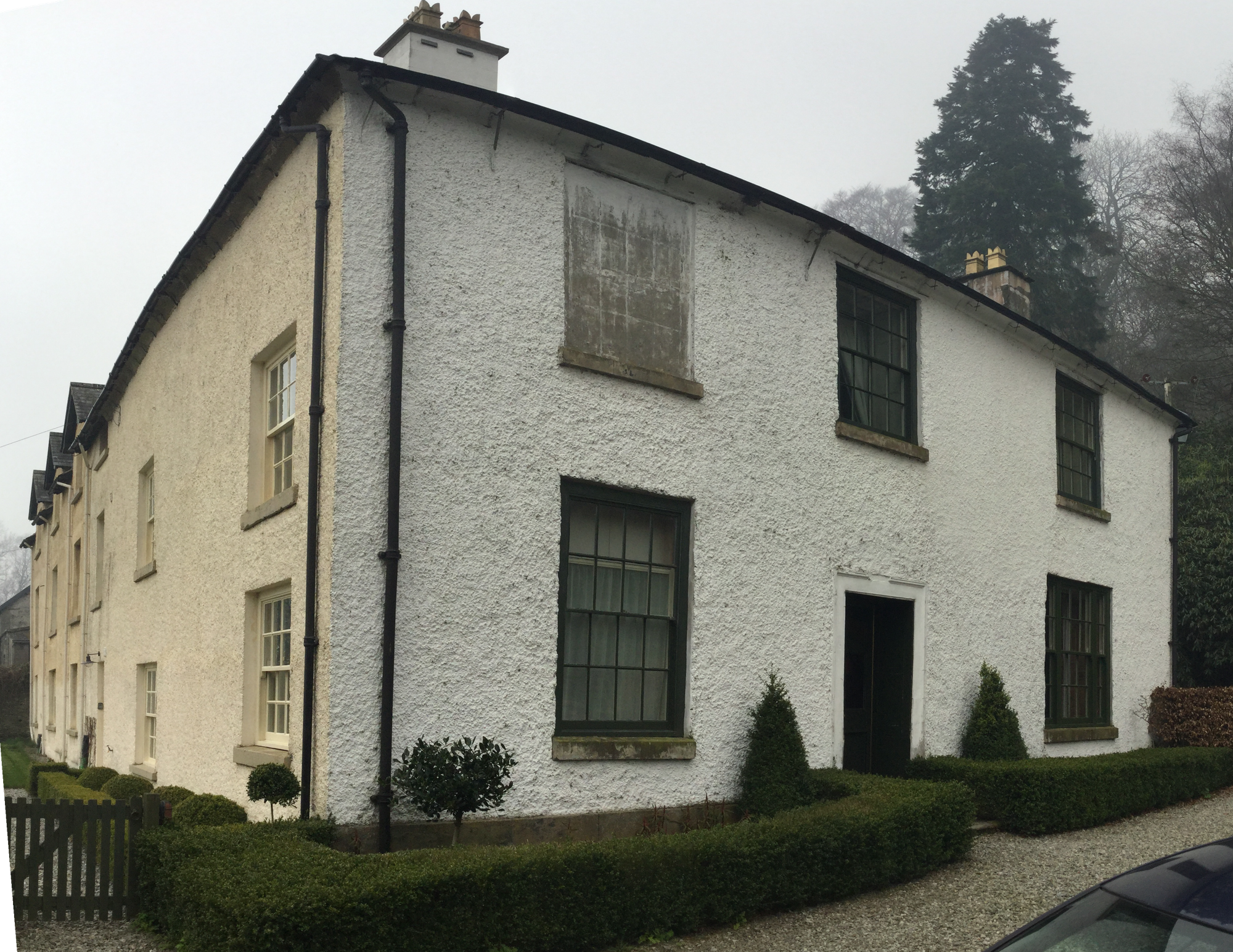
Probably the best part of this visit in 2017 was to meet Huw and Bethan Beech. They were a young farming family who were in the middle of lambing season when we came to stay. They were fabulous hosts despite feeding young lambs in their living room at that time and being up all hours looking after the births and children.
Mr. Beech leant me his updated copy of the Yales and Wales. This version was updated by descendants of Rodney Yale and included the history written by Gordon Sherratt which I have referred to frequently for this article.
His enthusiasm for the Yale history was palpable when I told him of my ancestry. I showed him my copy of the book. He said "You have the book!" and ran to get his copy. He then said "You are related to Owain Glyndŵr." in a rather reverent tone. I learned much more from his copy of the book that evening.
In that copy I managed a crude reproduction of a photo that shows the visiting American Yales with the Ivor Beech family in 1979 or 1980. Huw Beech is the little boy in front.
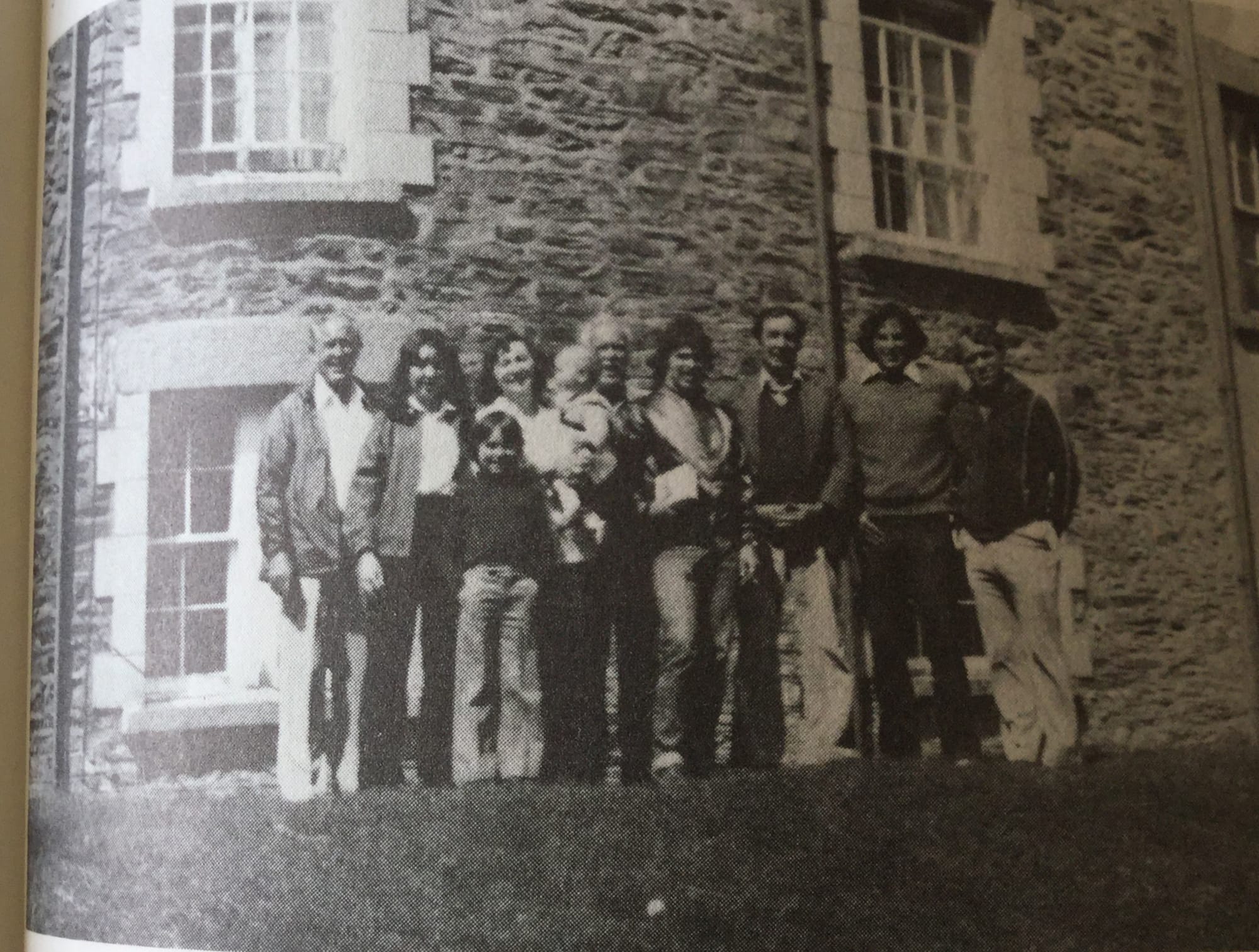
Huw informed me that after the last Yale left, the Beech family was able to buy the property where they live now and run their farm and a B&B. The real surprise was to learn that the Beech family was one of the historical tenant farmers of Plas y Ial. And I thought what a wonderful story to know the tenants became the 'lords'.
I leave you here to decide if you should read further. I include a little more of the history of the family and local parish church.
(Here is a link to more of the Gordon Sherratt history…)
The Yale Parish Church of Saint Tysilio in Bryneglwys
The village of Bryneglwys (church hill in Welsh) was the location of the parish church of Saint Tysilio.
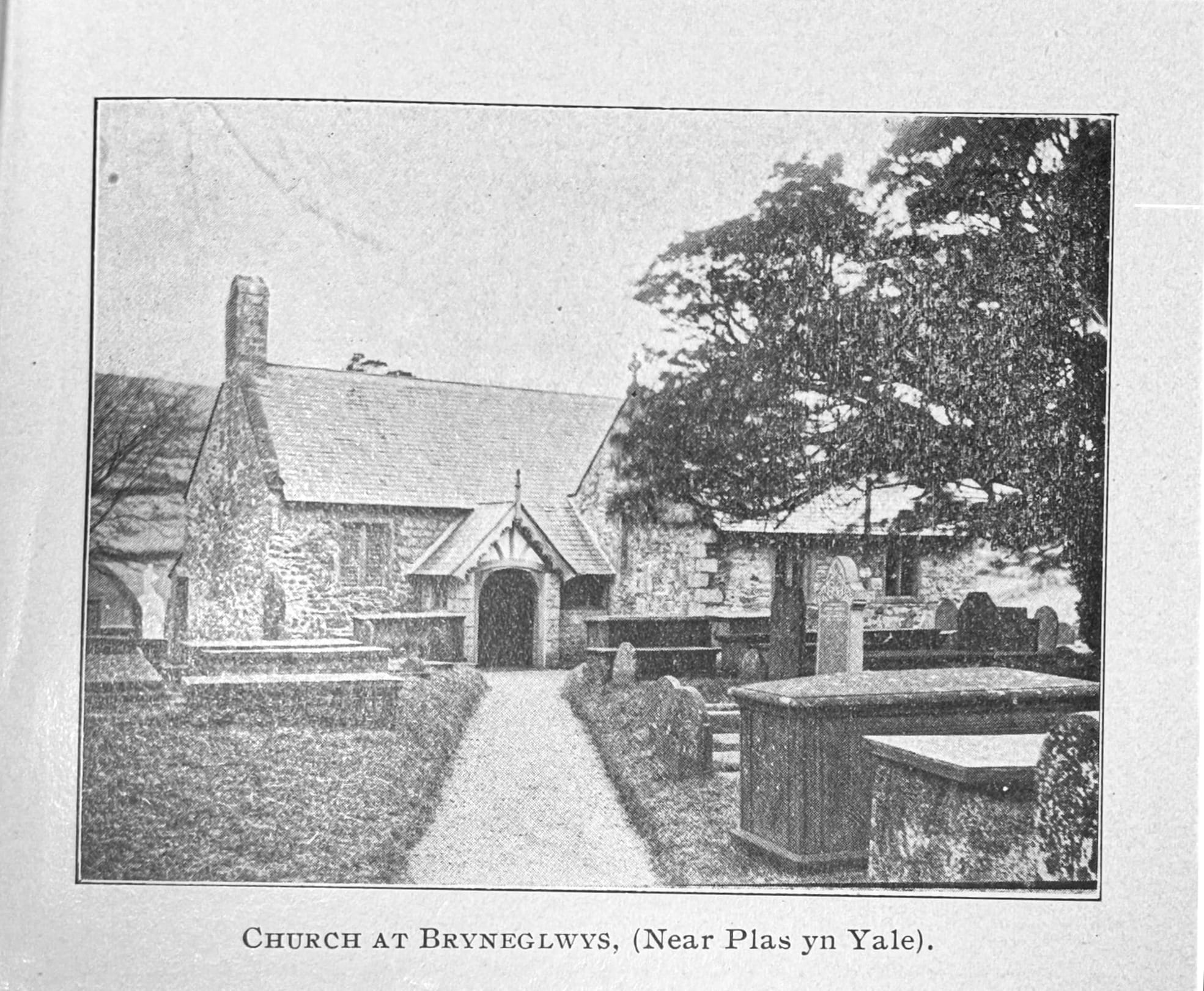
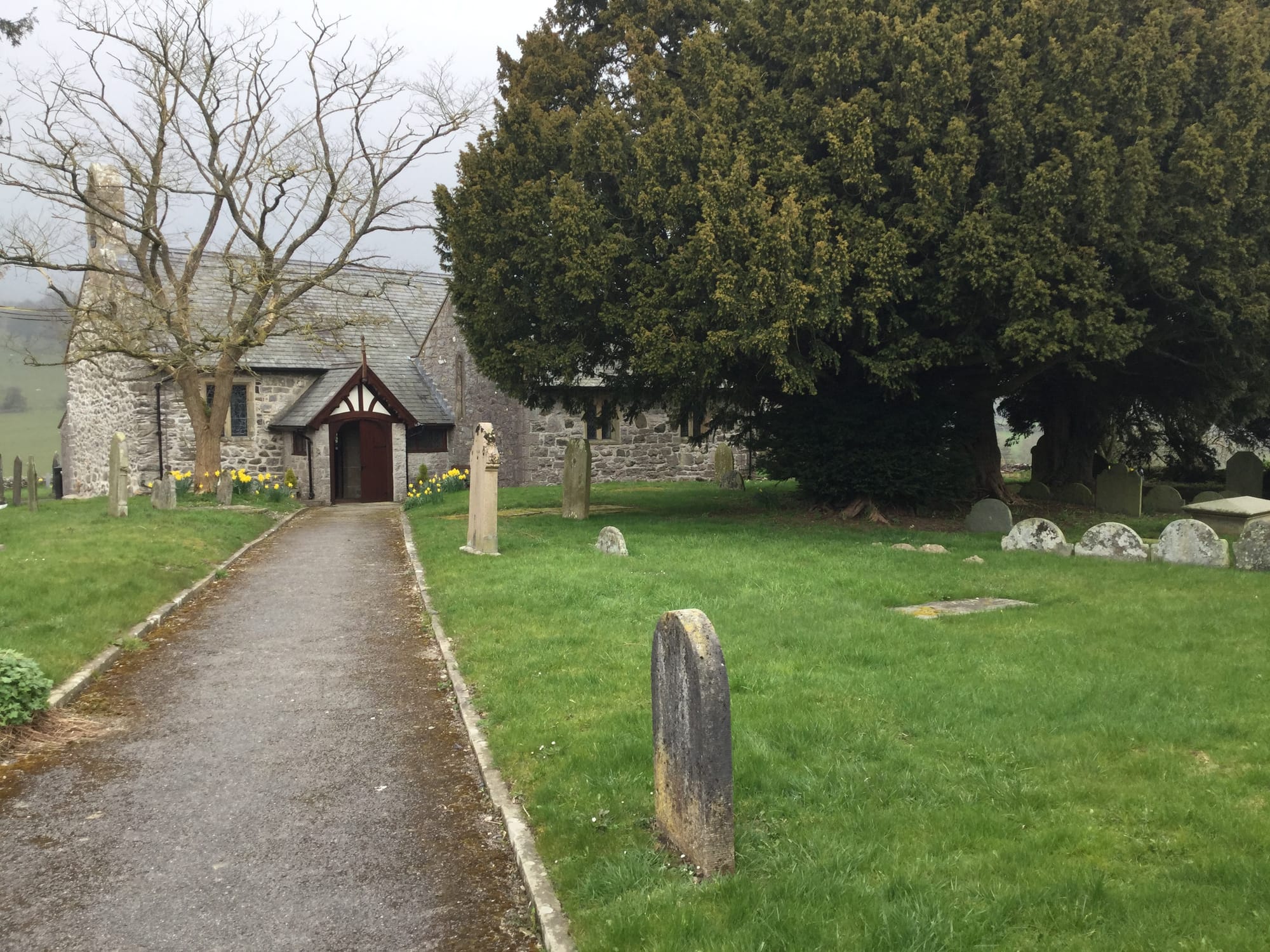
Here the Yales worshipped and the Yale Chapel was added to the church around 1575, during the reign of Queen Elizabeth Tudor, by Chancellor Thomas Yale, part of her "privy counsel" and member of the Yale family.
His younger brother Roger Lloyd ap Ellis later Ellis of Yale was the first Welshman to take a surname in the English fashion and this was taken from the area in which he lived Ial or Yale. Ellis of Yale served under Cardinal Wolsey as secretary of state alongside Thomas Cromwell in the service of Henry the VIII.
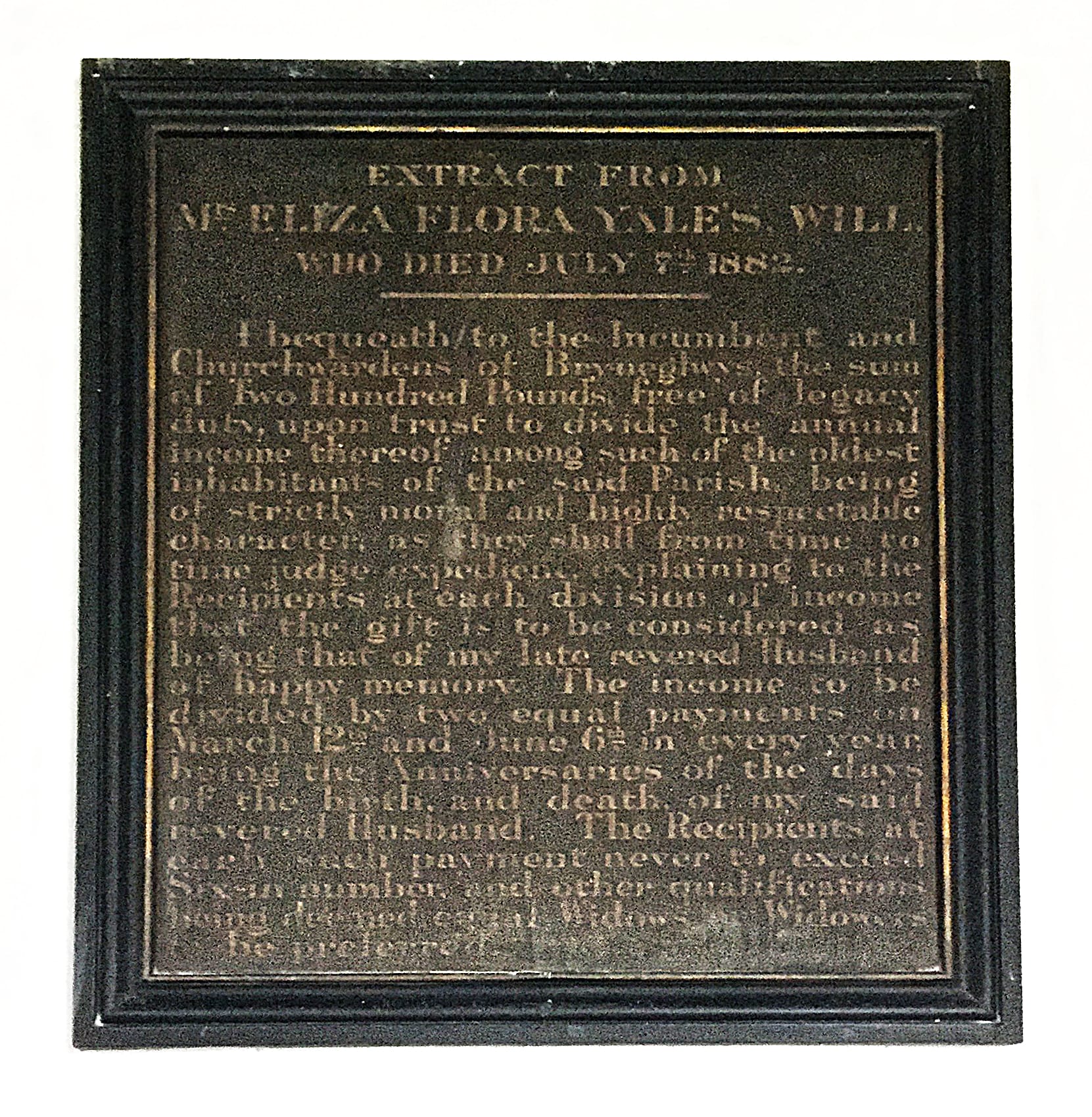
In 1882 Eliza Flora Yale died and left money for the parish in her will. An extract of that will was made into a plaque on display in the chapel.
It reads...
I bequeath to the Incumbent and churchwardens of Bryneglwys the sum of Two Hundred Pounds free of legacy duty upon trust to divide the annual income thereof among such of the oldest inhabitants of the said Parish being of strictly moral and highly respectable character as they shall from time to time judge expedient explaining to the Recipients at each division of income that the gift is to be considered as being that of my late revered Husband of happy memory. The income to be divided by two equal payments on March 12th and June 6th in every year being the Anniversaries of the days of birth and death of my said revered Husband. The Recipients at each payment never to exceed six in number and other qualifications being deemed equal widow and widower to be preferred.
Other plaques dedicated to the Yales in the church include
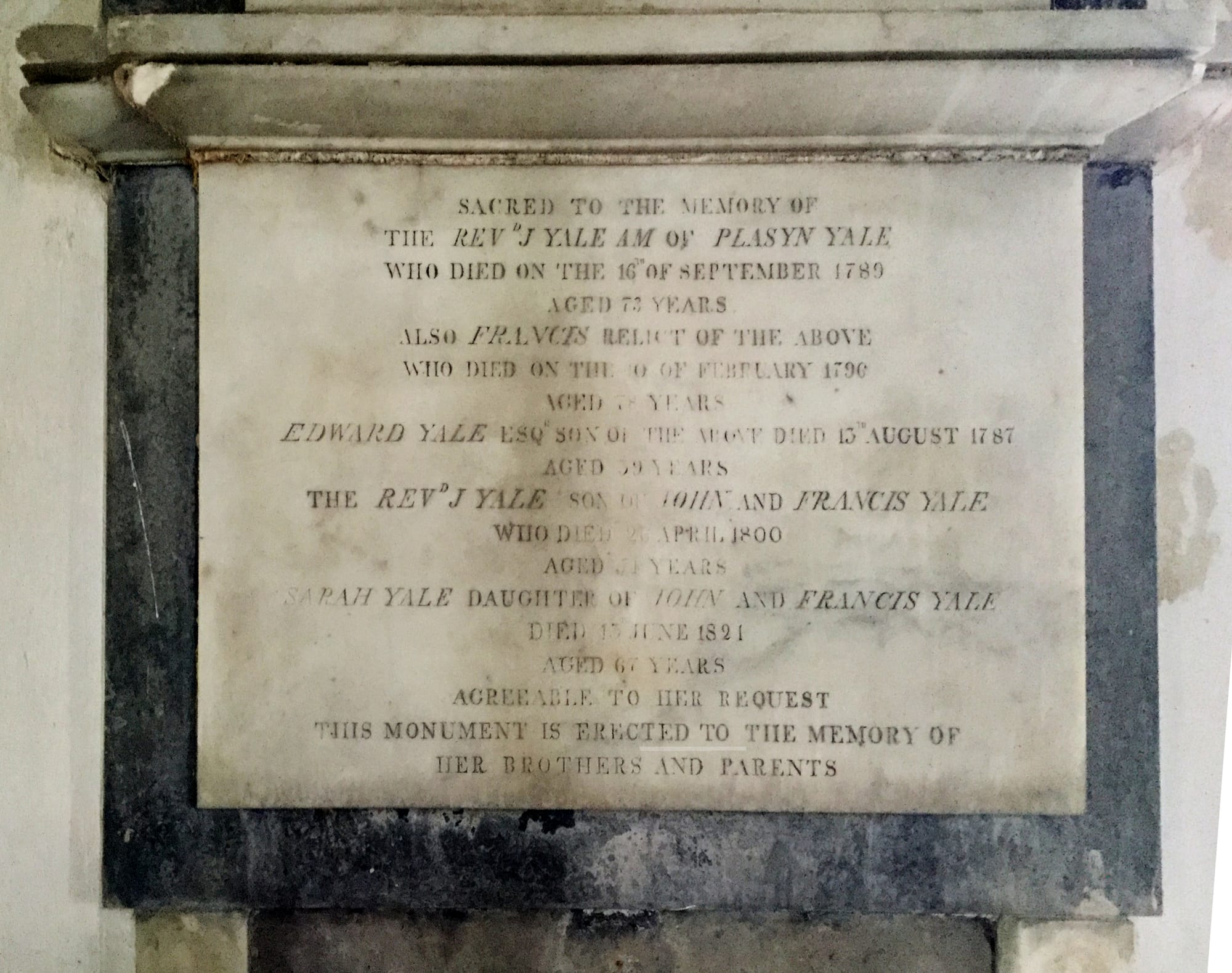
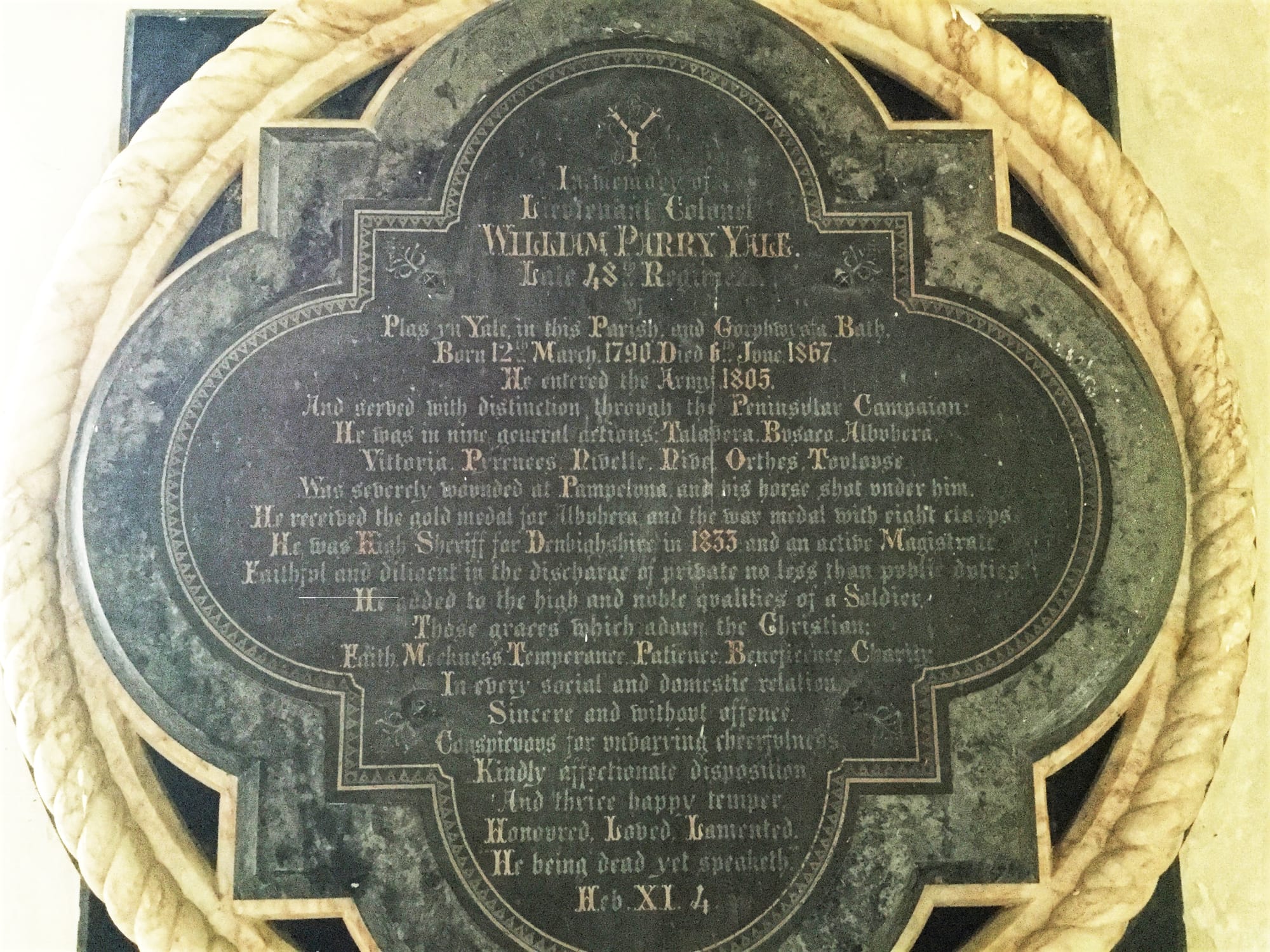
Transcribed from the monument above.
In the memory of Lieutenant Colonel William Parry Yale Late 48th Regiment of Plas yn Yale in this Parish and Gorphinysta (resting place in Welsh) Bath (the city in SW England where he died) Born 12th March 1790 Died 6th June 1867. He entered the Army in 1805. And served with distinction through the Peninsular Campaign. He was in nine general actions Talavera, Busaco, Albuhera, Vittoria, Pyrenees, Nivelle, Nive, Orthes, Toulouse. Was seriously wounded at Pampeluna and his horse shot under him. He received the gold medal for Albuhera and the war medal with eight clasps. He was High Sheriff for Denbighshire in 1833 and an active Magistrate. Faithful and diligent in the discharge of private no less than public duties. He added to the high and noble qualities of a Soldier: Faith, Meekness, Temperance, Patience, Benefience, Charity. In every social and domestic relation, Sincere and without offence. Conspicuous for unvarying cheerfulness, Kindly affectionate disposition. And Thrice happy temper. Honored, Loved, Lamented, He being dead yet speaketh. Heb XI 4
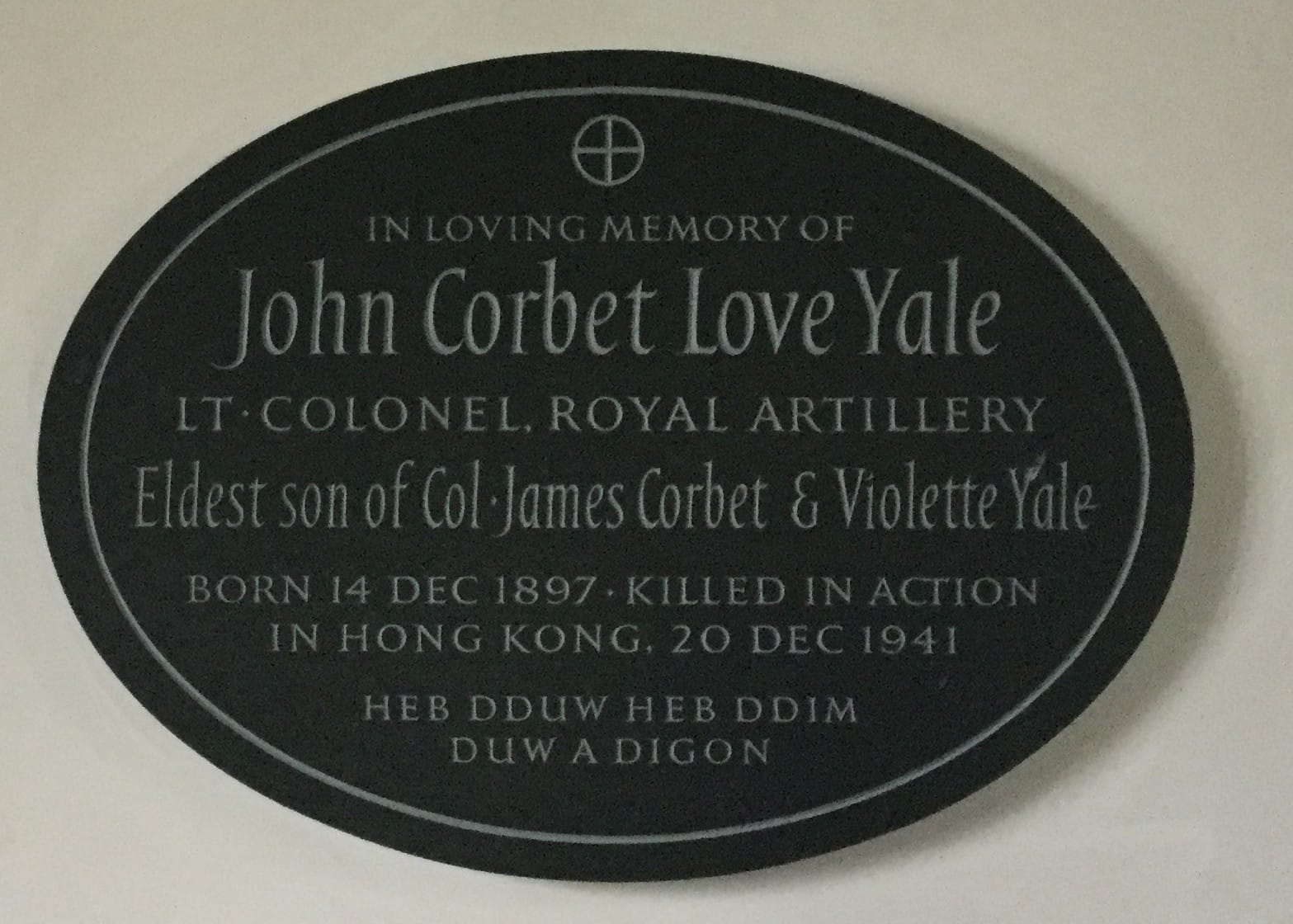
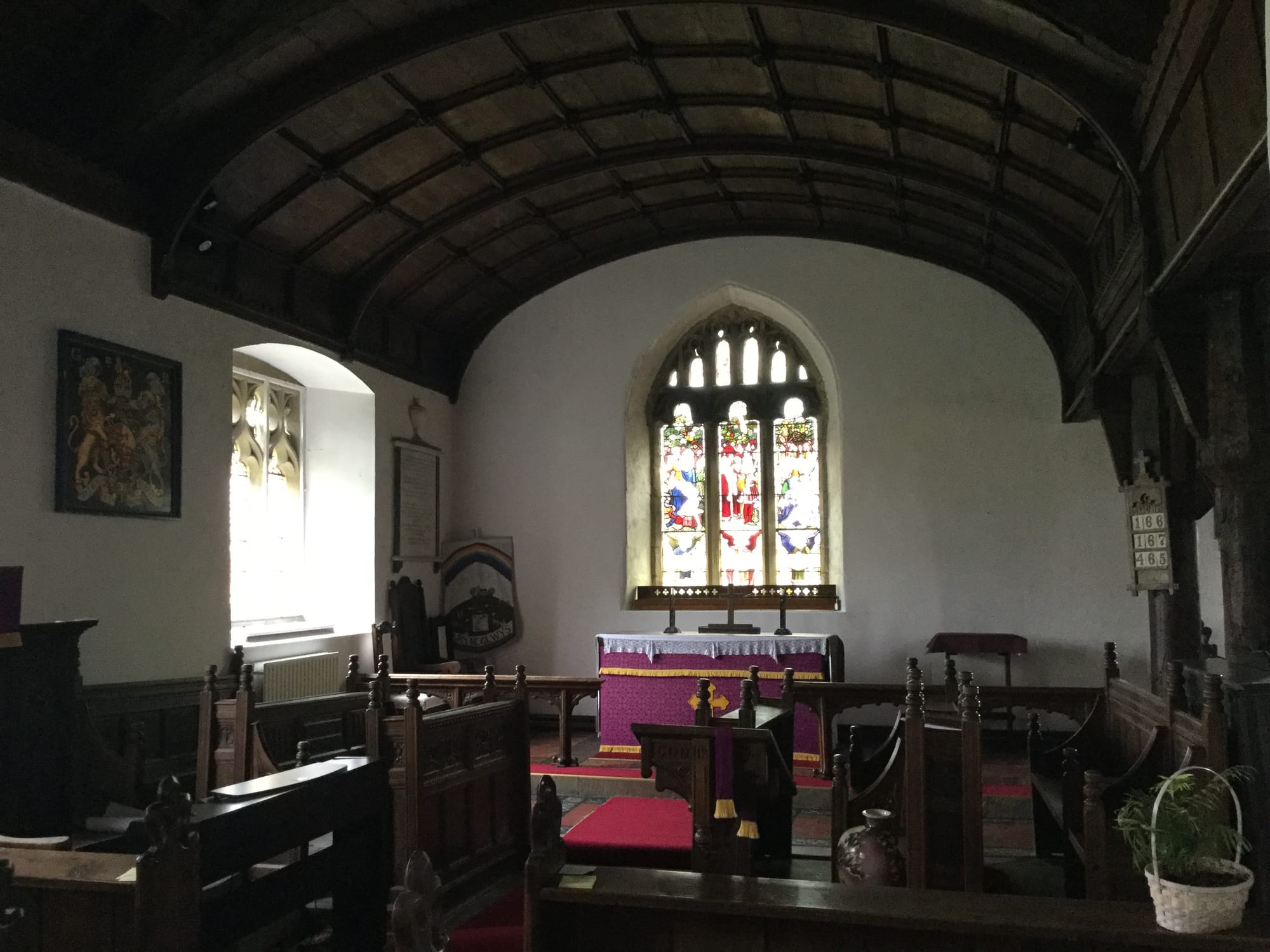
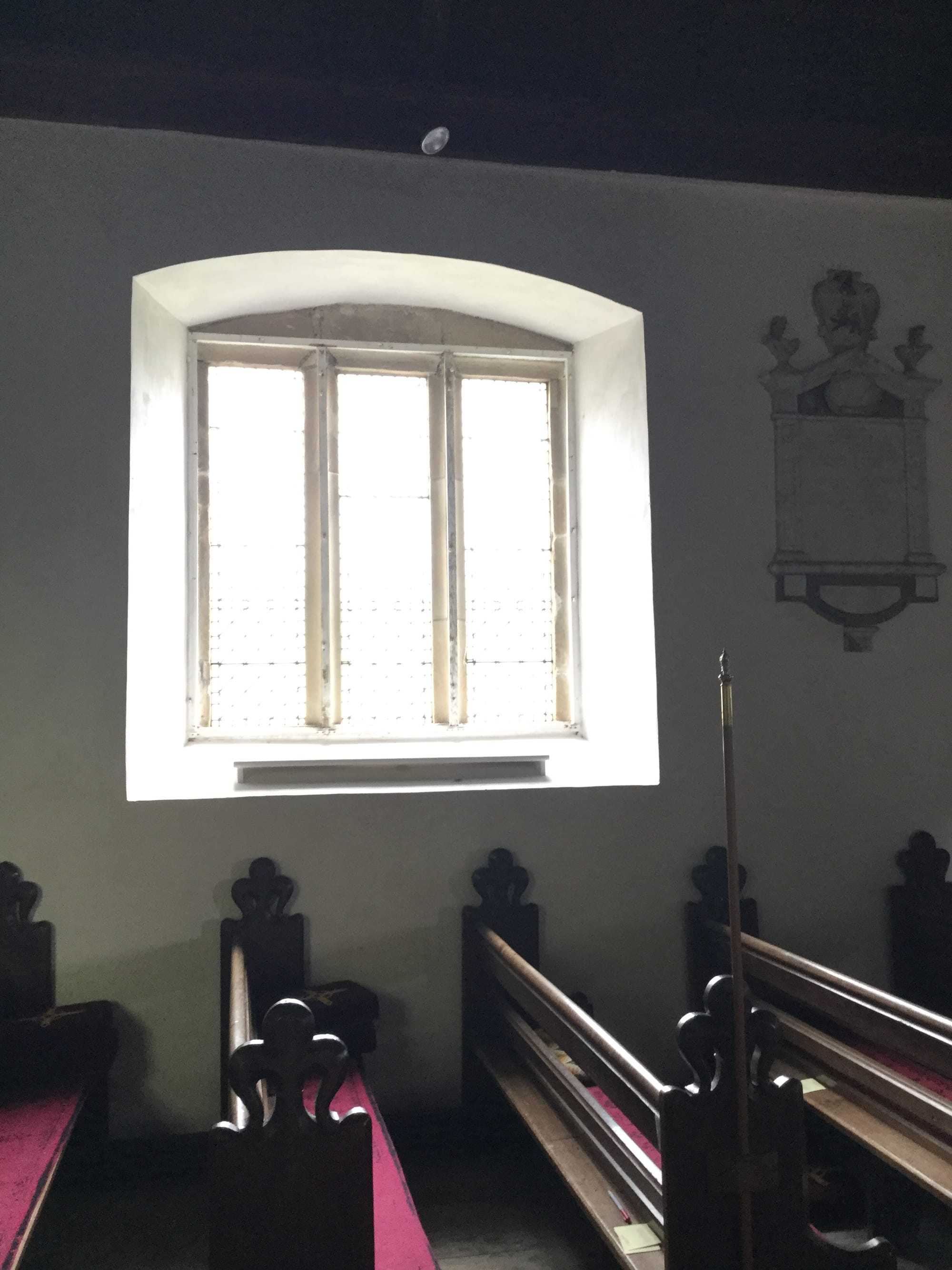
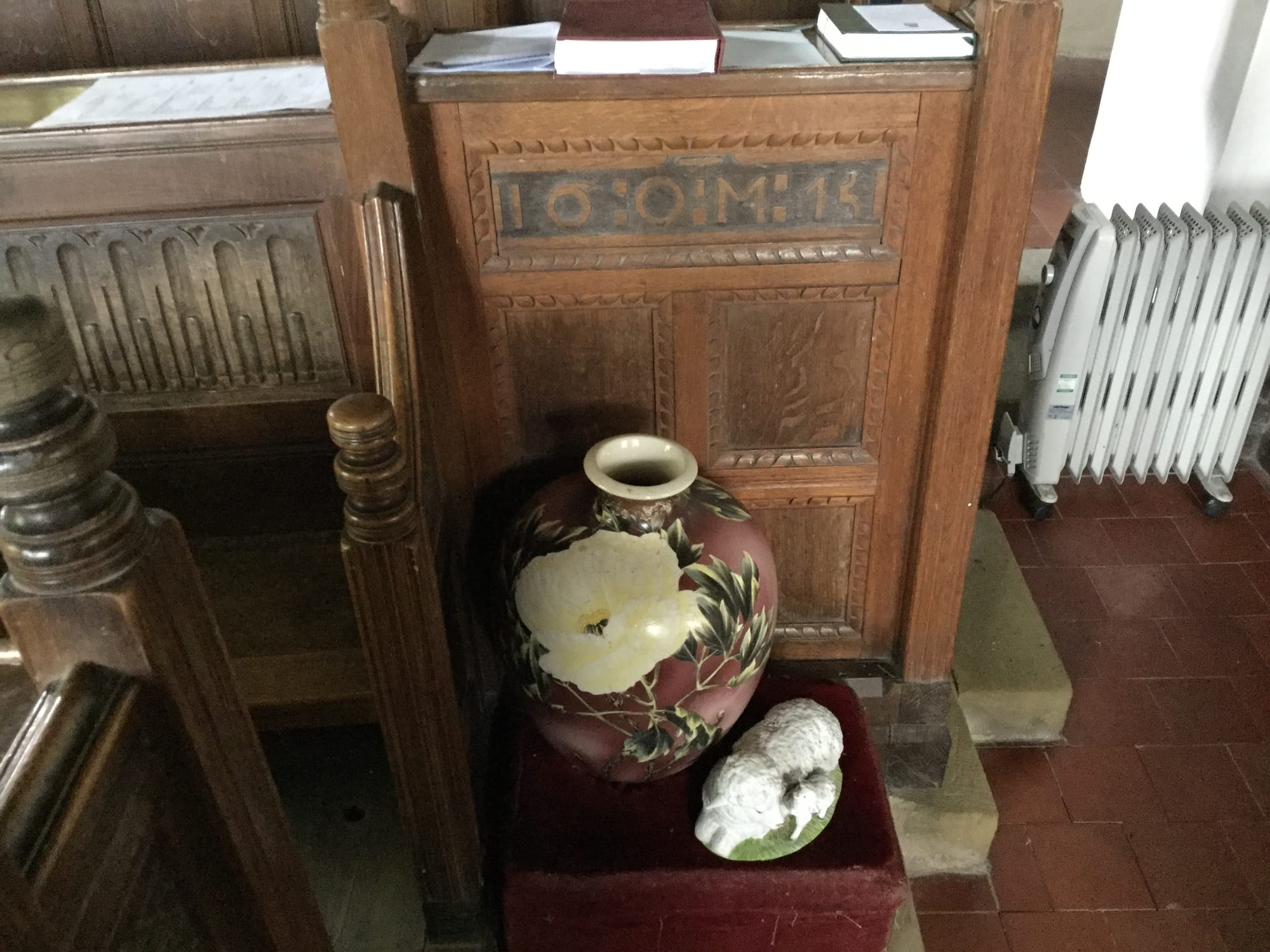
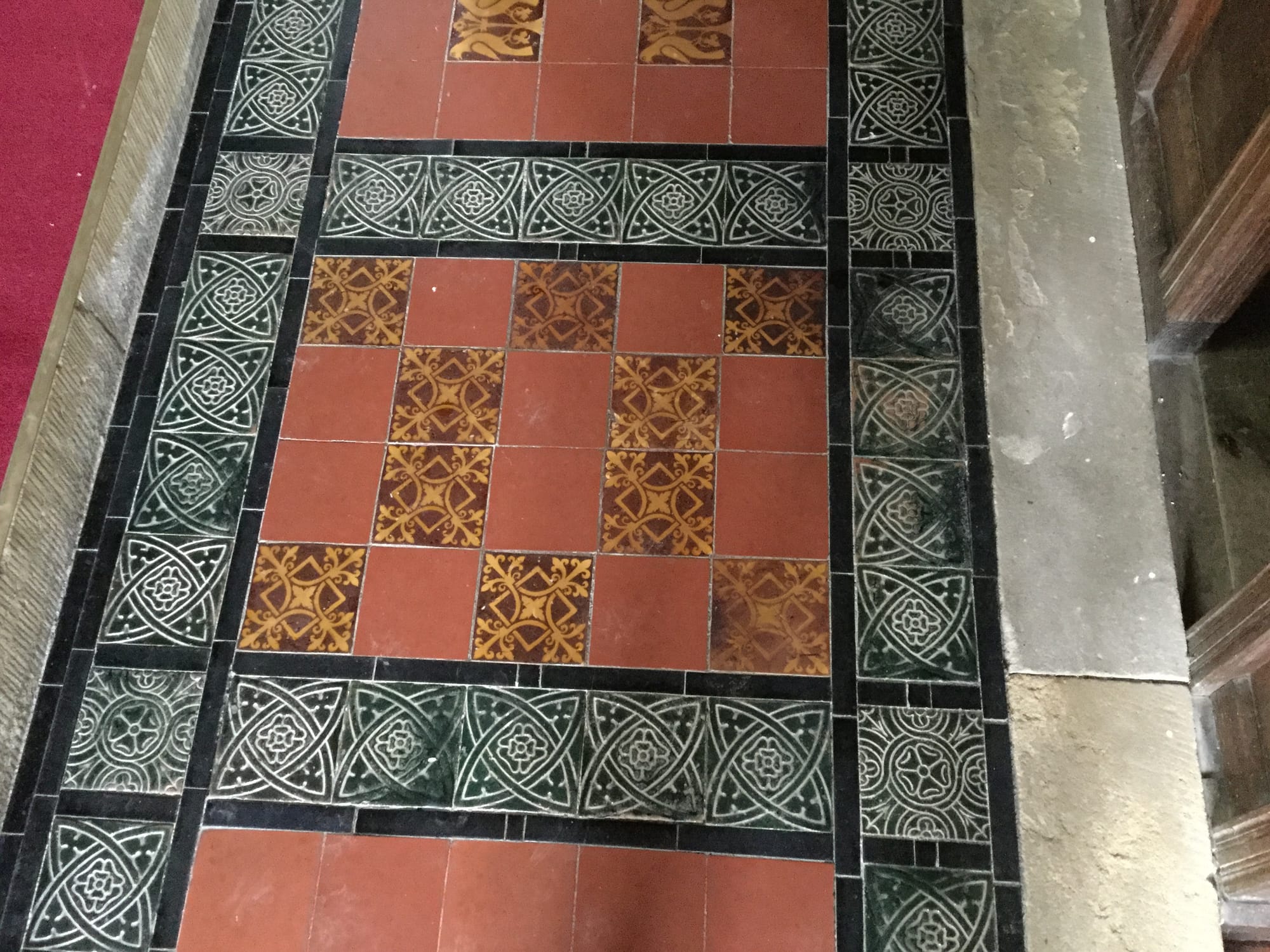
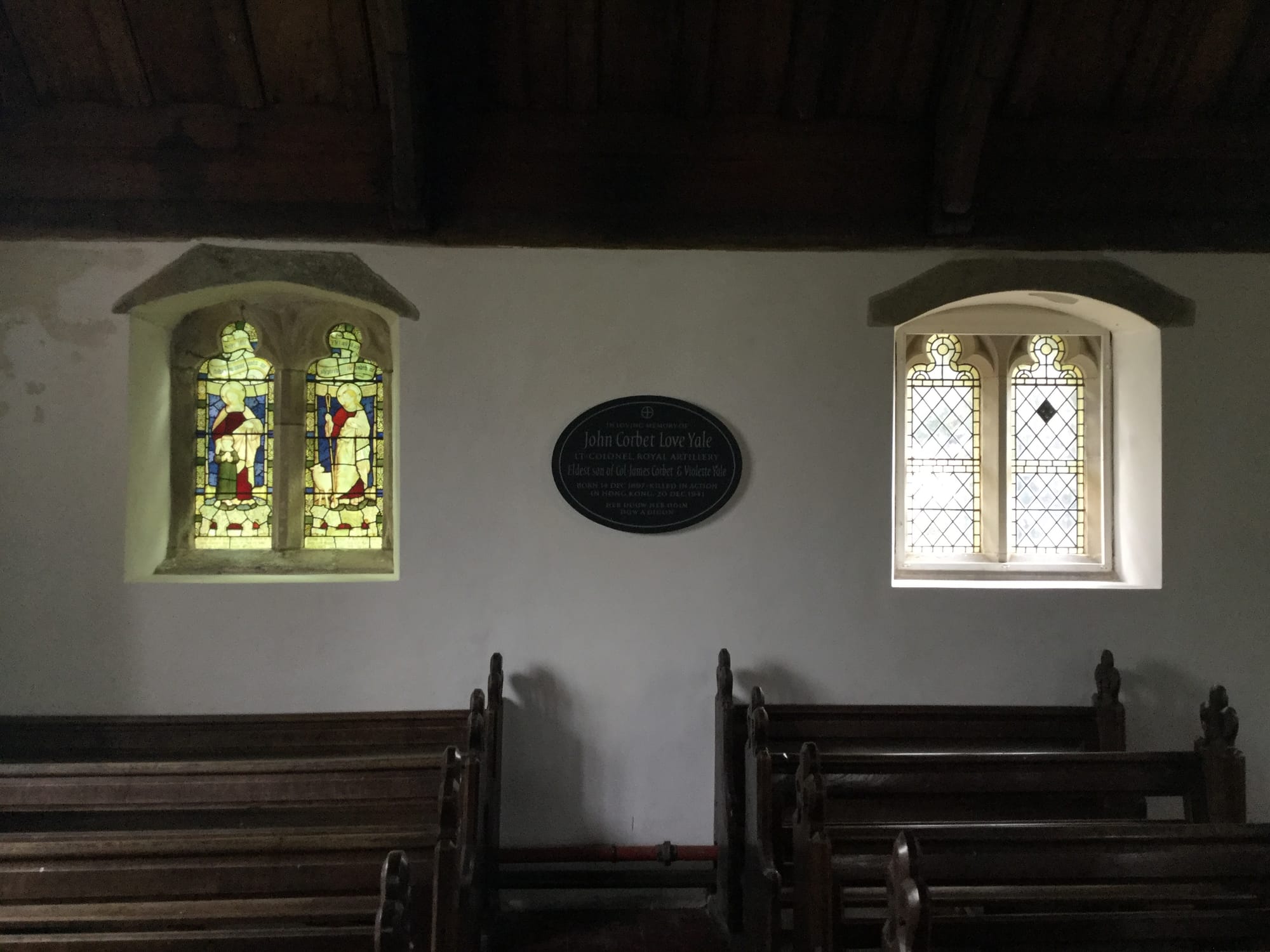
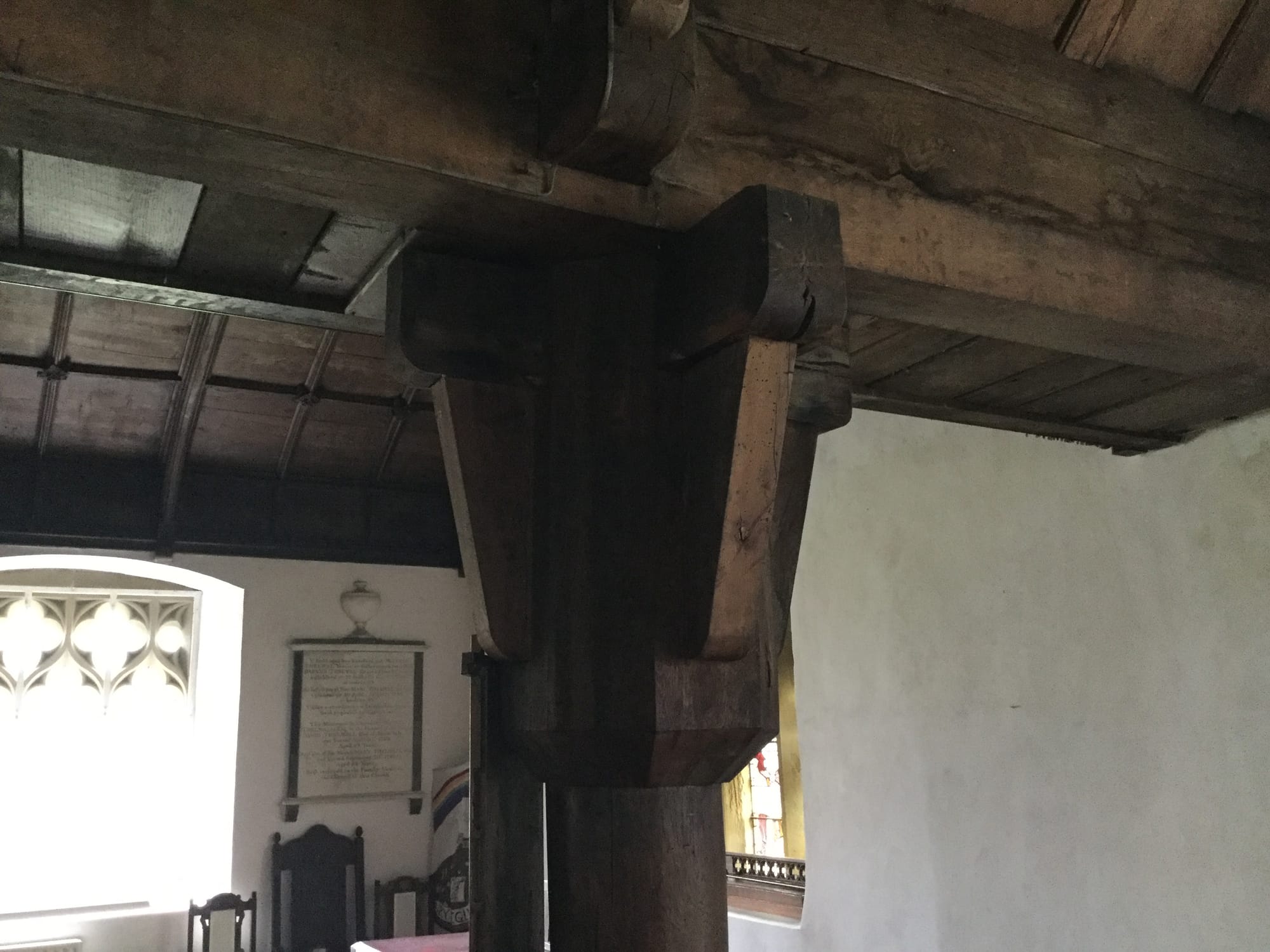
Various views inside the church.
Further History of the Yale Family
Plas Grono was where the half-brother of Thomas Yale (of the Plas y Ial line) David Yale lived. David Yale inherited Plas Grono from his ancestors and the grounds of Erddig Hall. Erdigg Hall is a National Trust property and may be visited today. This is where the line of Yales that traveled to America derived from. David Yale is the grandfather of Elihu Yale the founder of Yale college.
The Yale family lines split geographically in 1637 with the sailing of the 250 ton ship the Hector, leaving London and arriving Boston 26th June 1637. It is generally assumed she sailed onto Quinnipiac (New Haven) Connecticut as the Yales settled there. On the passenger list...
- Eaton Anne, second wife of Theophilus Eaton and daughter of George Loyd Bishop of Chester and widow of Thomas Yale
- Eaton children of Anne Eaton by her former marriage
- Son David (b. 1613 d. 1690 in Plas Grono, Wales)
- Daughter Ann (b. 1615, d. 1698 Plas Grono, Wales)
- Son Thomas (b. 1616, d. 1698 New Haven Connecticut
- Elizabeth (b. c. 1618, d. c. 1625 probably Chester, England)
Mrs. Eaton returned to England with her son David; it isn't said how her daughter Ann returned but she may have traveled on the same journey. This is why these people died at Plas Grono in Wales. Only Thomas stayed on in New England.
Theophilus Eaton when he arrived in Boston explored up the coast and over-wintered in an area, he considered suitable. His family and the rest of the company sailed to this location from Boston in the Spring of 1638. They purchased the land from the Quinipiak Indians and established New Haven and Theophilus Eaton became the first governor. This would become part of the state of Connecticut and the home of Yale University.
Thus began the New World lineage of the Yale line that led to me.
Owain Glyndŵr (born 1359 died c. 1416)
There is much written of this heroic Welsh prince. He had a remarkable life studying to become a lawyer and later as a soldier in the king's service.
Rebellion came about because of Baron Grey of Ruthin seizing some land. Owain sought redress from the English Parliament which was ignored. This and other English actions led to the 'Welsh Revolt' in the late 1390's.
Owain fought from 1400 to 1404 and was able to declare himself de facto King of Wales from 1404 to 1405 with the aid and recognition of the French. He held parliaments at Machynlleth and Harlech in North Wales and planned to build two universities, one in the north, the other the south of Wales.
Despite repelling 4 royal expeditions into Wales, eventually a series of setbacks saw him gradually lose control of Wales by 1415.
He remains a figure of great national importance to many Welsh who have long resented the intrusion of the English. Welsh Nationalism in the 20th century led to the reinstatement of the Welsh language and eventually a devolved parliament, the Senedd under Westminster in England. Signs and notices in Wales are all given in Welsh and English.
In the 1960's and 1970's there was a period of militantism that led to arson and sabotage of English properties.
Wikipedia has a good potted history of Owain Glyndŵr which is a fascinating read for those interested in Welsh history.
The Arms of Yale
No bit of medieval history would be complete without a coat of arms.
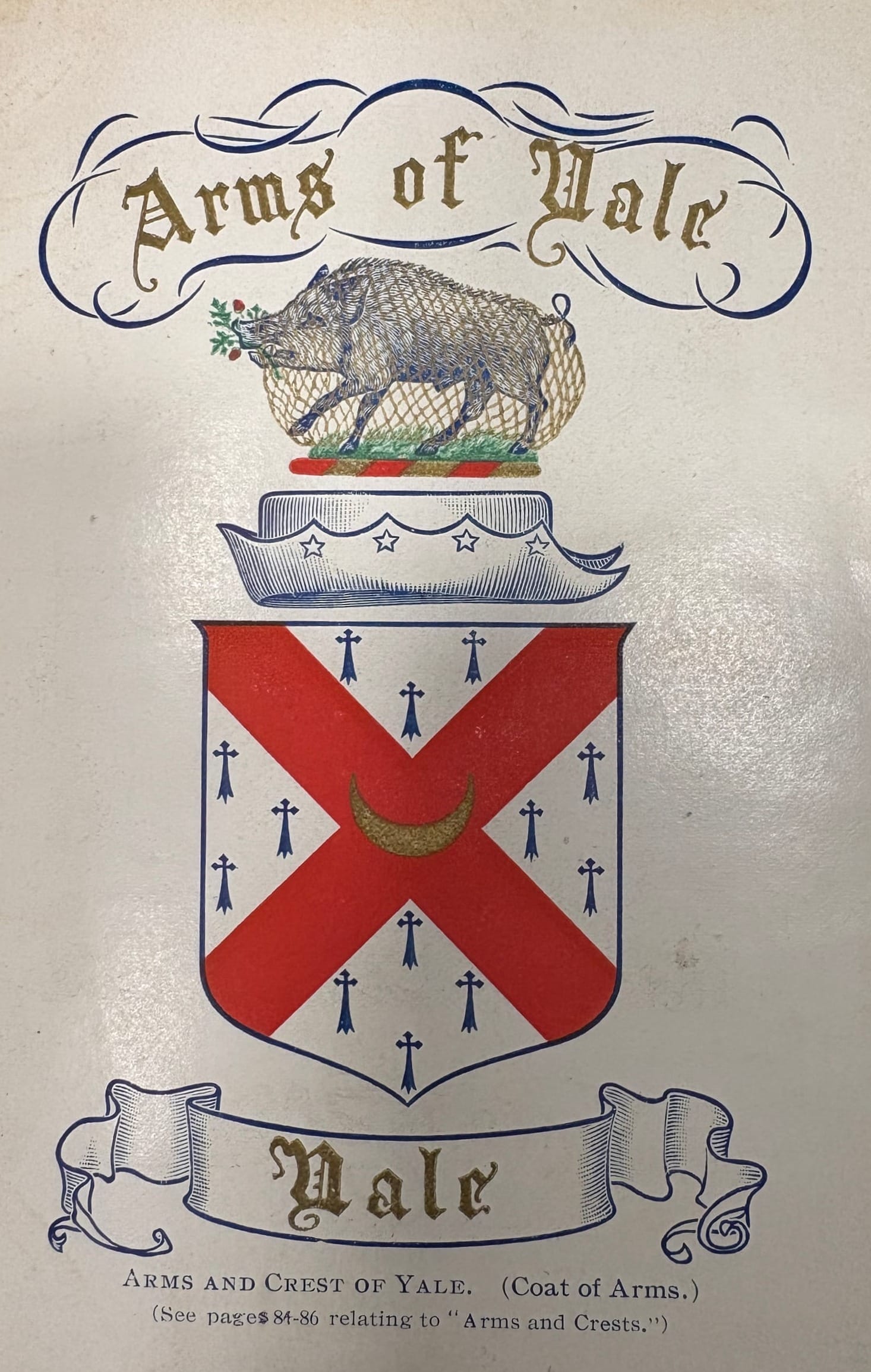
This is an excerpt from The Yales and Wales regarding the family arms. What is not mentioned in this description is the gold crescent moon on the shield. Further research indicates this is a horns upward orientation of the moon and it indicates cadency, that is a second son. A symbol called a Label is first son, a Mullet or black star is third son, and a Martlet or bird figure is the fourth son.
The escutcheon, or shield, is the most important in the arms, and next in importance are the stripes on same. Each of the various devices have some sort of significance.
The Arms and Crest of Yale (Coat of Arms) are undoubtedly almost as ancient as heraldry itself, as the emblem illustrated in the colored plate, herewith, is essentially the same as the Arms and Crest of the family of John Fitz Thomas (Fitz Gerald), who was Lord of Decies and Desmond and Count Palatine in 1259. His family Arms and Crest included the Ermine shield, with the red St. Andrews cross, and the wild boar. Also the shield and the red St. Andrews cross, are incorporated in the Arms of the Dukes of Leinster and other descendants of the notable Maurice Fitz Gerald, who died in 1177. In fact the arms of practically all of the "Geraldines," (descendants of Maurice Fitz Gerald and of Gerald de Windsor), include the shield with the red St. Andrews cross, and the most of them have the ermine field.
The Yale Coat of Arms, was therefore, derived from the Fitz Geralds and handed down through the direct male line, from Osborn Fitz Gerald (Osbwrn Wydde1).
The Arms of Yale shown by the plate are the Arms of the Yales of Plas Grono, the ancestors of the Yales in America, and practically differ from the Arms of the Yales of Plas yn Yale only in the "fretty," or lattice work of gold, which appears on the Arms of the latter. The wild boar in a gold net on a green mount, with an acorn slip in his mouth, is represented in the crest of each; but the chapeau, a military or official cap or hat, seems to have been added at some time, by some member of the family of Yales of Plas Grono.
The Arms and Crest shown in the plate are technically described as follows:
Arms :- ERM, (ermine) A SALTIRE GU. (A red St. Andrews cross).
Crest :- A MOUNT (hillock) VERT (green), thereon a boar az. (blue),
within a net or. (gold), in the mouth an acorn slipped ppr. (natural colors).
The ermine represents the fur of a small white animal, a native of Armenia, and the marks on same are supposed to represent the tails of the animals, sewed to the fur for its enrichment. Ermine is an especial mark of dignity and has long been associated with royalty and the nobility.
The St. Andrews cross is a symbol of resolution, while the red denotes military fortitude and magnanimity.
The wild boar is a fierce combatant and may be considered to represent a valiant warrior. Blue may have a religious significance and possibly originated in the Crusades. The acorn slip signifies strength and antiquity; while the golden net indicates that a great warrior finally succumbed to pacific influences.
The chapeau denotes military authority.
Crests were anciently affixed to the helmets of the commanders for their distinction in battle and were in use before the heriditary bearing of coat armour, and they were not considered in any way connected with family arms, until by enactment of Edward III., in the fourteenth century.
The use of arms by private persons was forbidden by proclamation during the reign of Henry V. All persons in the British Isles, who had not borne arms at Agincourt were prohibited from assuming them, unless by hereditary descent, or with the sanction of the authorities. Peridocial circuits (visitations) were held afterwards, until the end of the seventeenth century, to determine by examination of pedigrees, etc., the right to the use of armoral bearings Many of these records are preserved in the British museum and are still consulted, for evidence of the hereditary right to use family arms.
Ashworth P. Burke, author of "Burke's Peerage" and other works,
aptly states: "A right to bear arms is the true criterion of nobility."