Slickrock
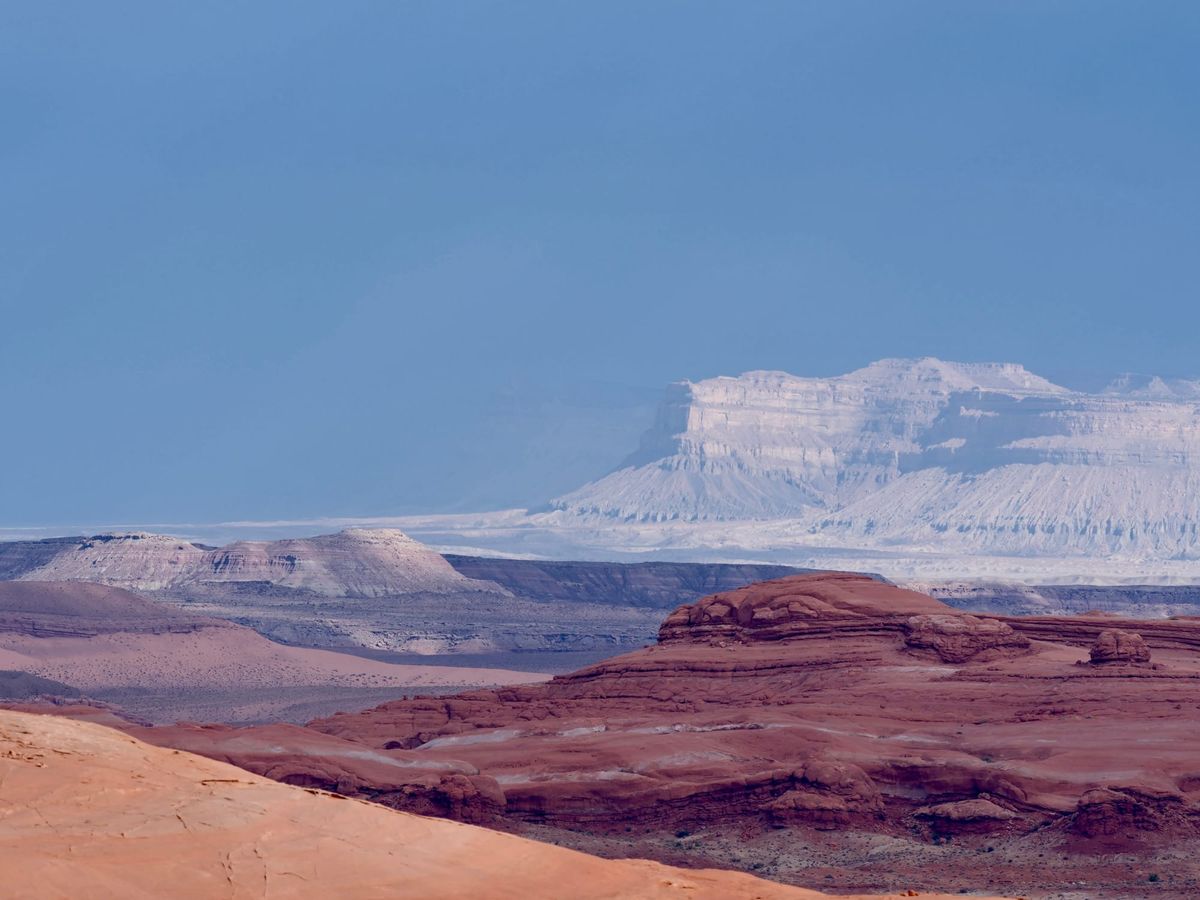
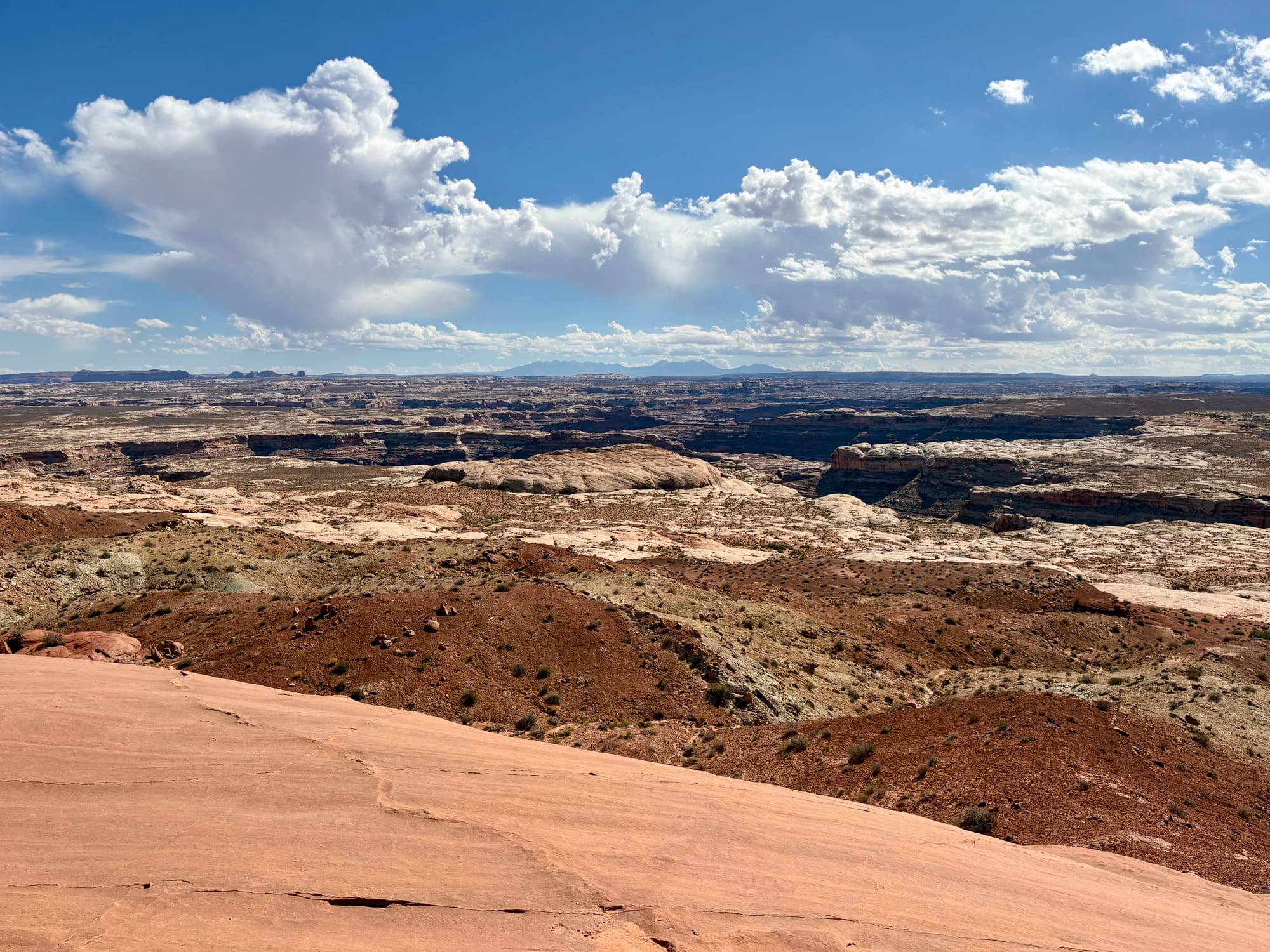
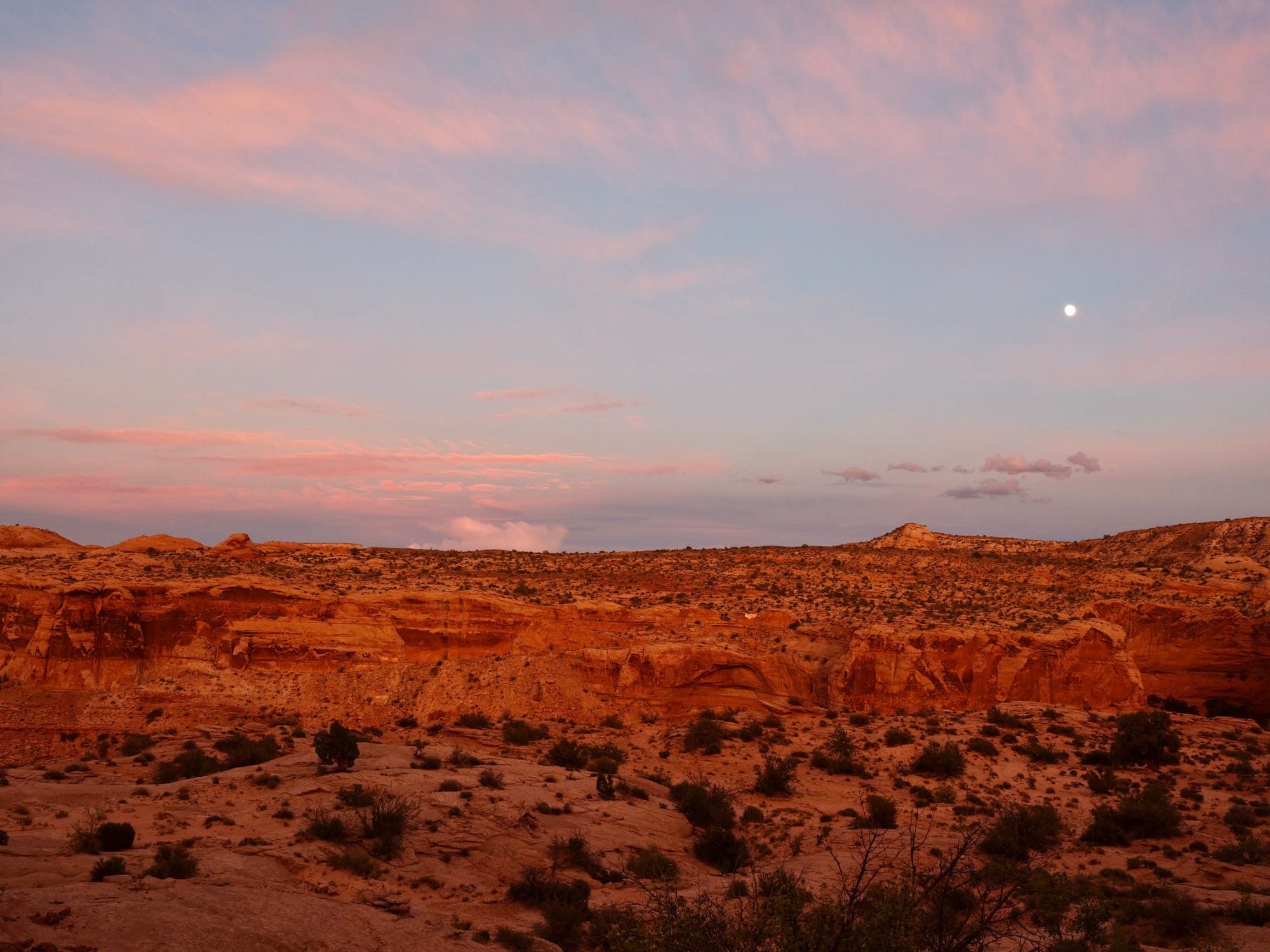
This is open country, here beside Canyonlands. A small green place on the map that pretends to represent all of Canyonlands. It is this vast tortured topography of sandstone, sand, clay, reds and whites and beiges and oranges and deep mountain blues.
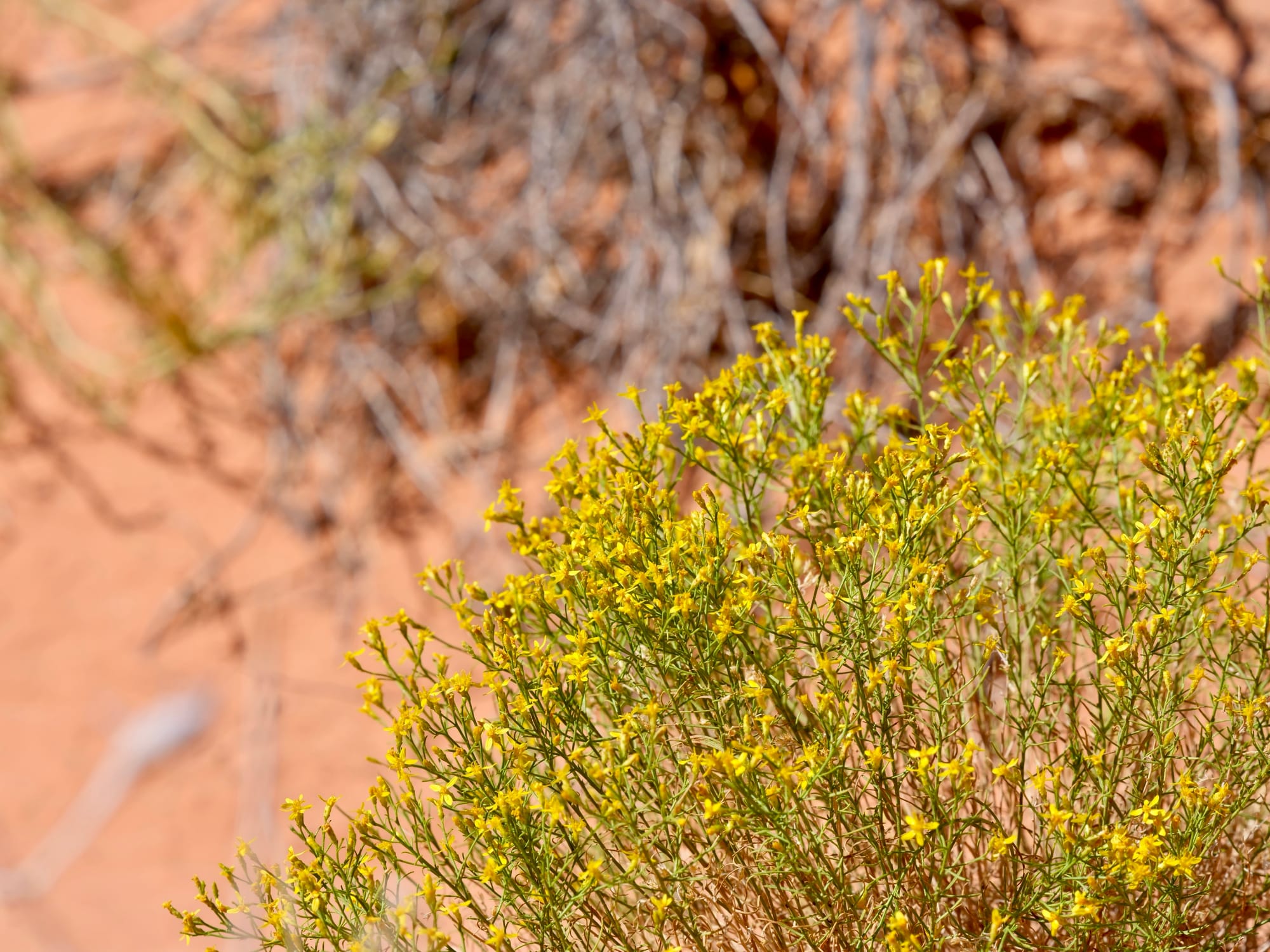
It is a yawning hinterland of sage, cactus, snakeweed, scantily placed juniper. Water, as sparse as the juniper, though the canyons hoard it in their great gluttonous throats. There it hurdles and chortles its way as red and brown chocolatey gouts of earth and water until it discharges into the Green river running silently in the deepest of redoubts.
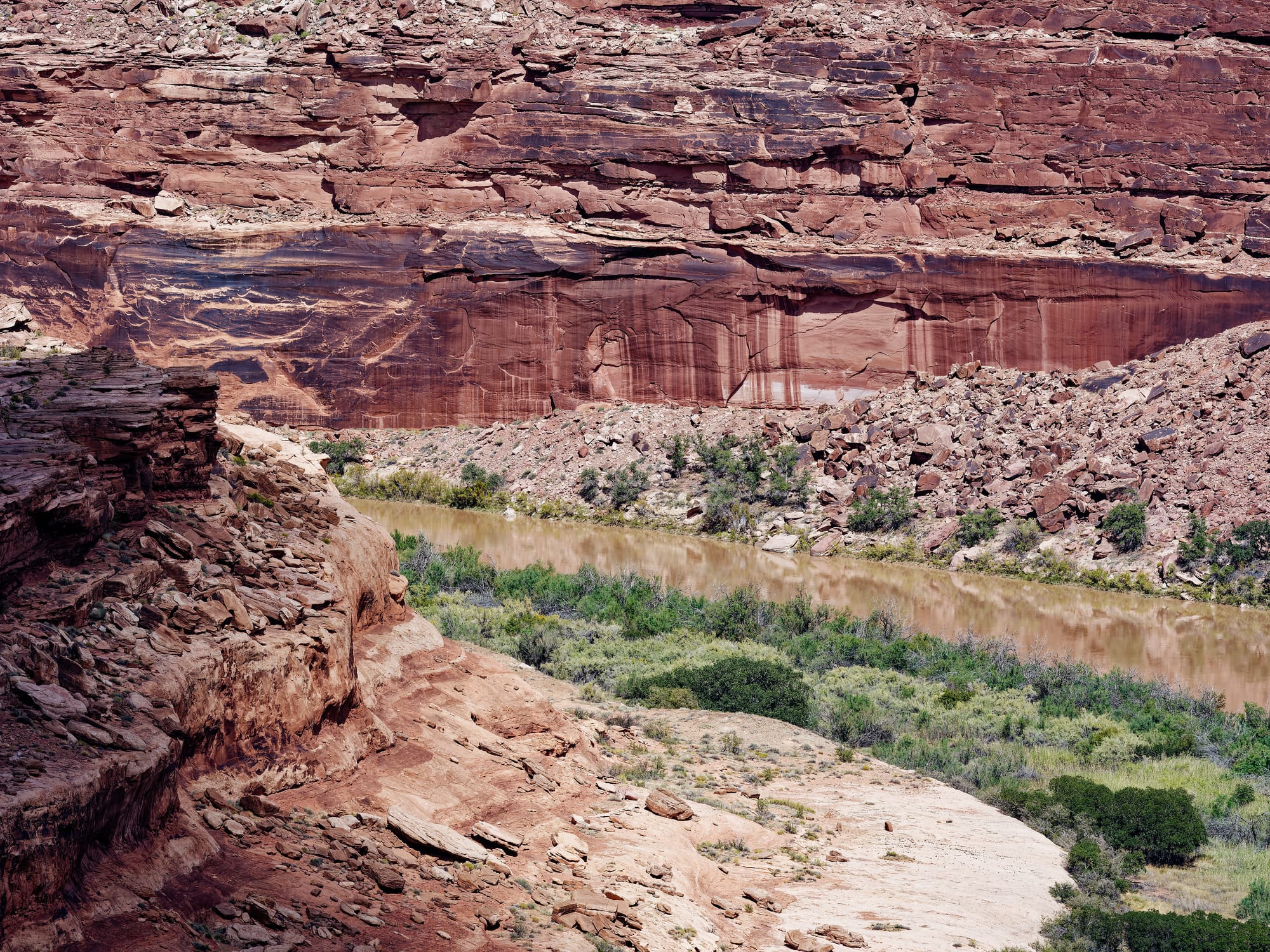
Green River
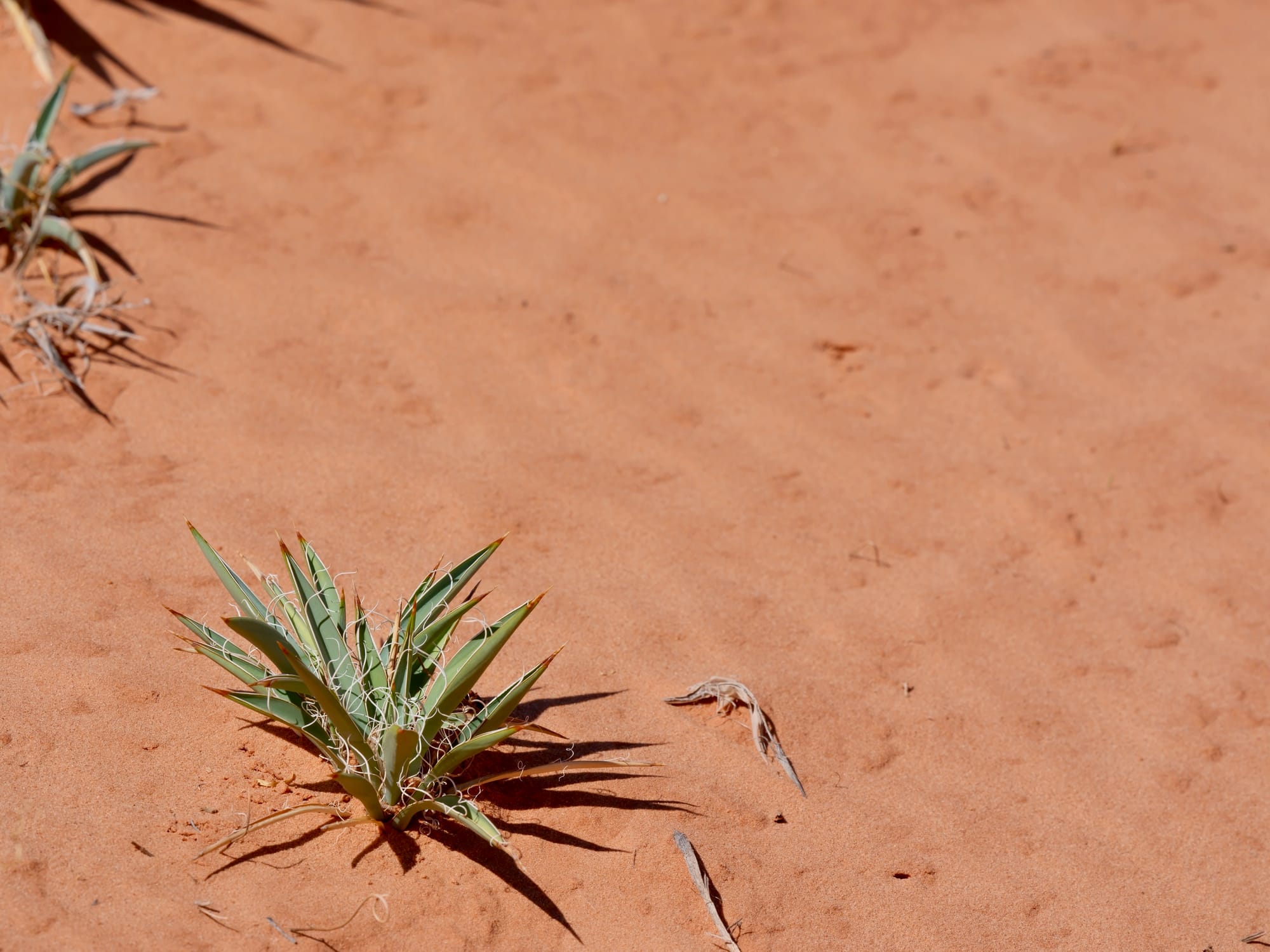
When it rains, and it has here recently, the texture of the red soil is renewed, footprints recede into puddles, a thin crust of sun-baked clay forms which crunches underfoot. Small pebbles and stones stand proud of the surrounding soil, the small patch of soil they have protected while the rest runs off.
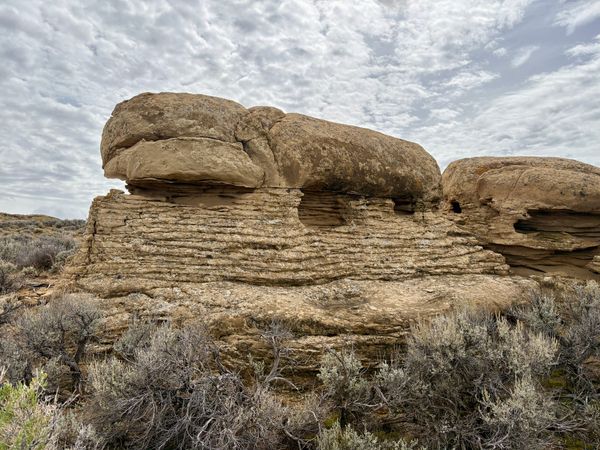
Persistent weathering over centuries reveals barren stretches of red sandstone, slickrock. Scattered across the flats are patches of river-polished stone, some chert, jasper and agate, but mostly just stones. These are the polished epithet of rivers so far in the past that they have never borne a name.
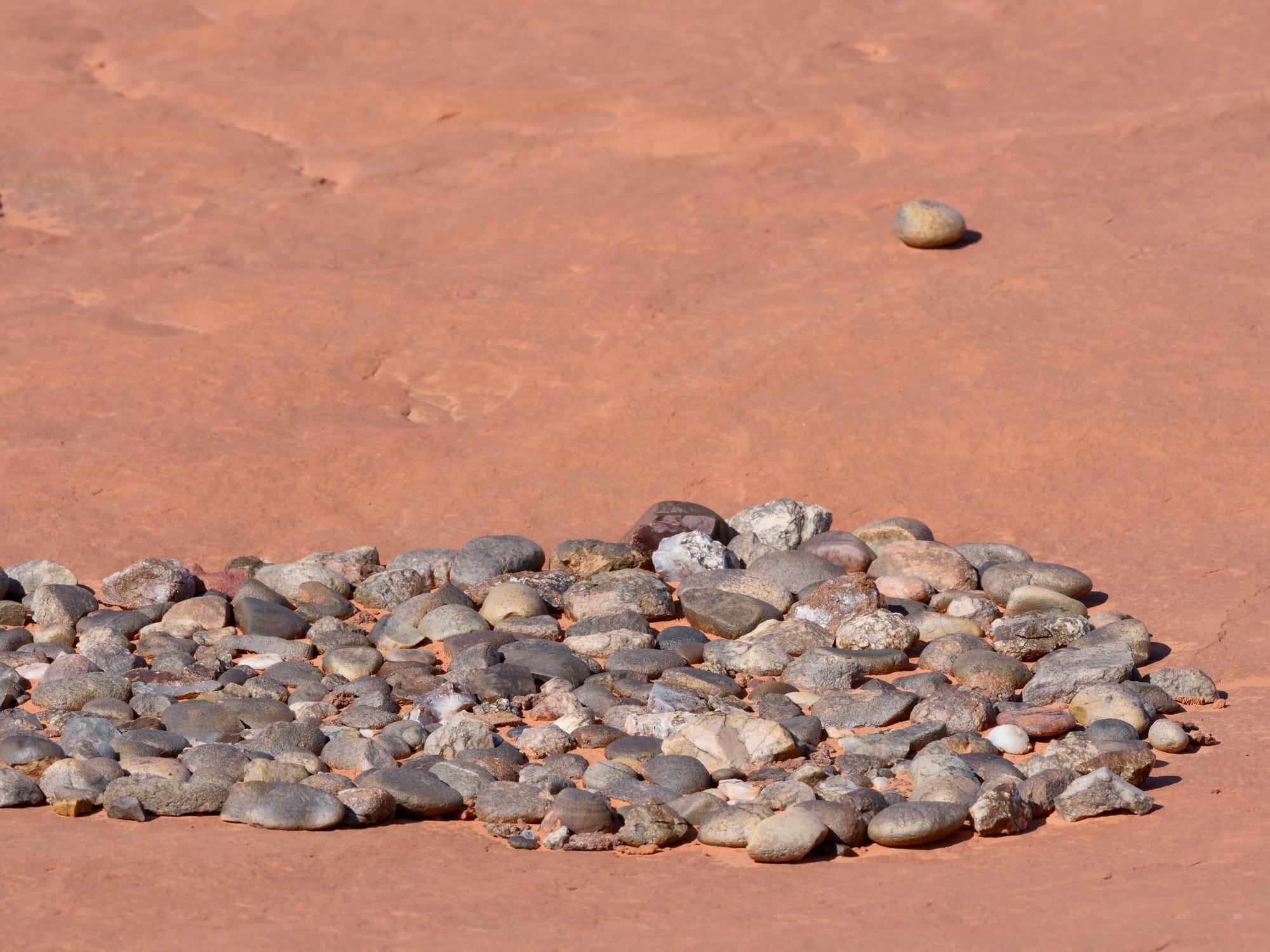
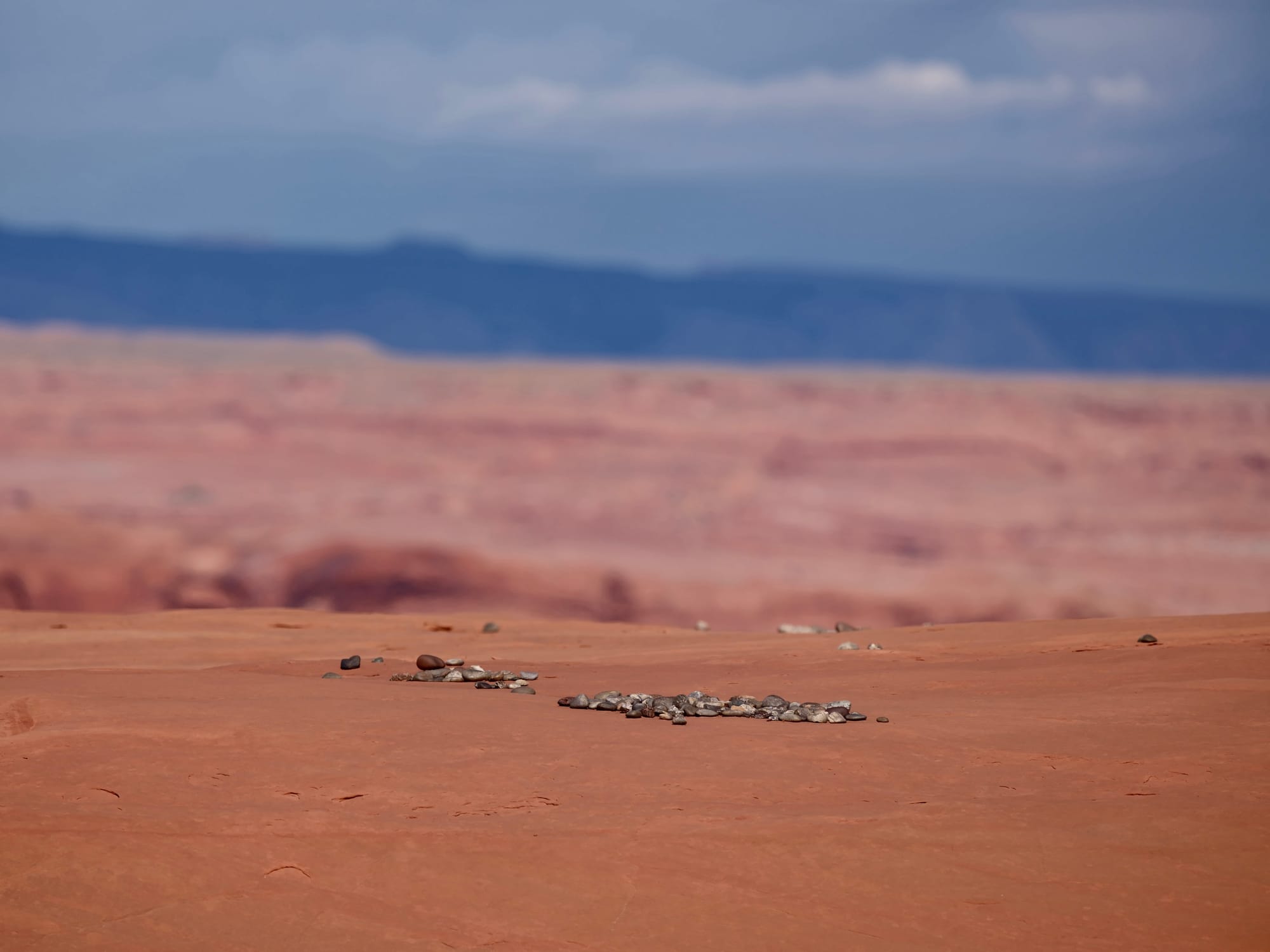
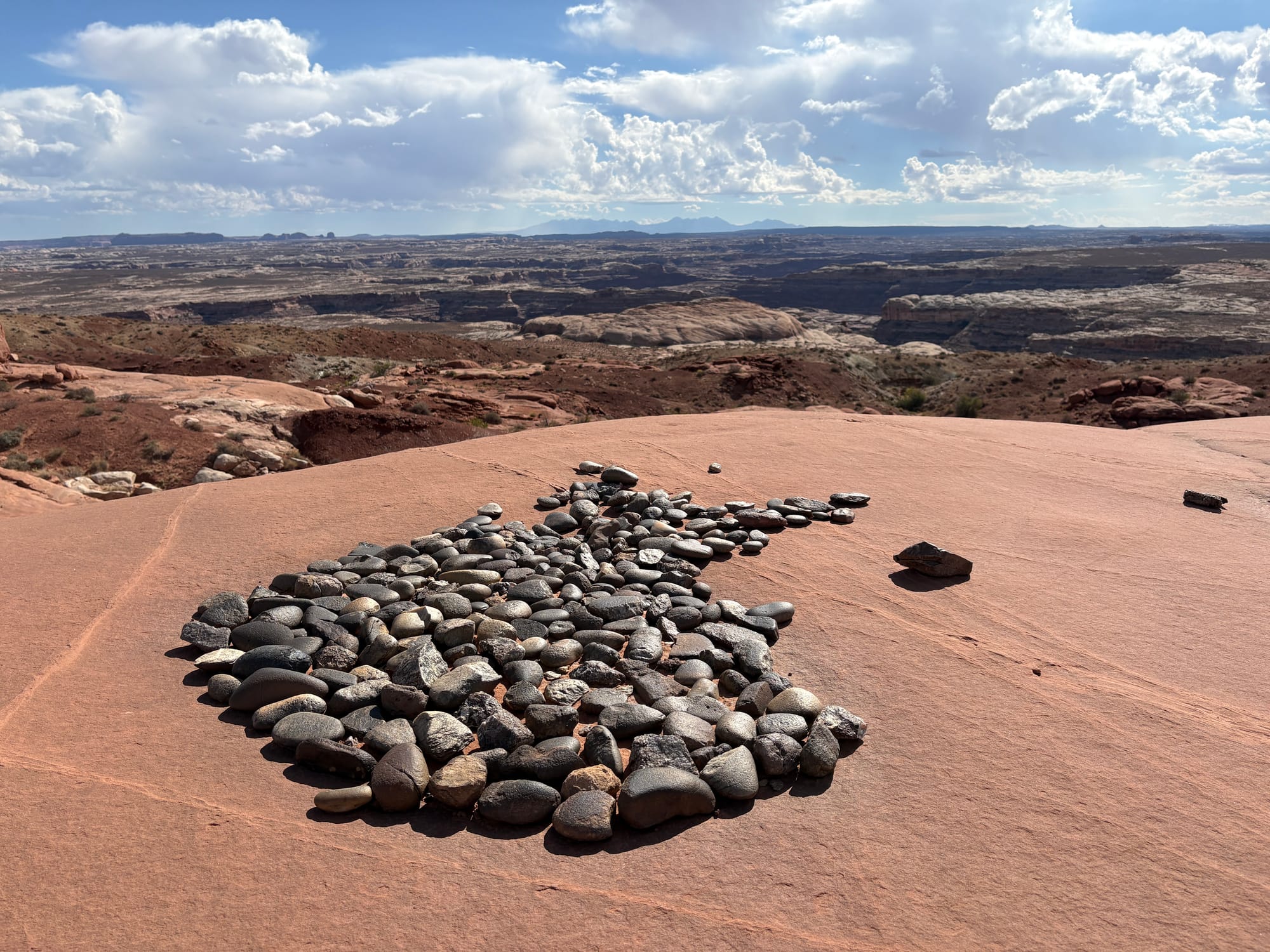
Rivers that flowed off of mountains unknown and moved sand and silt and the polished stones they left here. Later, the sand and clay stripped away by rain and wind, these river remnants lay stranded in stony pools and clusters, little islands of the past, defying entropy, at least for now.
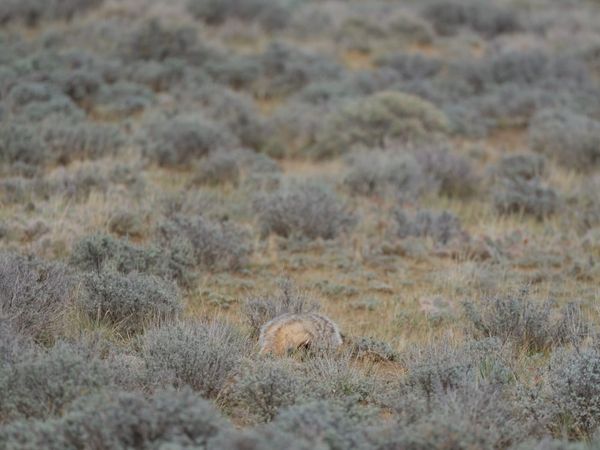
Here one can see the jackrabbit and cottontail and are left to imagine the deer with their delicate hoof-prints impressed in the still-wet sand and mud at the edge of a pool of thick red water under a smooth sandstone pour-over. One is also left to create in ones mind the image of the coyote trotting through the sage looking over it shoulder, wary of danger or looking guilty.
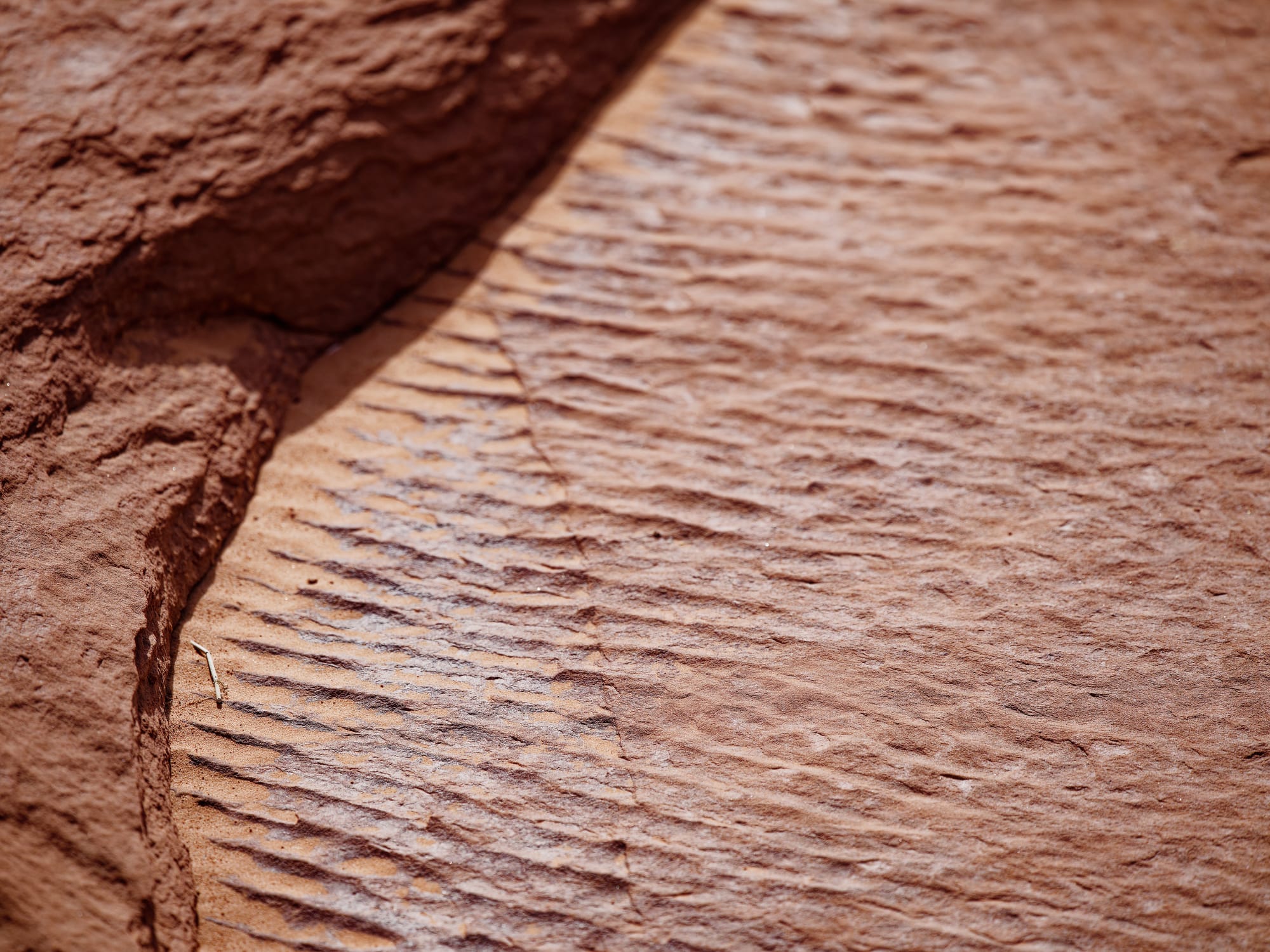
The sand banked in the washes or flung up into rippled dunes is recycled from ancient dunes turned to stone, buried, petrified, and liberated again by wind and water.
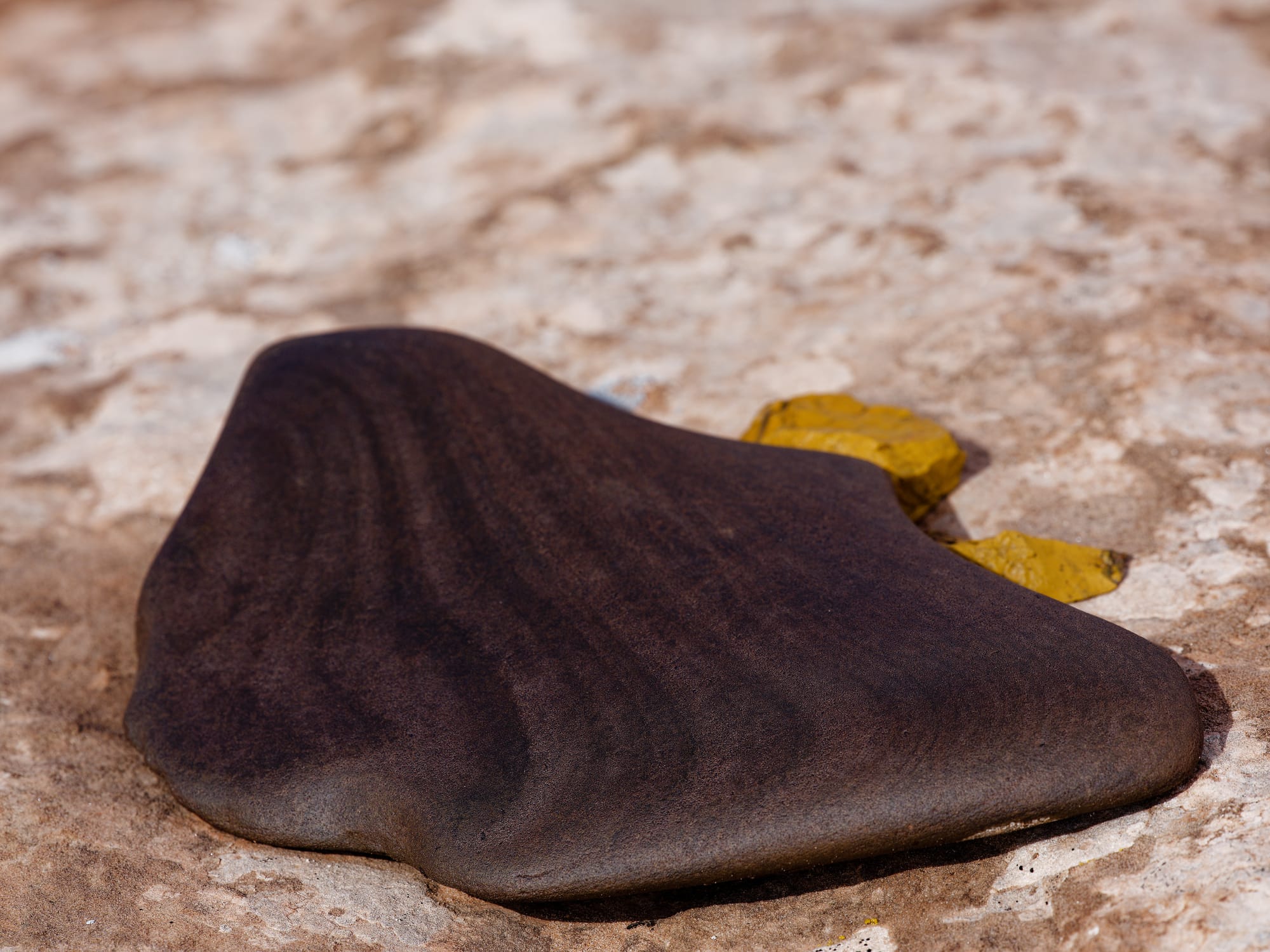
And here is the sign we are in the cow-shit spattered West. It seems no place is without this bovine pestilence. Difficult as it is to believe, this is also a place where someone, actually a surprising number of people, thought they could find no better place to raise cattle. Cow shit is everywhere you go. It is in our campgrounds, on trails, on high rocky prominences.
I suppose you look out here and you see hundreds and thousands of acres of free land with nobody here, at least not anymore.
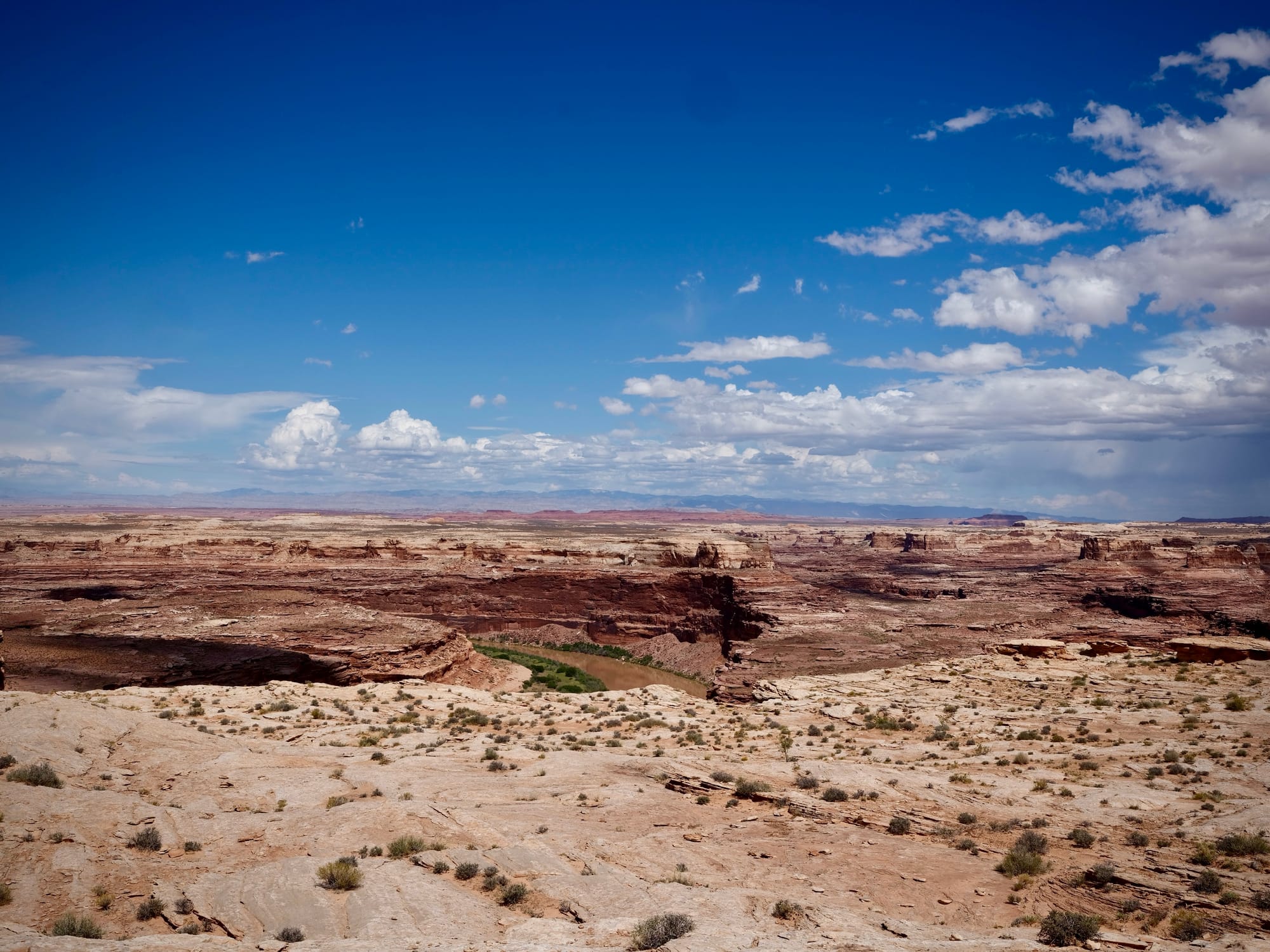
Of course there’s no water here except to say deep in the bottoms of the canyons, or wedged tightly in rock layers directly under one’s feet. The only reliable water, the Green River lies hundreds of feet straight down and miles away, through the slick-rock serpentine sandstone canyons. A place that can manage to support a few rabbits, coyotes, and down in the deep canyons, some deer, bighorn sheep, kangaroo rats, and other small rodents. I don’t know what depths of imagination or grandness of ambition exists to think that there’s a living here from cattle.
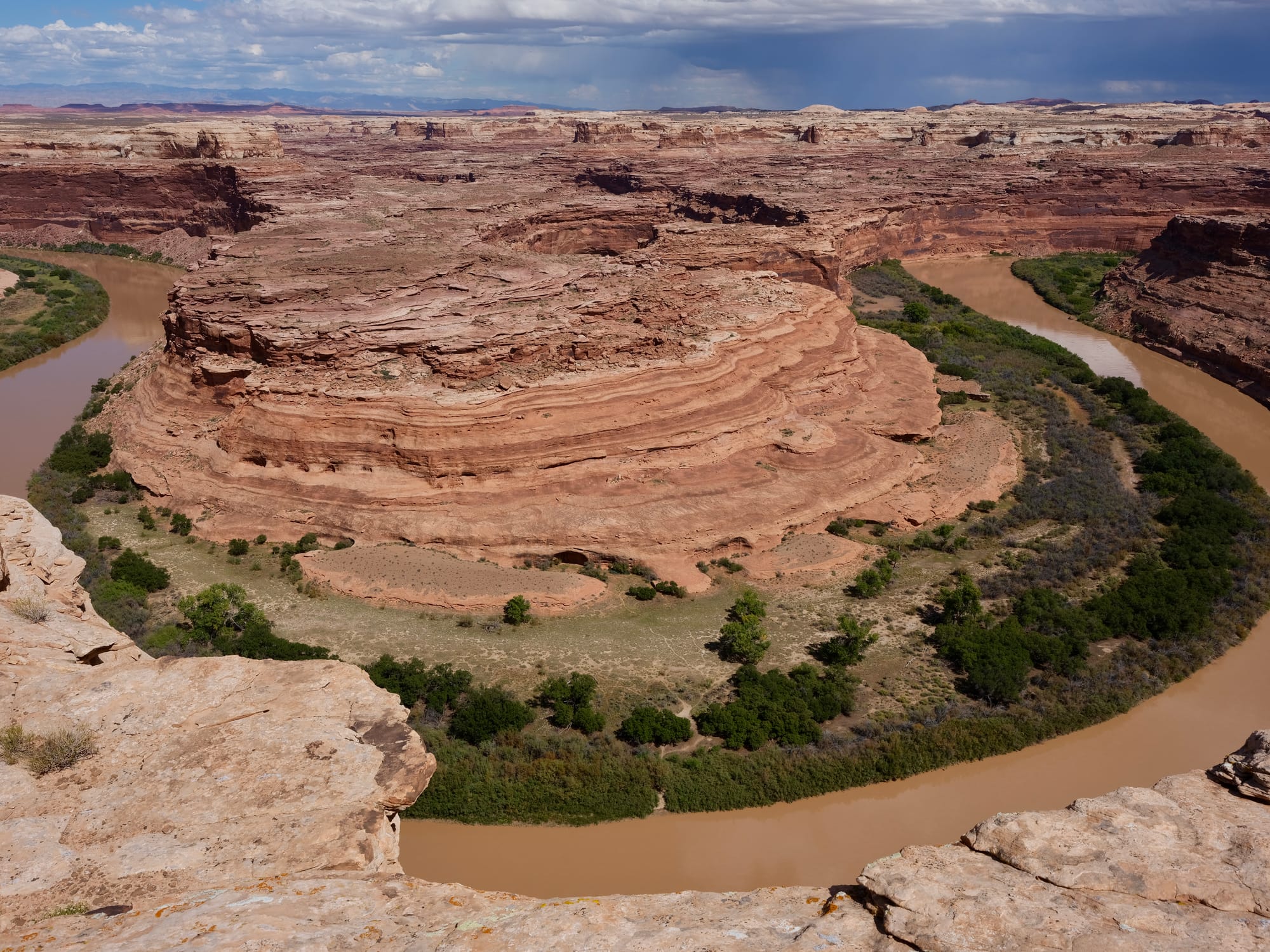
Green River Gooseneck
You see today big plastic tubs and earlier old steel tanks and water is trucked out to these remote locations for the cows to congregate around. And if you walk out to the Horseshoe Canyon part of Canyonlands National Park, a little tiny green staircase Tetris-shaped blot of land on the map. The trail one takes down to the bottom to view the country and cryptic panels left by the Ancient Puebloan people, long gone from the landscape before the arrival of Europeans, was made by one of these imaginatively ambitious ranchers. Someone who decided that his cows belonged here. This is where he would stake his claim in the vast American West!
That’s him who wrestled with the same problem all over this land, the problem of how to make the land carry ever more large herbivores. And he set about building a road from this desolate land all the way to the bottom of the canyon. A canyon that is watered intermittently by flash floods, is also home to a few small springs. Chipping and dynamiting slashing diagonals all the way to the bottom through the steep sandstone walls, down—down to the bottom. It’s like a rocky staircase and one wonders; what did he drive down here beside cattle?
Halfway down there’s an old steel tank and galvanized pipe running down to the bottom and I suppose an attempt to pump water up for his cows.
Time and politics has meant that the Park service must memorialize this man’s madness and desperate ambition, not as madness but as anodyne or perhaps heroic pioneering. It’s not some scar upon a landscape but instead has been transformed into archaeological artefacts no different than the strange etchings on the walls of the canyons some thousands of years older. Thus this man’s work has displaced a deeper and richer ancient history of a place and the peoples we should probably never be able to truly understand. (Though I am left to wonder who is more difficult to understand.)
I sit and contemplate about the expected equivalency between a man with drill and pick and shovel and dynamite beating his way into landscape to raise a few cows or sheep against a people that have mysteriously disappeared and left stone buildings under rock alcoves, strange writings, pottery, baskets, sandals, and remnants of corn they grew in the wet bottomlands for centuries.
In Britain the wealthy built vast estates and in their boredom built towers and buildings imitating Greek or Roman architecture. These were called follies. Here we find a different folly, built more out of optimism or naive belief than boredom.
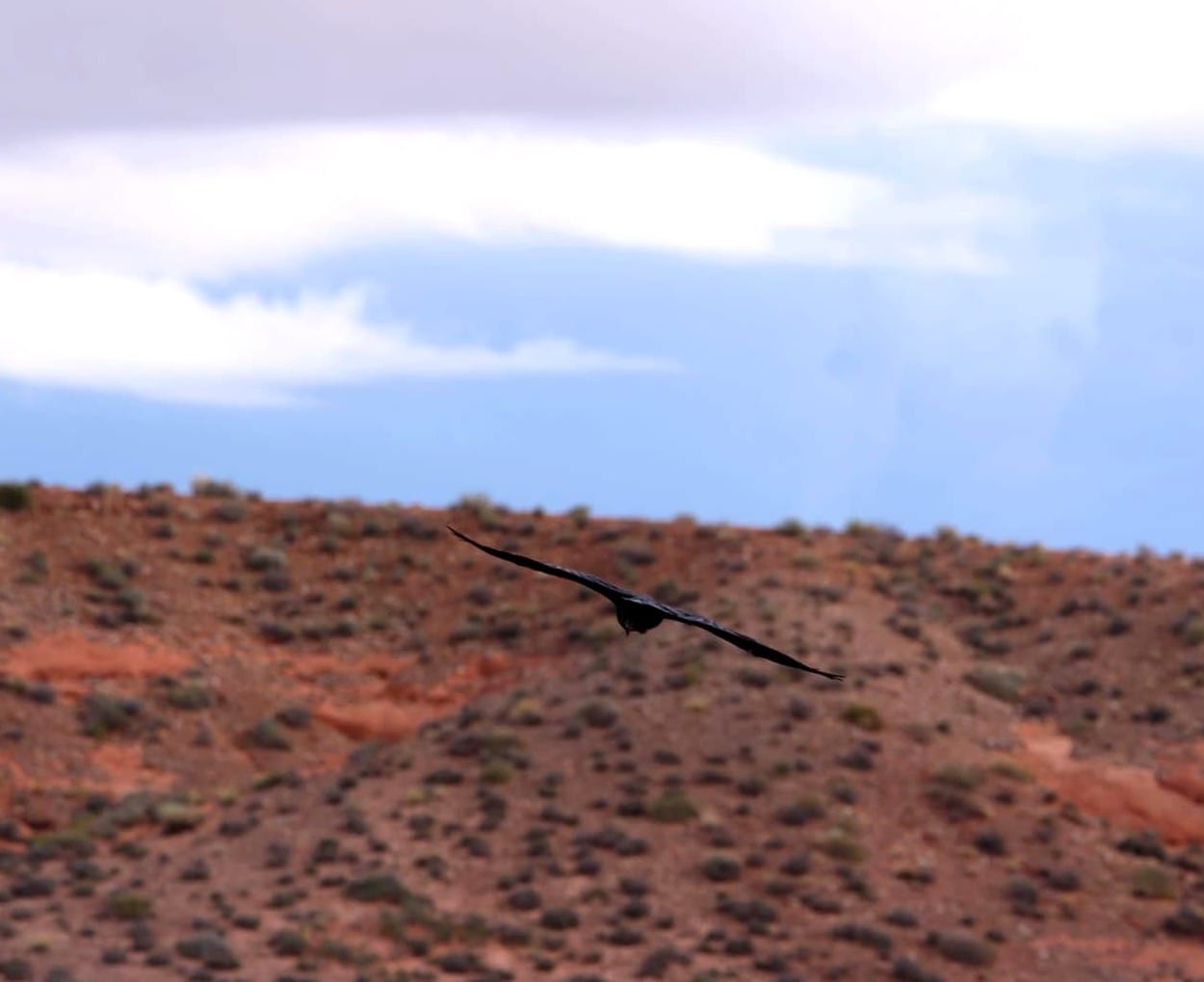
A raven is floating the smooth rocky contours on an unseen updraft from a steady cooling breeze. The sun sits intensely high in the sky and its rays penetrate with heat belying this September day. The sky sits blue and immutable in a patch surrounded with cumulus puffs and distant thunderheads that portend perhaps a change.
And it is here that Mollie has discovered she is a desert dog. The wind scrubbed sage is short enough for her to see over. Mounted on short legs she revels in a landscape scaled for her. She also loves the slickrock, perhaps its smoothness, or maybe she feels as I do that it presents endless paths and challenges. She is a great slickrock companion. Her short legs means she path-finds well, as I can usually follow her. Though I lack her nerve to stand toenails-over some great precipice.
We are driving out to a trailhead over roads that were never so much made as driven. Whose last and only maintenance consists primary of the last set of tires to roll over them or the work of wind and water. Mollie does not like bumpy car rides and I took some mercy on her.
Thinking that we really just wanted a walk and this type of country is the best for cross country traverses, I park the truck and we get out near a rim of red sandstone. I loaded up the pack with plenty of water and some food and headed up to see what this country would show us.
Mollie is a black dog and as such suffers somewhat more from the heat of the sun. She is a consummate practitioner of what I have come to call ‘black-dogging’. Black-dogging is the practice of avoiding the direct sun and maximizing time in the shade. She picks the shadiest line of a walk, she will trot ahead to a patch of shade and wait for me to catch up before proceeding. Advanced techniques include finding cool sand or dust in the shade, scratching up the warm covering and laying flat, belly to the cool soil.
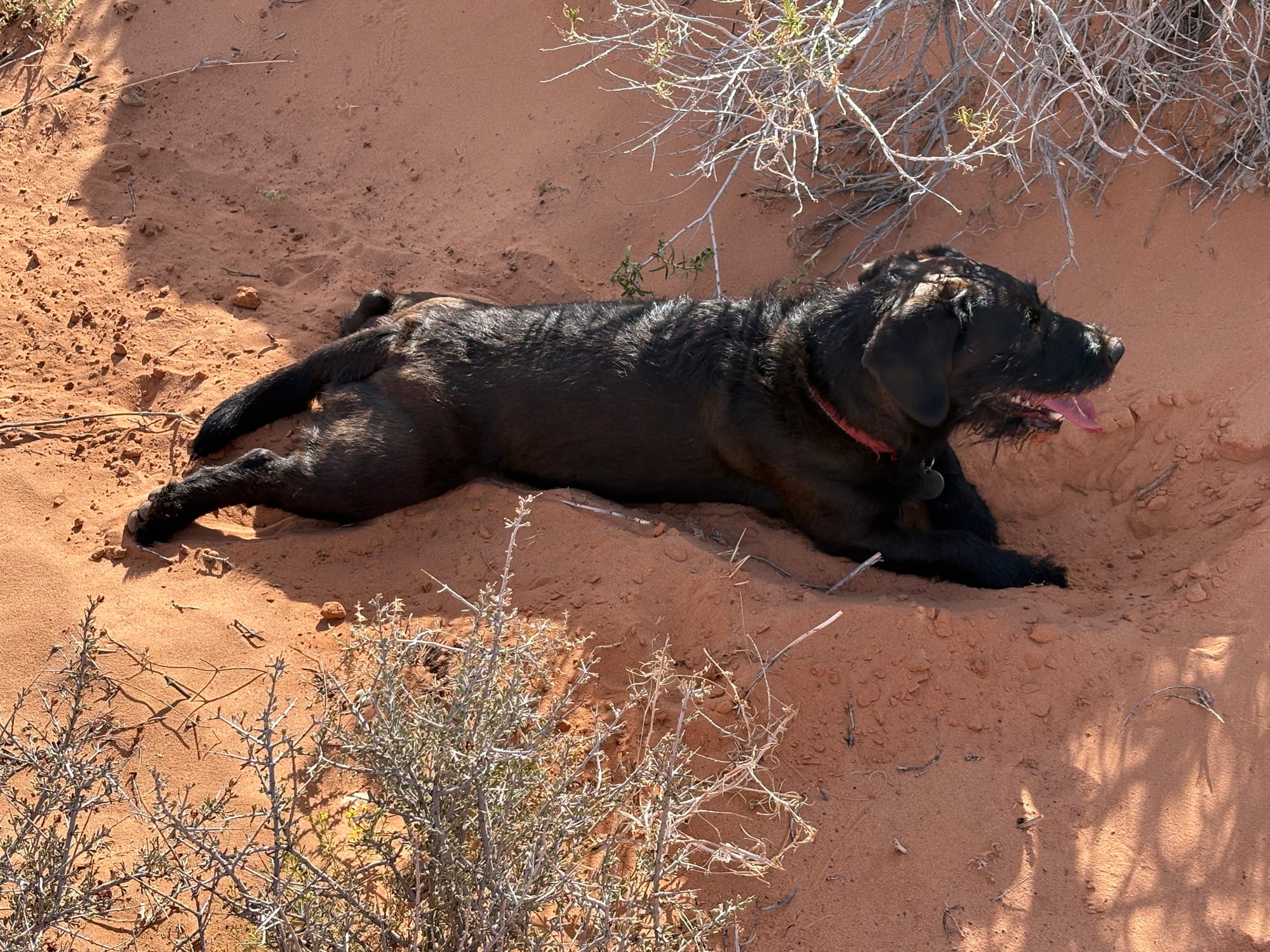
Black-dogging behavior.
So we walked the smooth contours, found places to ascend higher. We would travel the edges of small canyons and Mollie would wander their sandy bottoms in search of rabbit sign. On two occasions we found red-silted water basins of sand and sandstone. Here she waded straight in and one was deep enough for a quick paddle about. She revels in found wild-water.
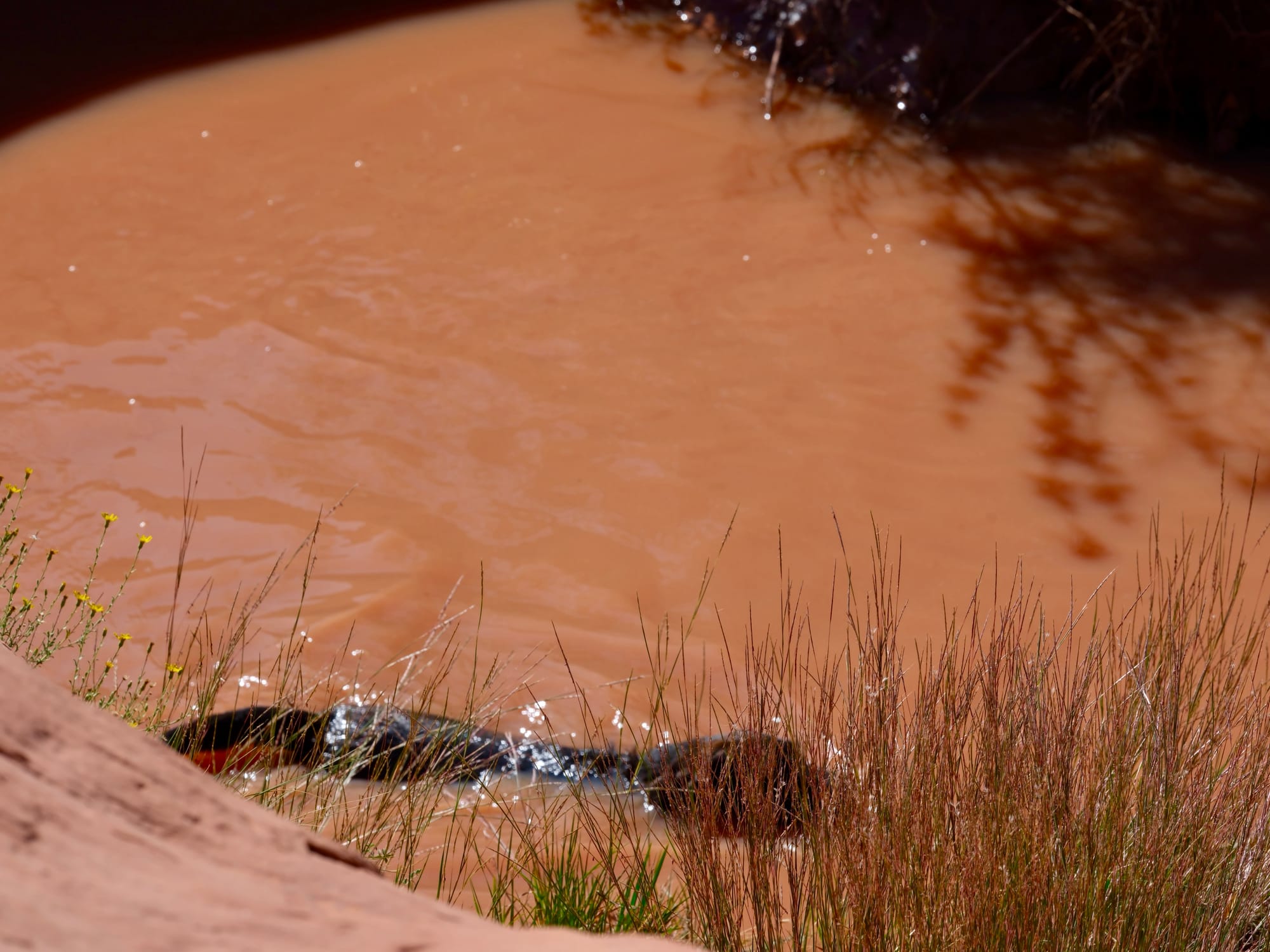
A dip in an ephemeral pool.
We made our way over the distant ridge to the east and once over it, could see into the vast broken labyrinth of the Green River drainage. Then I heard short staccato squeaking from Mollie, alarmed she might have come to harm I sprinted in her direction only to see a jackrabbit streaking away. She was just making excited dog noises. She cast about vigorously over the hot sand and rock and was soon over-heated.
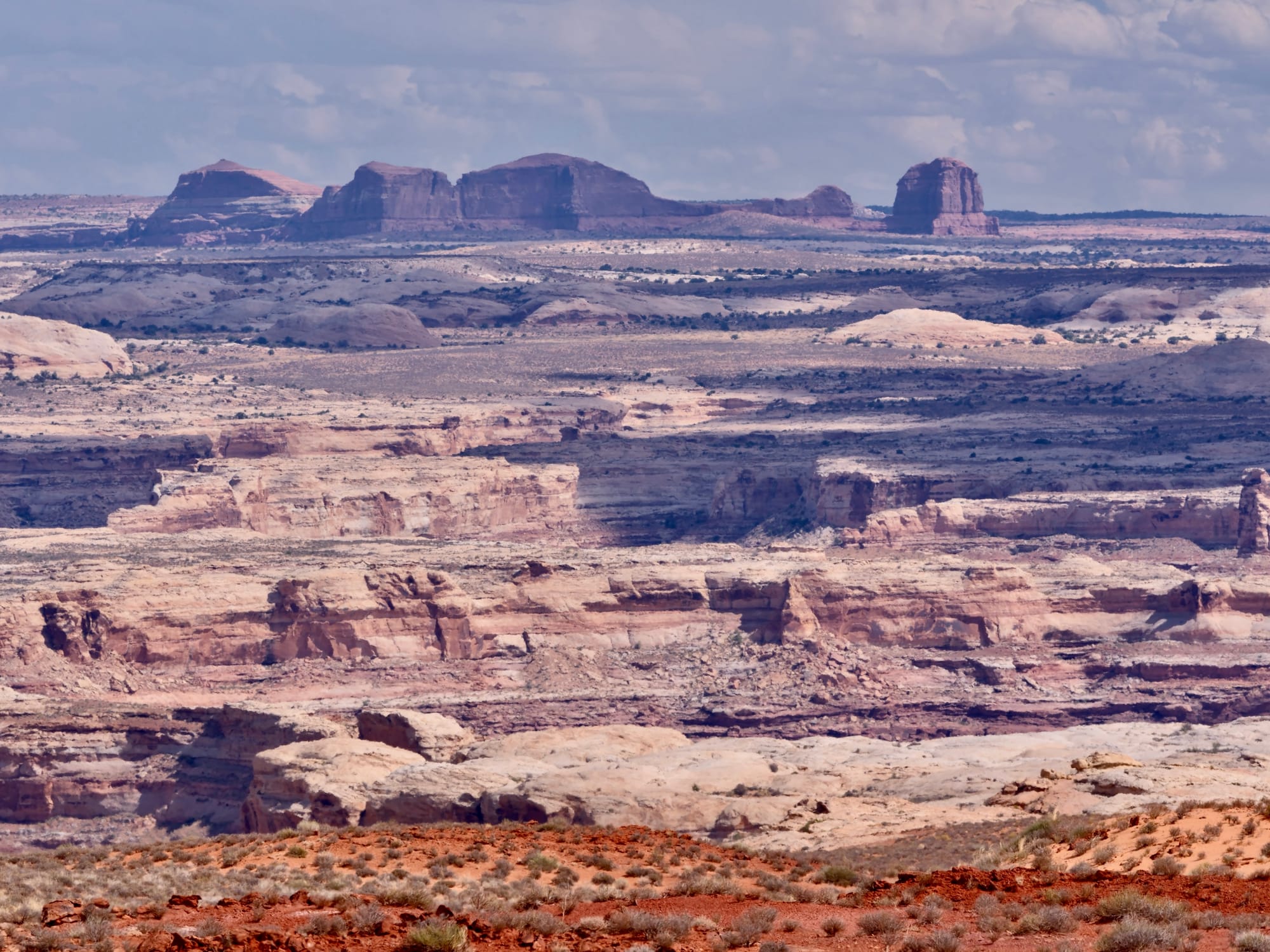
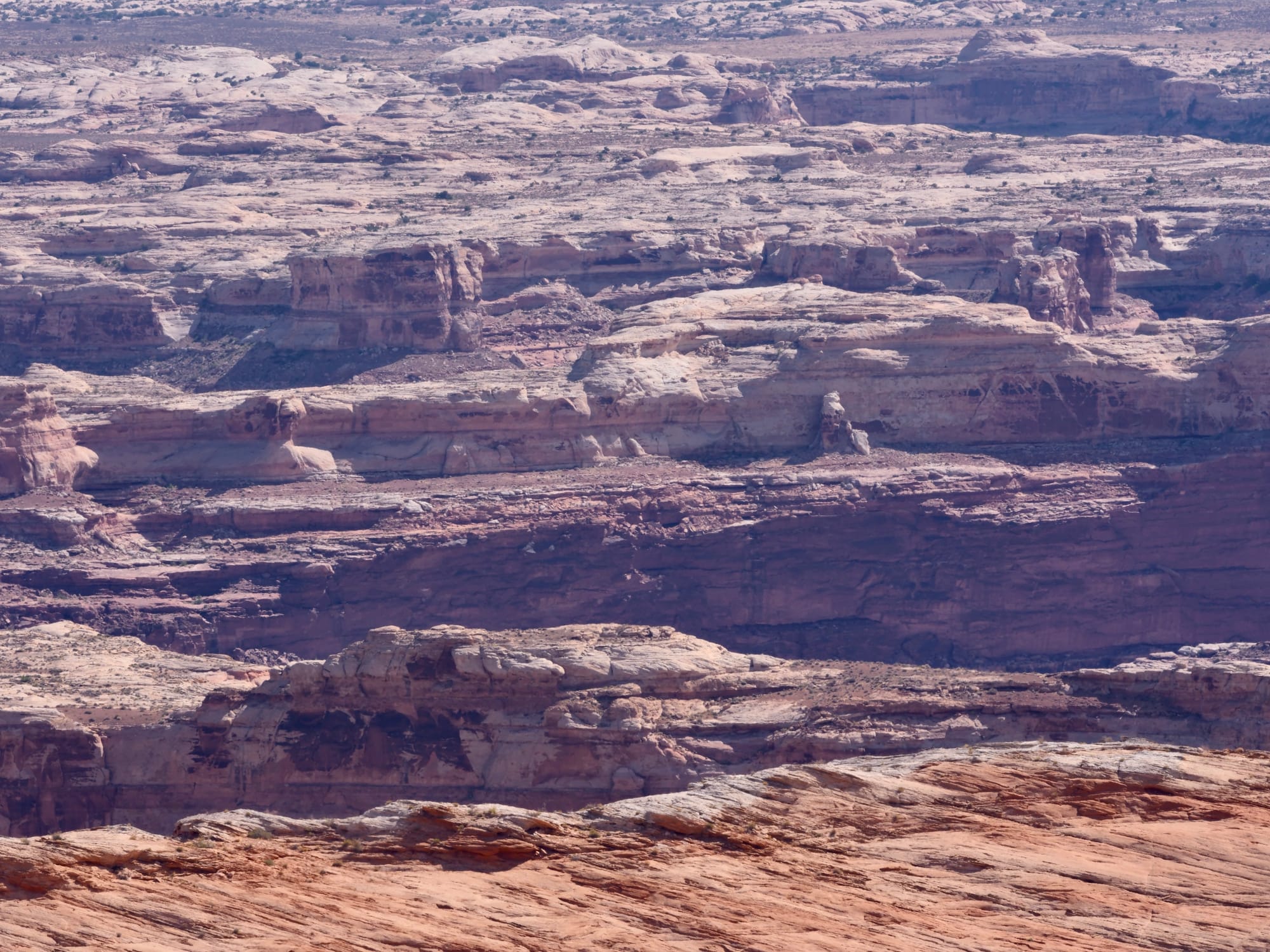
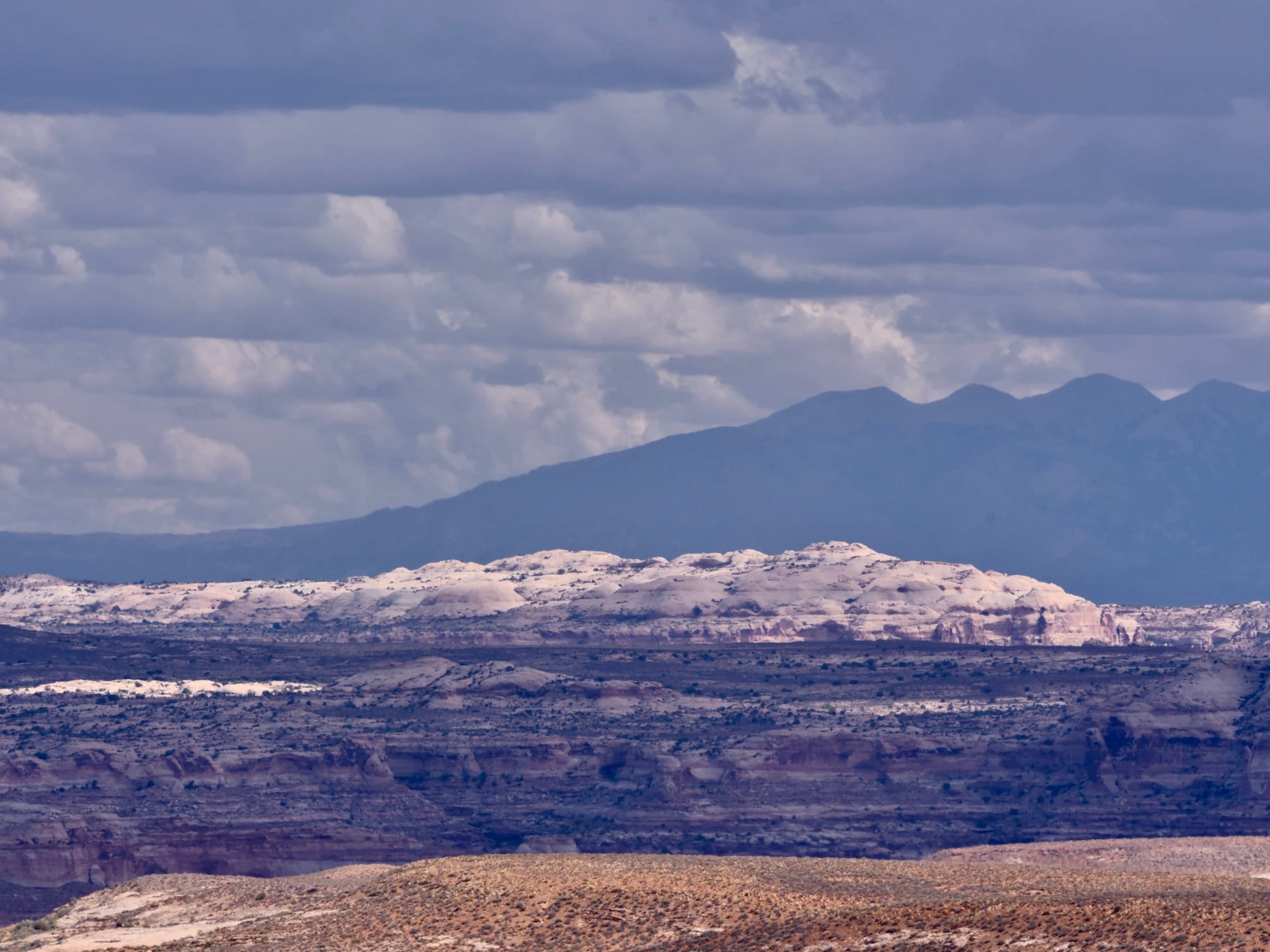
Somewhere the Green River abides.
Later she settled in the shaded curve of a little rivulet carved in the rock with a sandy bottom. She scraped up the wet sand and laid belly-down with her tongue hanging from a vigorously panting and pleased-with-herself face.
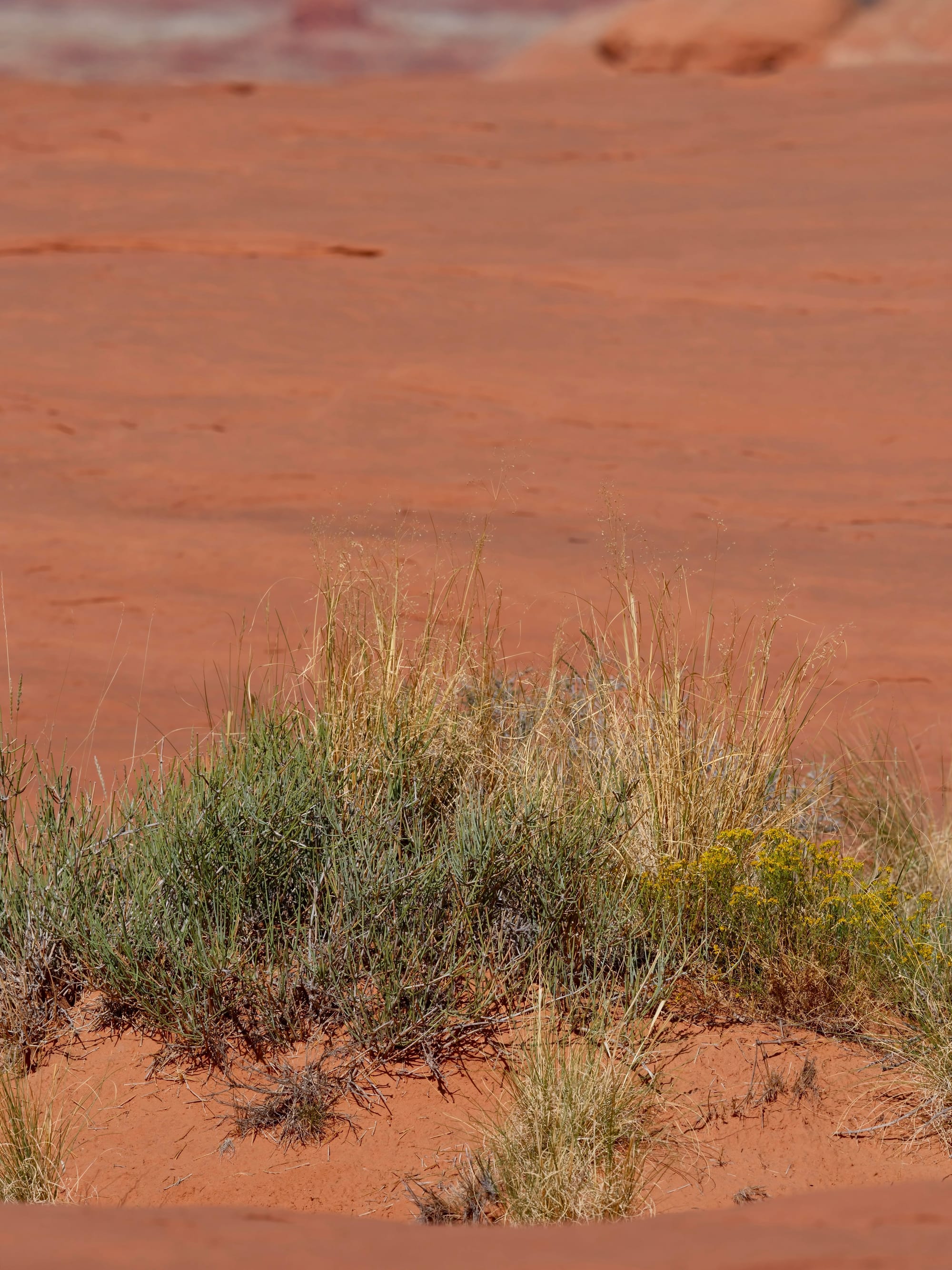
I took this as sign I should join and found a soft sandy seat in the shade next to her. Took off shoes and socks and then prepared a meal of meats and cheeses. Mollie refused water as she cooled down. It was clear the day would become hot for her so I resolved to take a shorter route back to the truck.
Eventually we started out again and Mollie could not help herself chasing after rabbits or their ghosts and soon she was overheated again. Again she found a sandy shaded spot and I joined her. Again she refused water. She was fine she was telling me, just needed time to cool down.
Soon we were on our way again. I was cutting across the meandering path we took earlier to shorten the return. Mollie however ran the other way and disappeared. I called and whistled but to no avail at least for several minutes. Finally she turns up and trots past me and I realize she was dripping wet. She had made her way to one of the remembered water holes and had a dip before returning to me. She really has a good sense of place and self comfort.
The rest of the walk was without drama. We followed roughly the same path as before. Mollie happy to be wet and nosing about for lizards or anything else that moved. I fear she will discover a rattlesnake someday and that will be the end of her. While I am cautious and would hate to have something terrible befall her I am also cognizant of her free spirit and that cannot be indulged without some risk.
We returned to the truck and I decided to drive further up the road such as it was. In many places it seemed we were driving aimlessly across the desert, the track easy to lose. We encountered a man and his standard poodle unexpectedly and I suppose the experience was the same for him. We stopped and chatted. He had hiked up from the river where he was camped. He and his party were out for 15 nights, spending two or three nights in any given location along the river. He asked for sunscreen which he had forgotten and I was happy to obliged. We exchanged names (his was Scott) and went on our ways.
We continued for another mile or more at barely more than a walking pace, up and over the small buttes and rocky hills interspersed with drops into wash bottoms before climbing back up again.
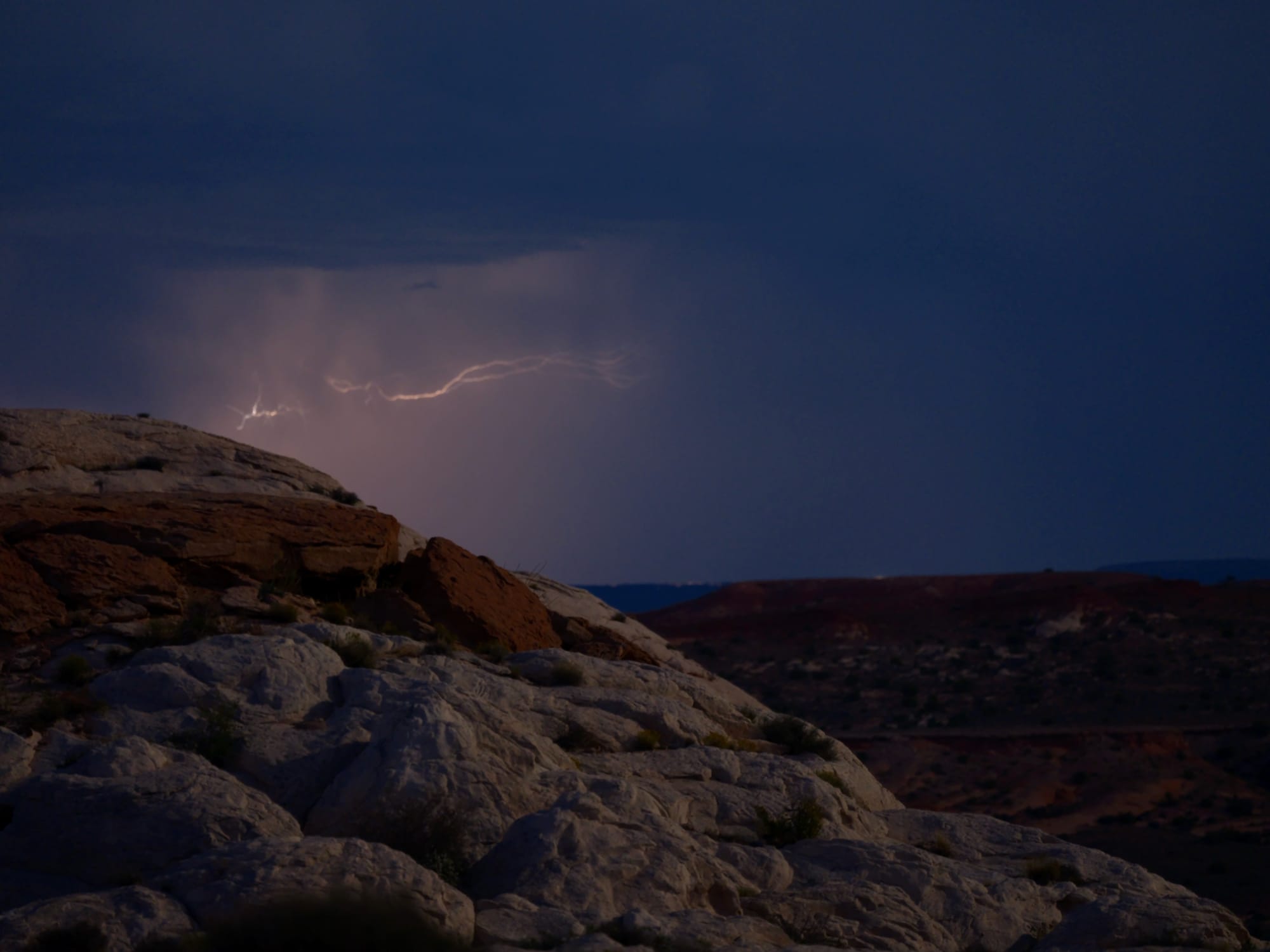
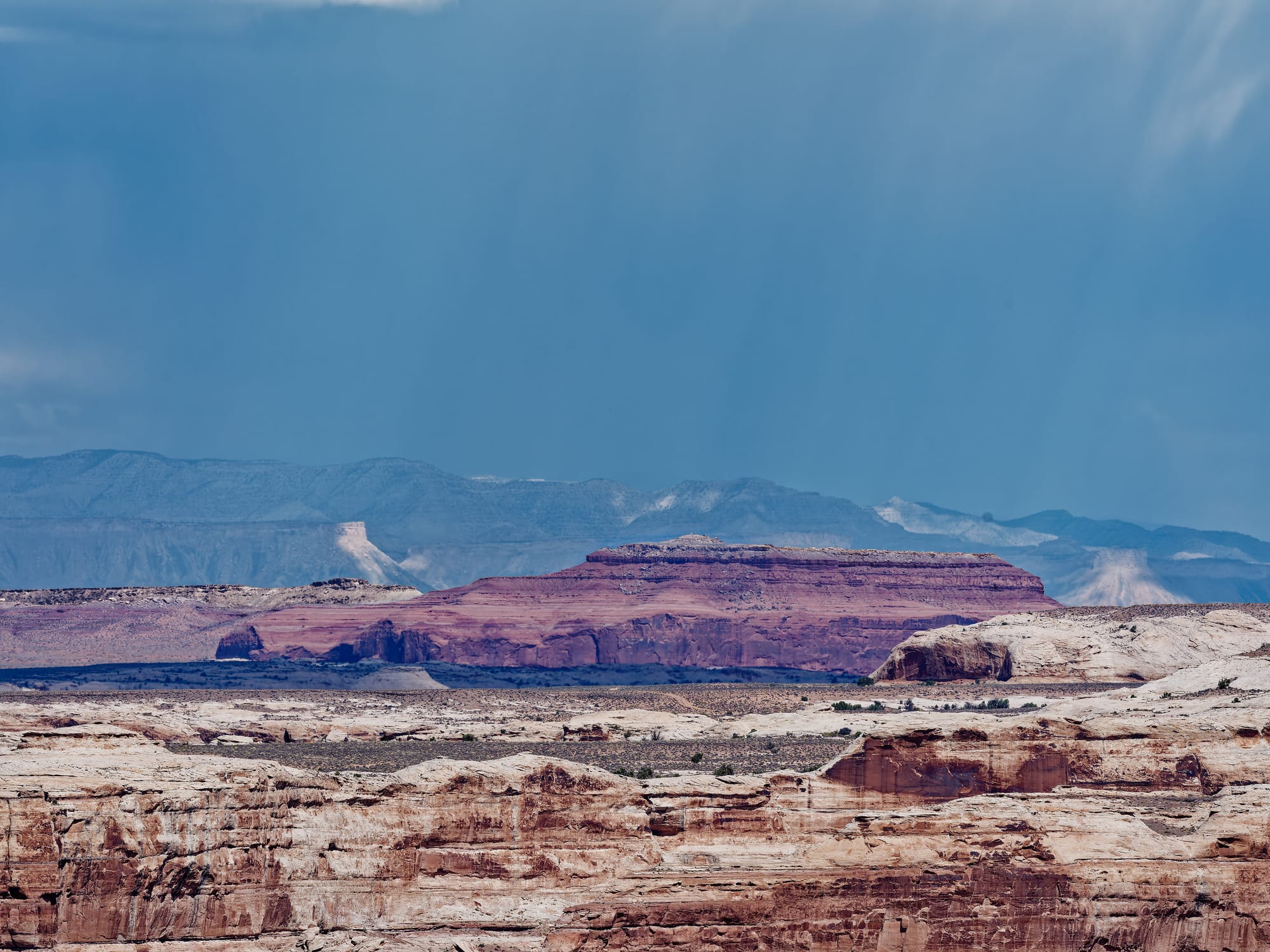
I stopped for a photo and saw what looked like storm clouds over the tops of a high ridge to the east. I had been keeping a weather-eye towards the west. It occurred to me the weather could be heading from either direction. With flash flood warnings in the area I decided to turnaround. We had food and water for three or four days so I knew I could wait out any of the washes we had crossed if they became flooded. Being prepared for dangers and willing them on are, however, two different things.
As we passed the place we had stopped to walk, I could see Scott and his dog high up on the same slickrock we had just finished walking. Curious. I waved and we drove on, happy we could no longer bedevil his solitary notions.
We returned to camp with a strong wind blowing; awning and tent were in complete disarray. [I set about trying to right everything but given the nature of the storms today I succumbed to reefing the awning and tent. In the desert the wind has much reach and can get up to all kinds of devilry. A tent pole was split and later I would effect a repair using some baling wire I found on a previous hike along with some packing tape.]
Mollie and I hung out in what shade was available as we watched thunderheads skirt to the north of us.
I was smelling rather ripe after the hike, so had a quick shower which felt very nice.
Sometime before supper there was a wall of dust approaching us from down-canyon. I rounded up any thing that might be blown about. We are perched on a canyon rim and I did not savor discovering dunnage in the depths of the canyon. Finally I got Mollie inside just as the wind whipped up. We shut the doors and listened the wind whistle; watched the dust blow in little scurries while the trailer rocked and resisted repeated blasts.
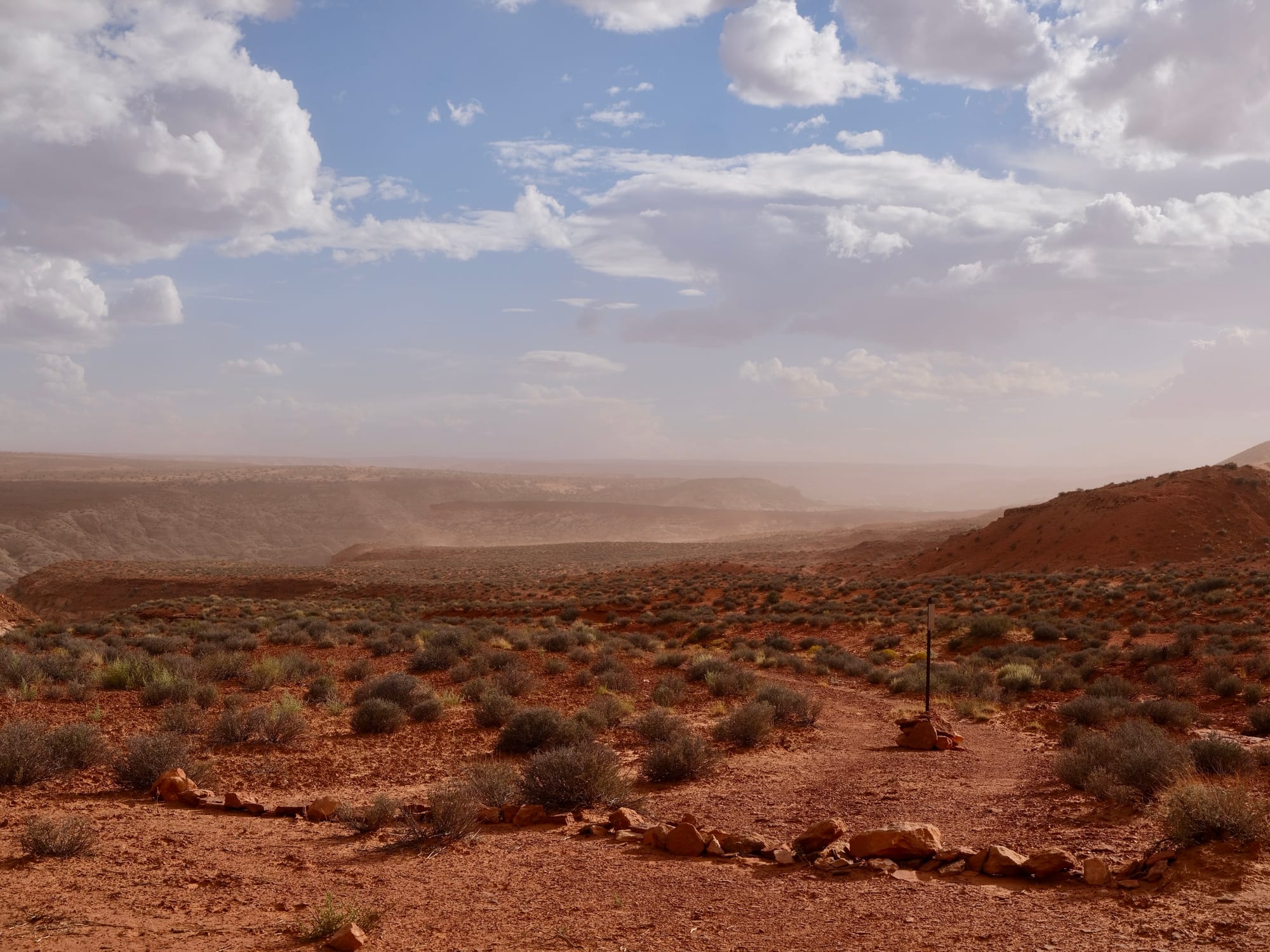
The wind getting up in the canyon below us.
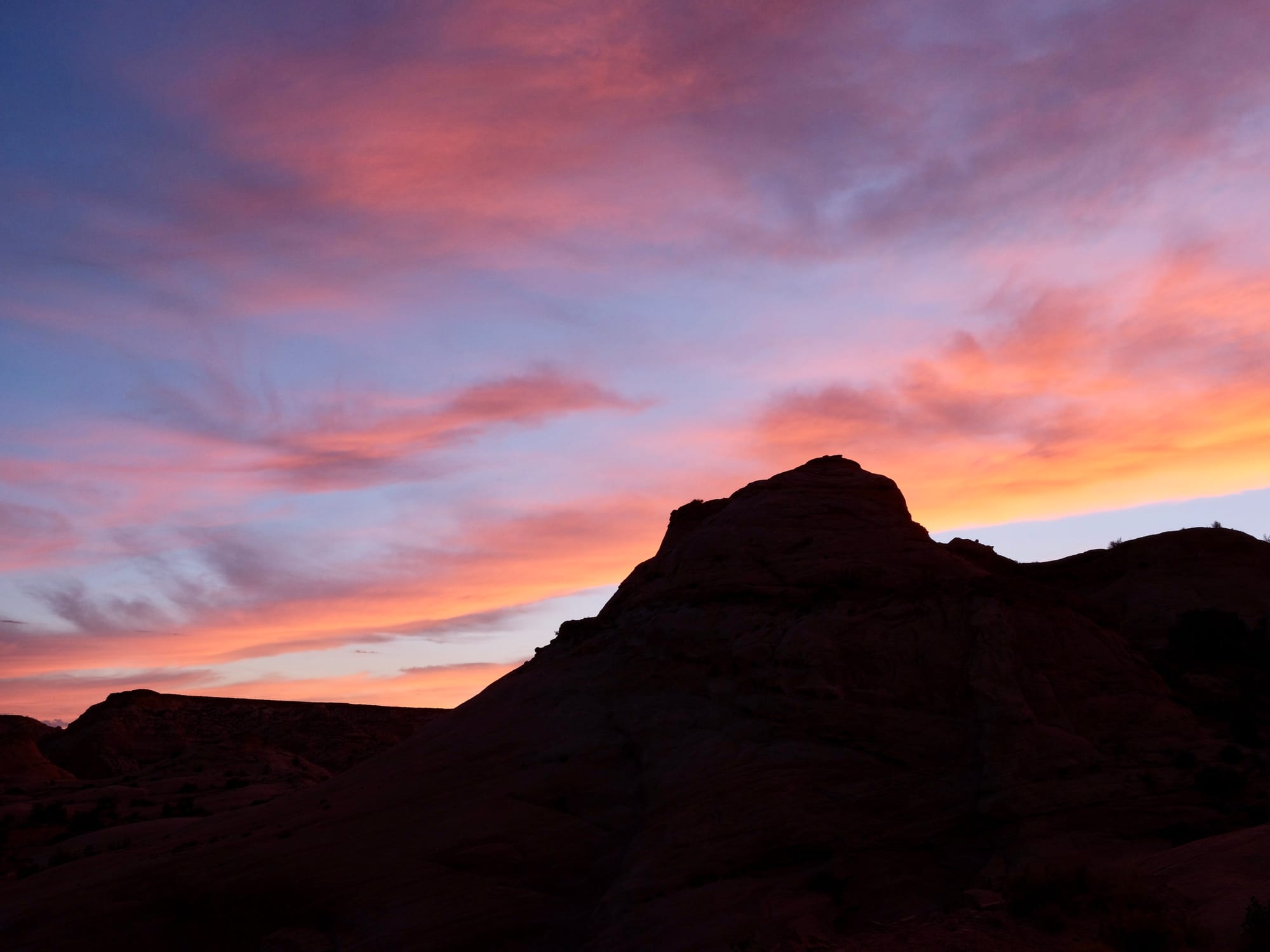
Here in the desert heat the wind plays little games; stirs up small eddies in the dust that part and move about; like small airy demons they dance across the desert floor in between the sagebrush. They bring up wisps of red dust further out on the horizon some of them having grown large, gigantic, they ascend up into the sky.
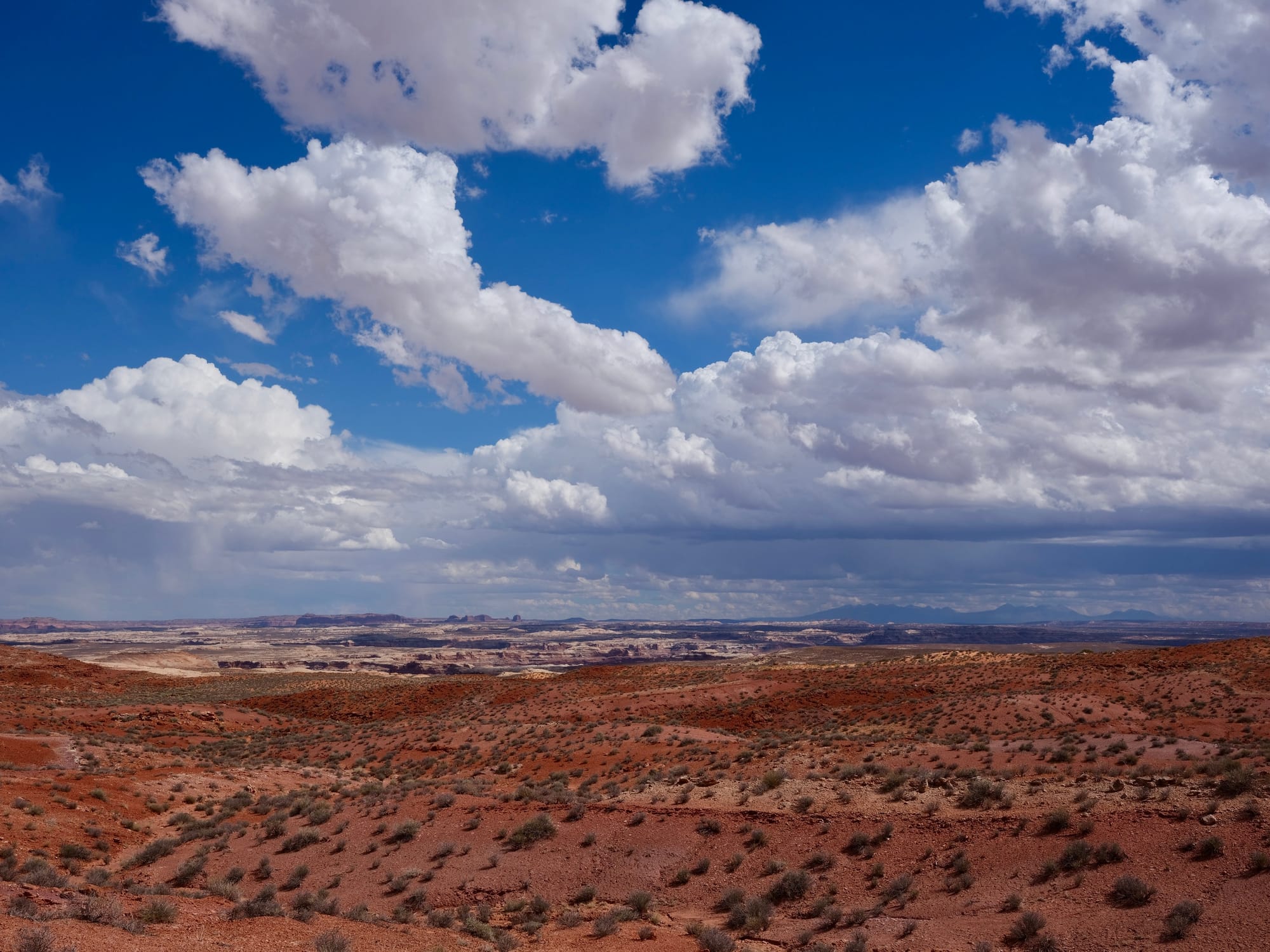
Sit long enough in this heat, with the red-bellied white clouds reflecting the baked elaterite earth, sit in the reign of silence and these little wind fairies will descend around you to make for their mischief and then ride off over the canyon‘s edge whisking and roaring before dissipating to the distant silence.
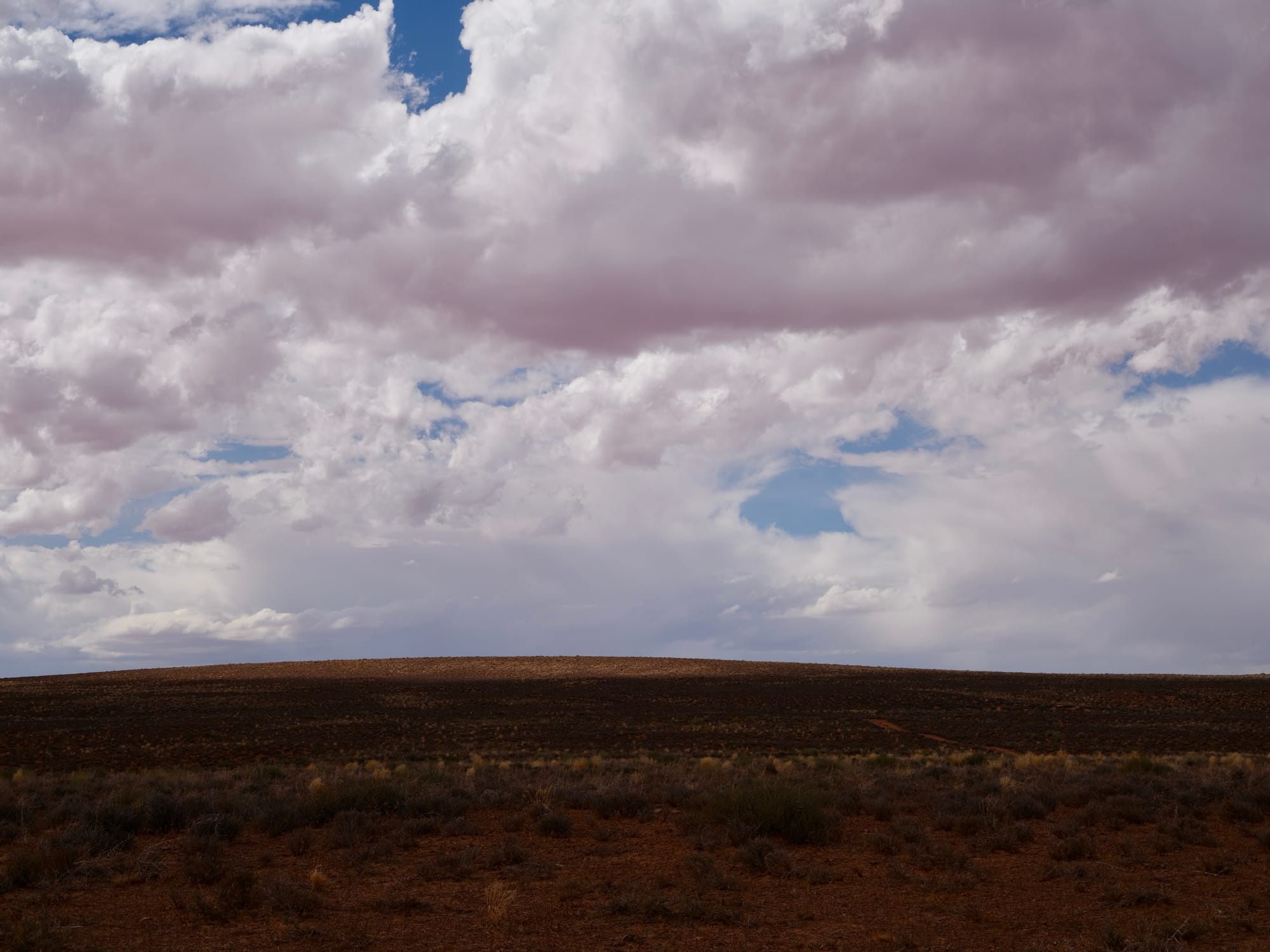
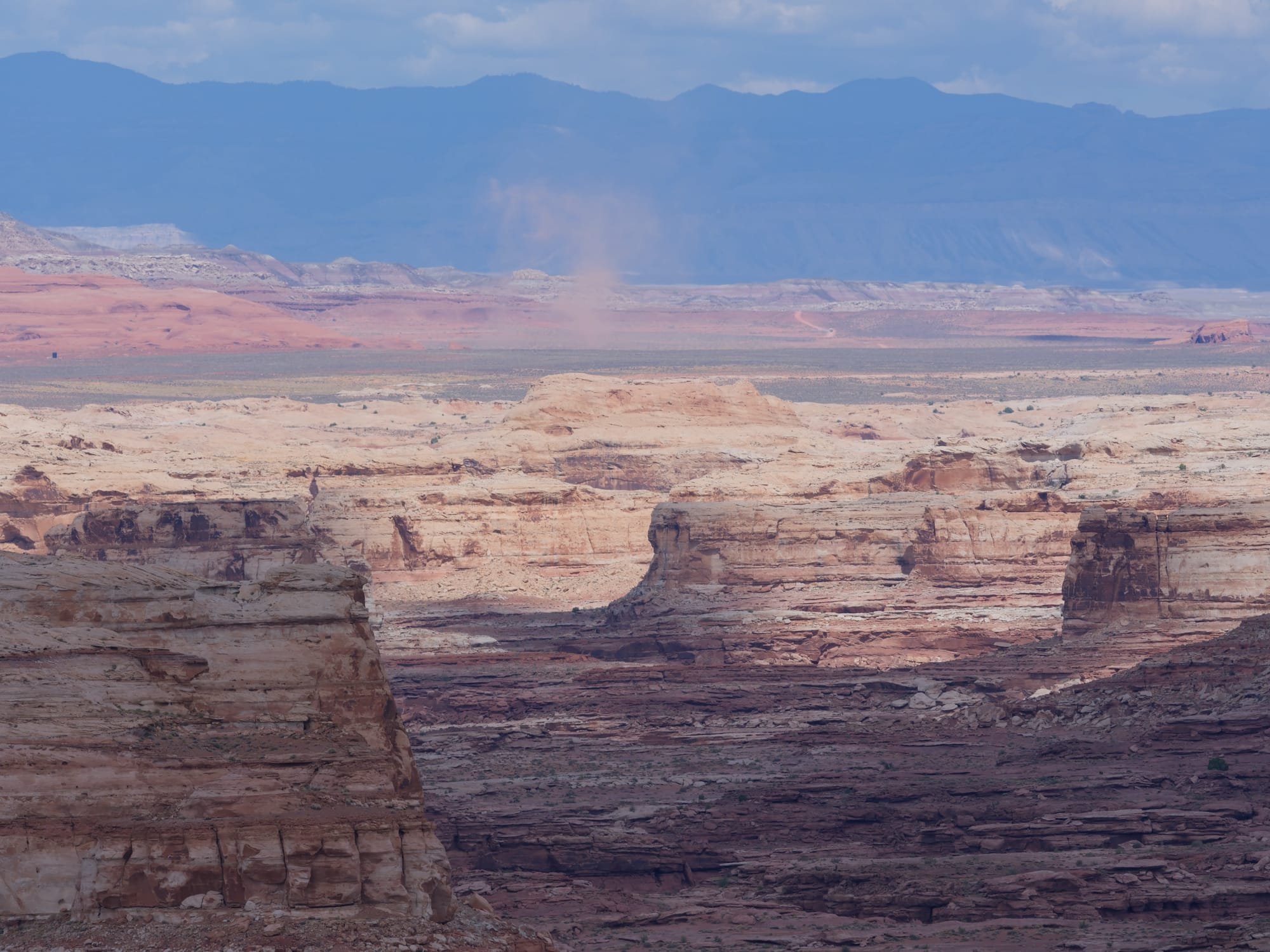
Red-bellied clouds and a distant dust devil.
In this remote corner of Canyonlands I found solitude and also a reminder the place remains dangerous for the unlucky, foolish, or unprepared. Assembled at the trailhead were at least four National Park Service vehicles followed by a host of civilian vehicles. From my remoteness they assembled kitted out with packs and some with walking sticks. One had a dog. A search and rescue team.
I thought perhaps I should hike the canyon when everyone had left. It would be cooler, and less crowded. I packed water and two headlights. There was a good chance the hike would end in the dark which I relished as night hikes, while tinged with extra risk, make for a unique experience.
I struck off directly from my camp across a small canyon and soon intersected the trail and made my way down the ‘mad cowboy road’. White chalk marks on the slickrock were indications of horses having been down and made it easier to path-find where tracks could not be found on the slickrock.
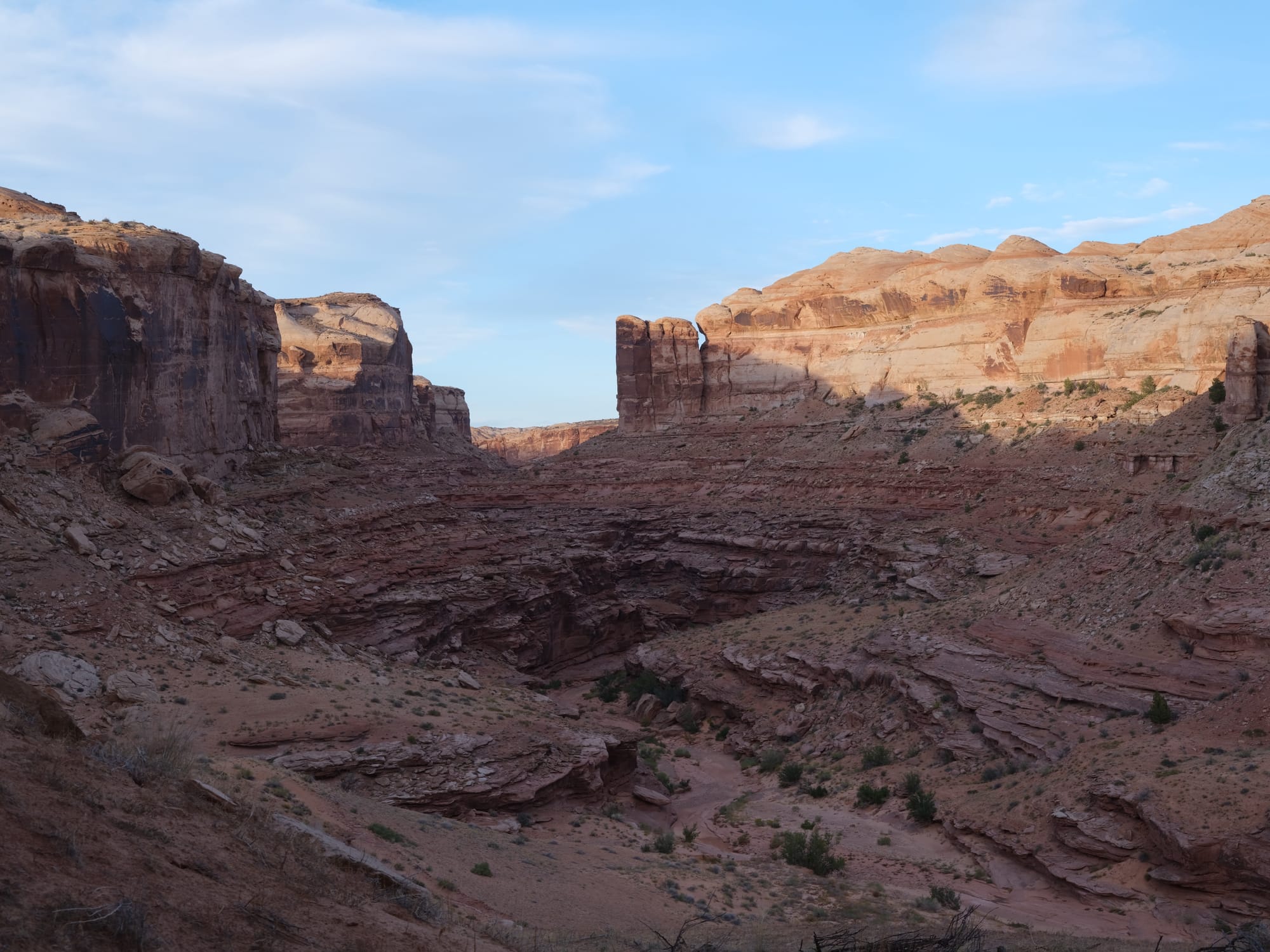
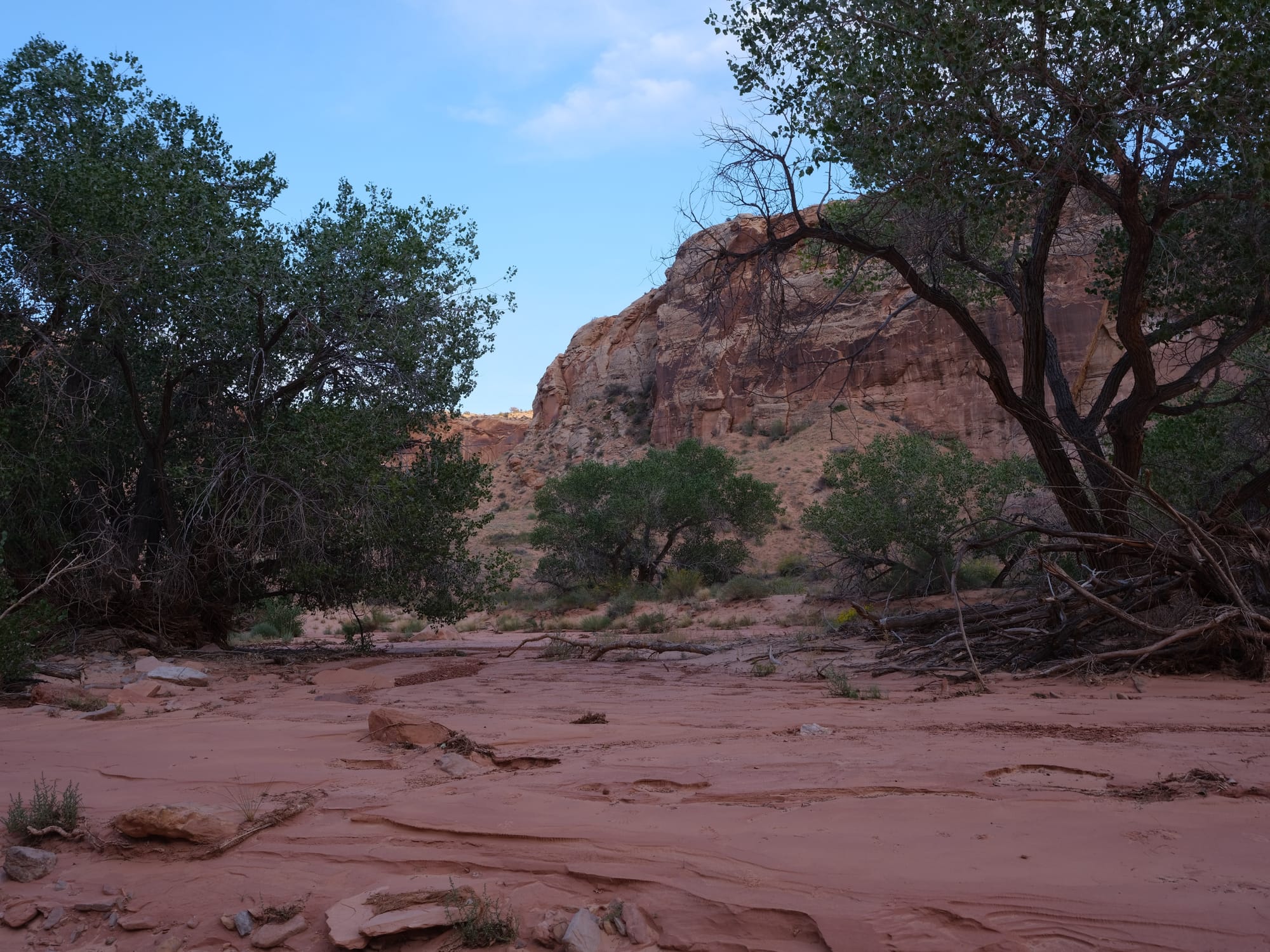
I was astounded at the scale of the canyon as seen from the bottom. From on top it was impossible to imagine the scale down here. A dry stream meandered through the sandy bottom dotted with Cottonwood trees still green in summer foliage. The hike out was spectacular.
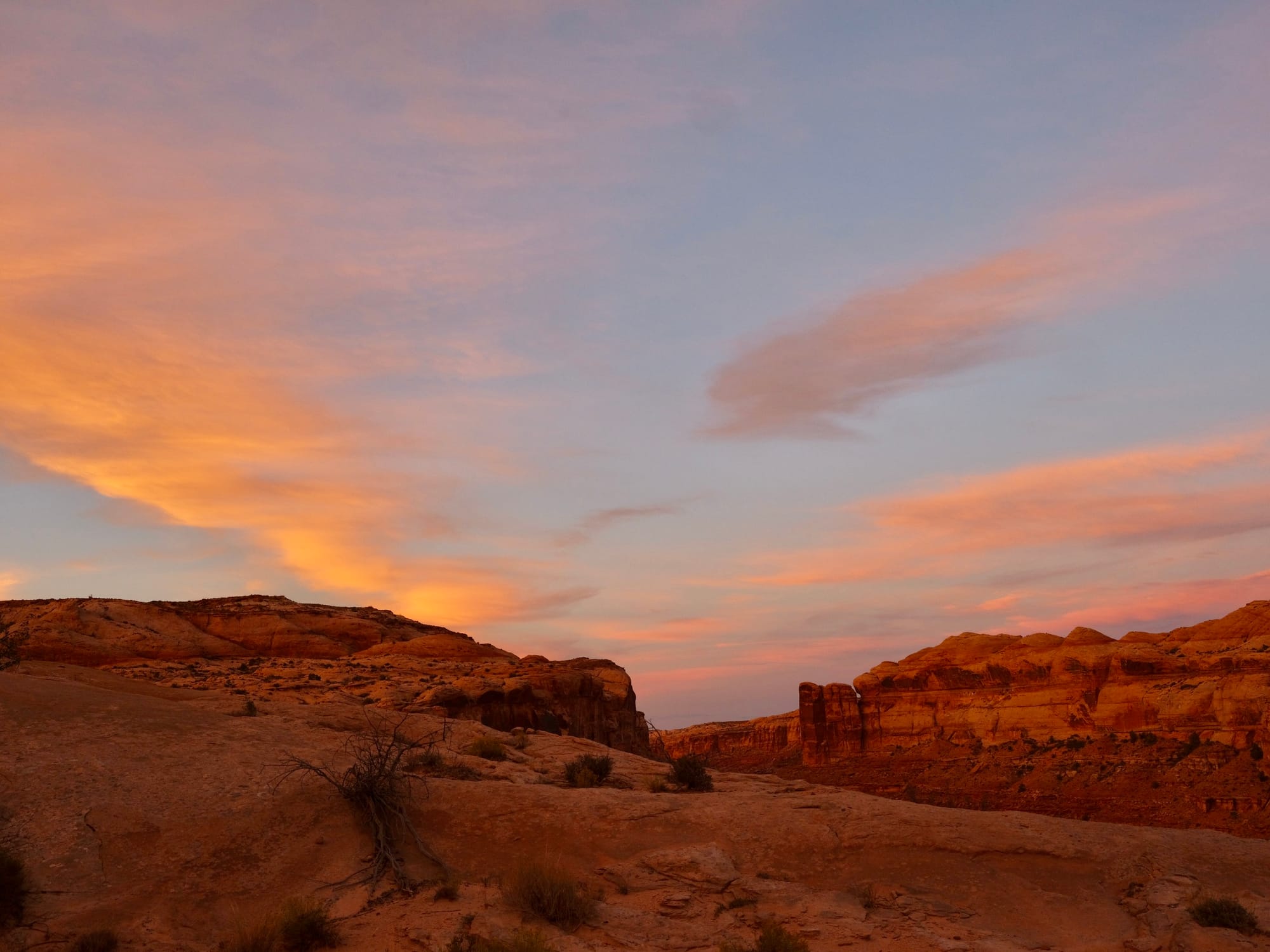
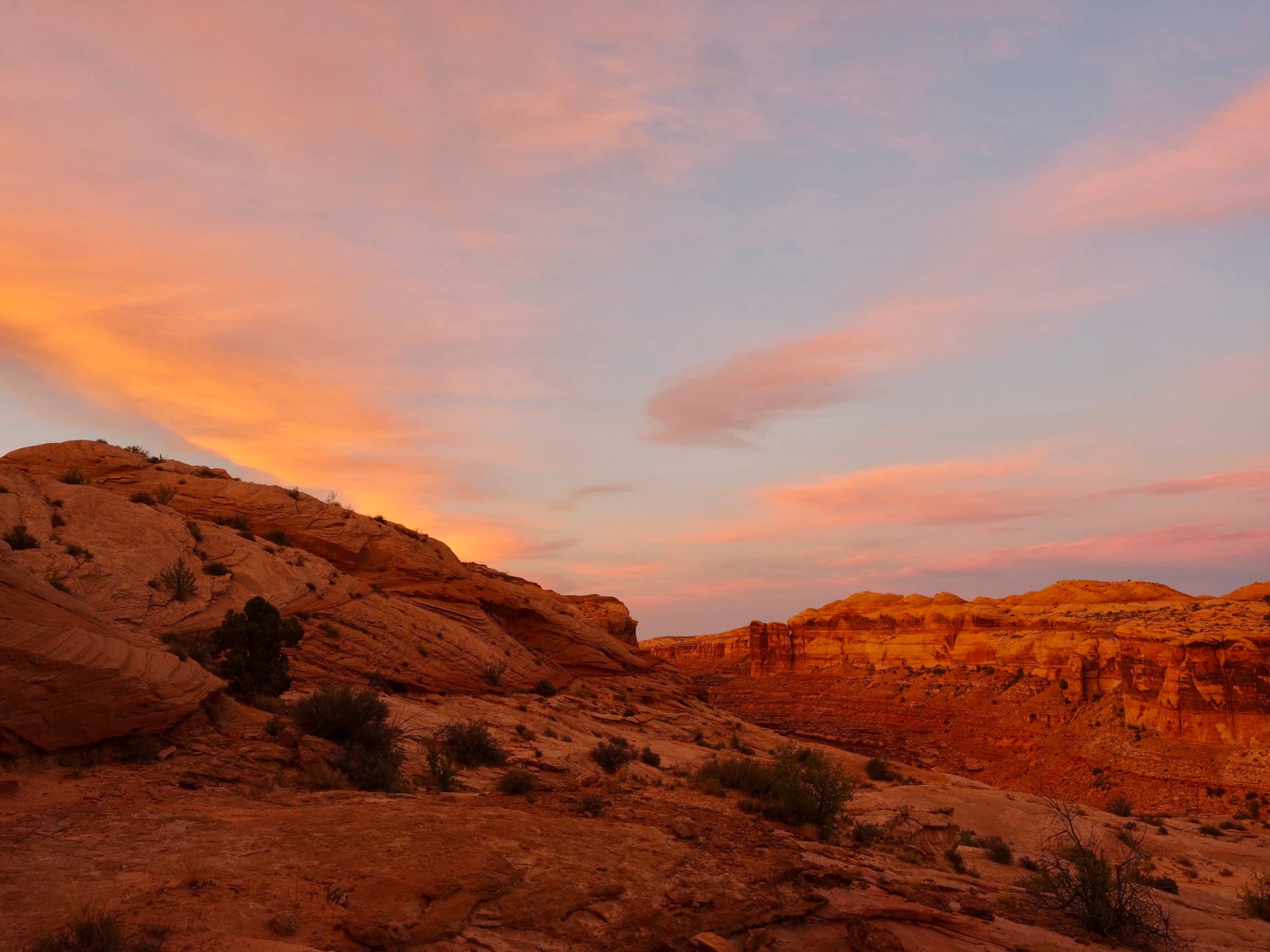
The next morning I walked over to speak with one of the Rangers. The subject they were looking for had been missing since late August. The car had been found at the trailhead. No sign of him. This was the second and probably final day of searching this week. This was a recovery effort as she man had been missing for over a month. The ranger said they had already extensively covered the canyon bottom and side canyons. This effort looked to be at least a dozen people both Park Service and volunteers working in pairs. Each pair were assigned a square on a map to walk across looking for footprints or other signs.
While we spoke a young woman Park Service employee returned from her first square up on the flatter canyon rim area adjacent to the trailhead. She and her partner were assigned another square and off they went. Colin the ranger at the top coordinated communications and checked in with each team periodically about status.
Writing this leads me to think of the lost gentleman and all these wonderful folk looking for him. Not to rescue him but to try and bring closure to his loved ones. I can only hope that when the end came for him it was peaceful, that he was out in country he loved.
We have this one life. And somewhere his bones will bleach under a desert sun like the Ancient Puebloans, Everett Ruess, Edward Abbey, and untold others before him. And this is all the physical testimony to our lives we can offer. And perhaps it is mawkish, macabre, or darkly romantic to imagine being lost to our world in that way; that this is a better ending than many of us are offered.
To leave a little mystery and a reminder that the world for all our mastery, is still bigger than us, that we may still lose ourselves, that we control little of what matters here on Earth.