A Place of Lesser Notice
Wells Nevada is one of those many interstate towns that did not survive the Interstate. A dilapidated downtown with plenty of boarded up old hotels. Everything new moved closer to the interstate and left whatever soul it had in the old part of town.
Wells is located, spectacularly, at the foot of the East Humboldt mountains. Still sporting patches of snow the rugged ramparts could be mistaken for the Alps except there were no lush green valleys below. Just dry rocky sagebrush.
Mollie and I had lunch and a short walk at the city park. It was nicely kept, sitting next to the high school and Mormon church. I bought some groceries at Roys, topped up the gas tank and the water tank before we headed down the interstate towards Elko.
Elko has done better for itself and seemed a small prosperous town. From here we headed north to an area I hoped would provide for some more scenic and quiet camping.
This is Humboldt River country and the highway hugs the valley. The river such as it is, not unexpectedly, is harnessed to the provision of hay and alfalfa for the local cattle industry. It is sagebrush on the hills above the valley with some craggy dark rock exposed. When visiting these places it is helpful to imagine what once used to be– marshes along the river meander and a stopover for the Pacific Flyway. Now it is shorn green grass, cattle, barbed wire, and no trespassing signs.
Up ahead is Wild Horse Lake State Park which I stupidly assumed meant there would be wild horses. Instead we have a half-full reservoir, the dry end of which (typically) seems to belong to a Paiute Indian reservation. The dam itself at the other end was built by the Bureau of Indian Affairs (the BIA or Boss Indians Around).
Generally, my advice is to avoid lake campgrounds and especially reservoir campgrounds like the proverbial plague. The boating crowd is not so interested in peace and quiet in my experience. Mollie and I press on, though I can tell she is tired of the driving. She loves the arriving but none of the rest of it.
We depart the pavement and head into the heart of ranching country which means it is mostly public land and hopefully ample places for dispersed camping.
Dispersed camping takes some getting used to. You never know if you will find anything, nor what it will be like. Open range land means lots of places though few that are level.
We pull off the main gravel road and I get out to open the barbed wire gate. The wind drives into the vehicle a unique smell. It smells, not unpleasantly, like cigars or cigar smoke. That measure where it starts to smell good before it becomes overwhelming. Part of it is the smell of sage but something else deeper and richer.
As I drag the gate shut I notice another gate on the adjacent fenced rangeland. There is a padlock on it and a private property no trespassing sign. The maps make it clear this is the boundary between National Forest and BLM land. Some local is restricting access.
Immediately the road crosses hard packed arid grass and sage land; uncounted black cows with their calves. Great. Now I have to keep Mollie leashed up. It is the end of June and yet the grassland already looks thin and used up, like the skin of an old man.
We cross this unpromising stretch, pass through another gate and I spot a couple of Long-billed Curlew I have frightened up. No time to get a camera out before they disappear.
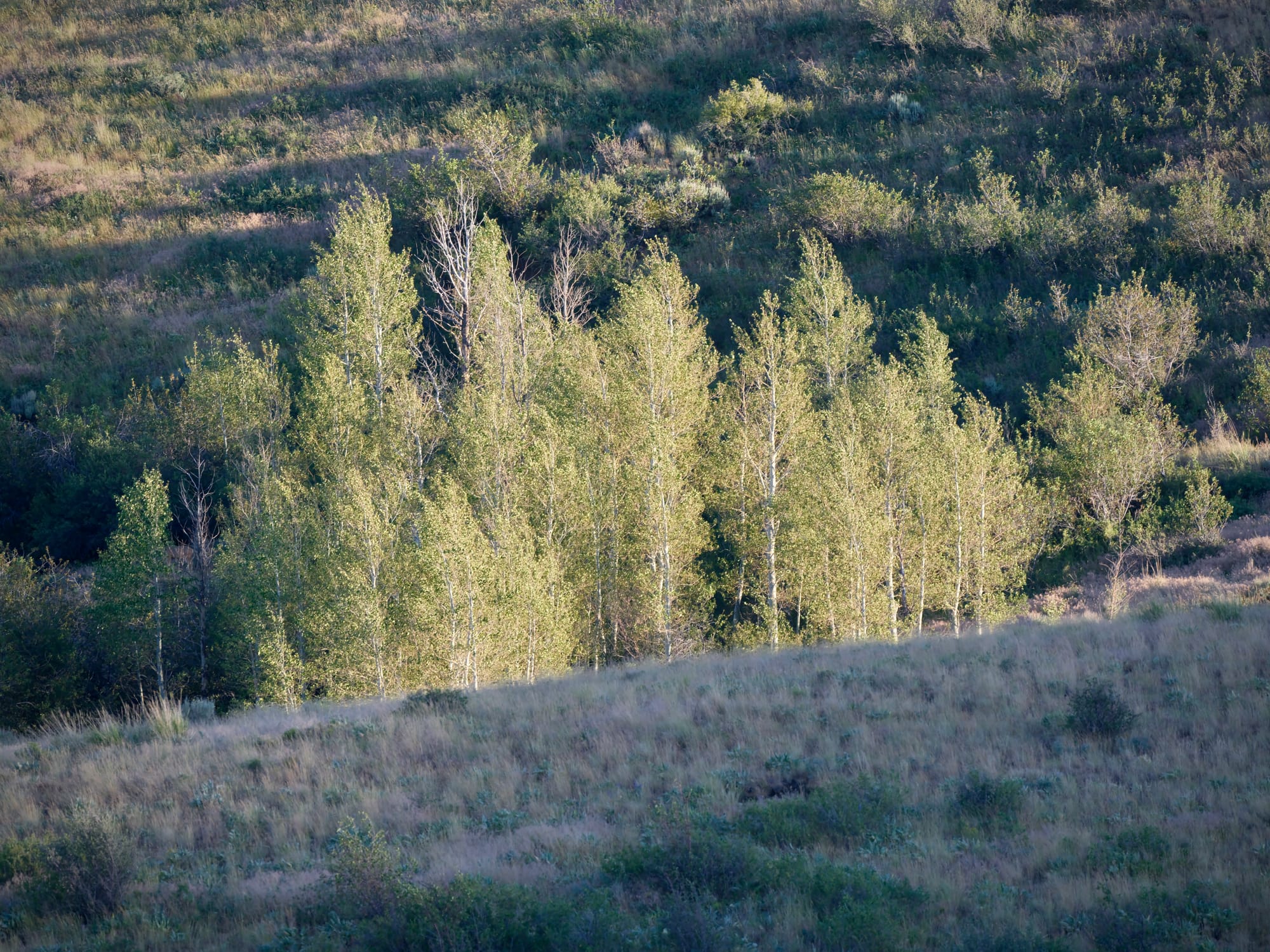
Up ahead it begins to look more promising with groves of aspen and willow. We scout the steep downhill before committing the trailer then arrive at another gate. This time Sage Grouse burst forth and scatter upland of us.
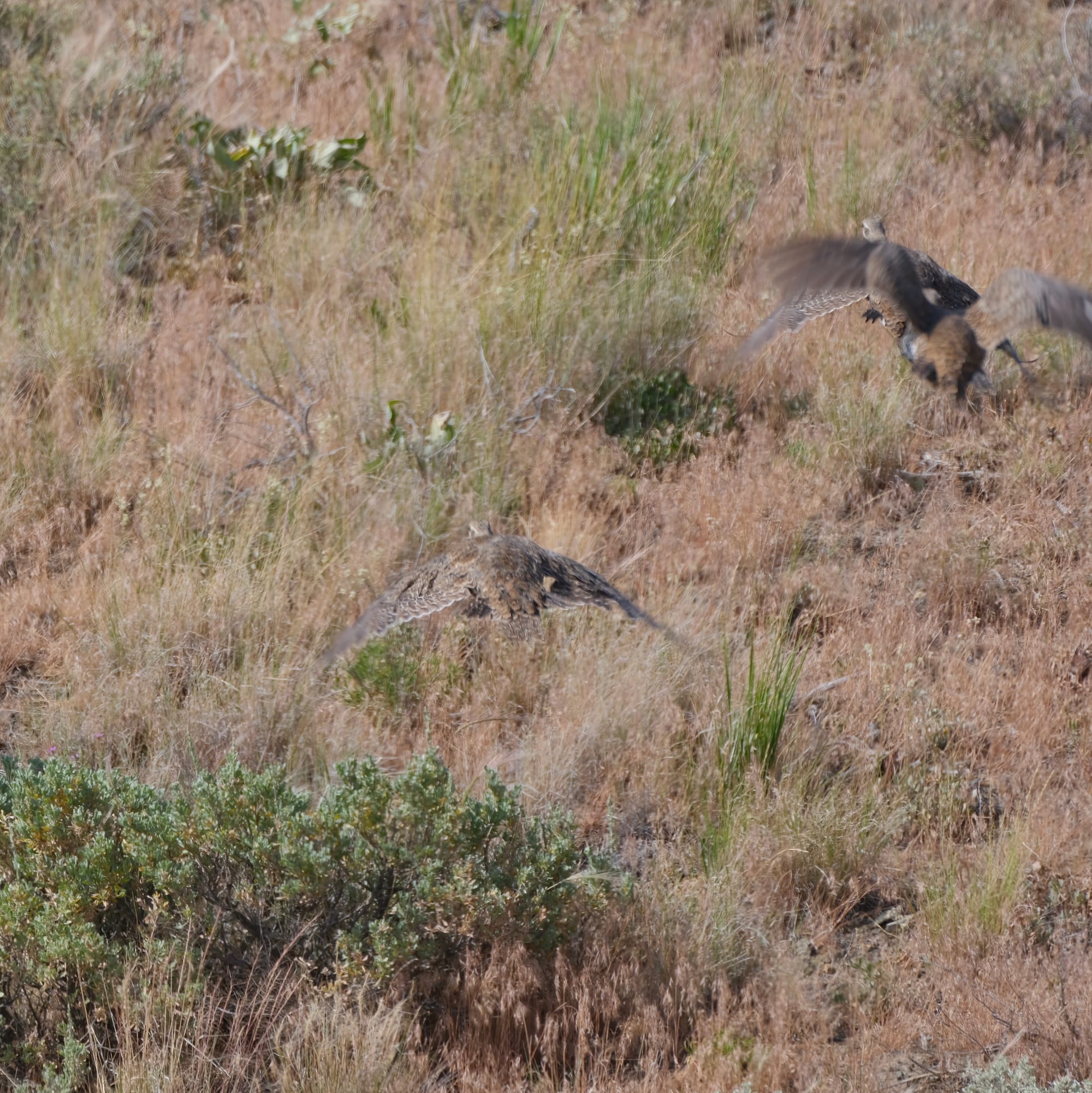
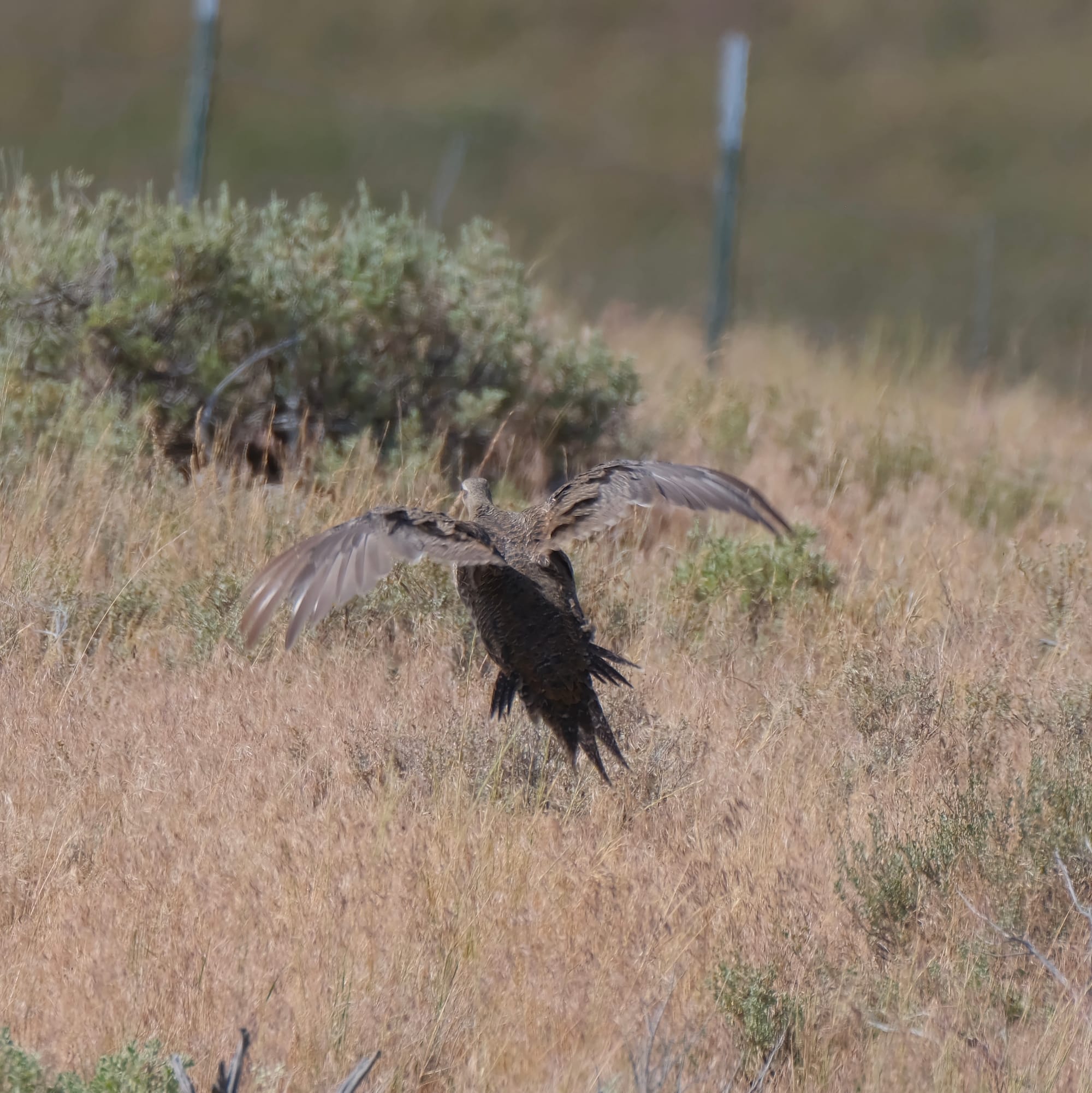
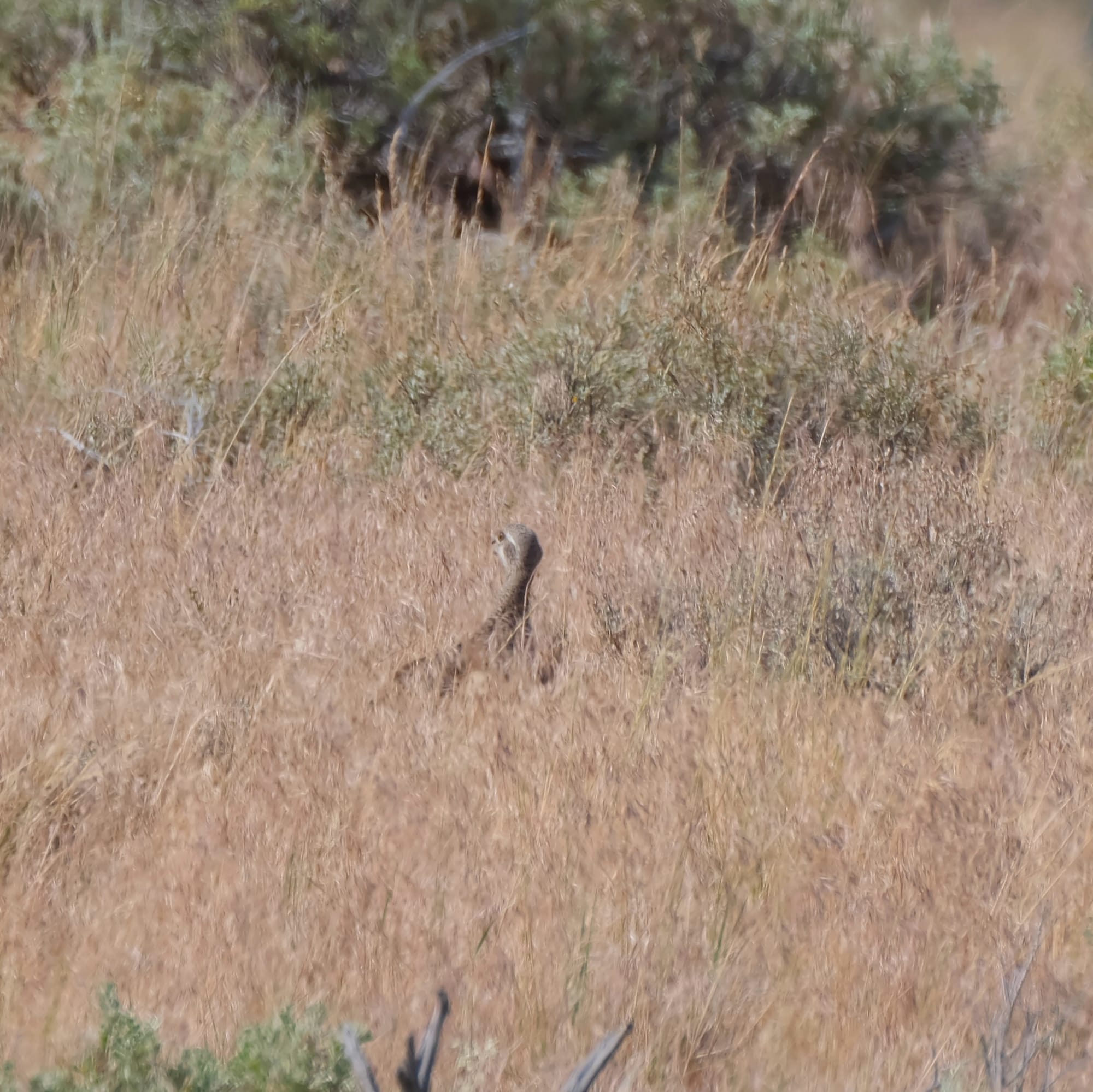
Sage Grouse flushed into the air.
We cross the gate and wind through cow plagued greenery where a small stream or some springs manage to keep everything verdant in the bottom of the canyon. Immediately we see deer, lots of rodents like chipmunks and ground squirrels. This little wet patch has a great density of wildlife in addition to the bovine residents.
We trundle up the canyon on the narrow dirt road. I am nervous towing a trailer, nervous about getting into a situation where I would be forced to reverse for a mile or more. My reversing skills mean this could take all day I fear.
In the end fatigue and a piece of flat ground conspire to call it a day. We are at a place of no consequence again. Like the last no place, it is beautiful; and no sign of anyone else.
I keep Mollie on lead while I try and assess the ground for rattlesnakes. Eventually it seems too high and hot so off she goes after the rodents.
Today, where I am sitting now there is a lot of raptor activity. Two nights ago we startled a couple of owls during a walk two nights ago. They sat so close to the road we were walking, it was astonishing to see first one then the next take flight and flee from us, the dog having startled them. Standing there as if deaf, there is no thunder of wings like the grouse. There is just motion.
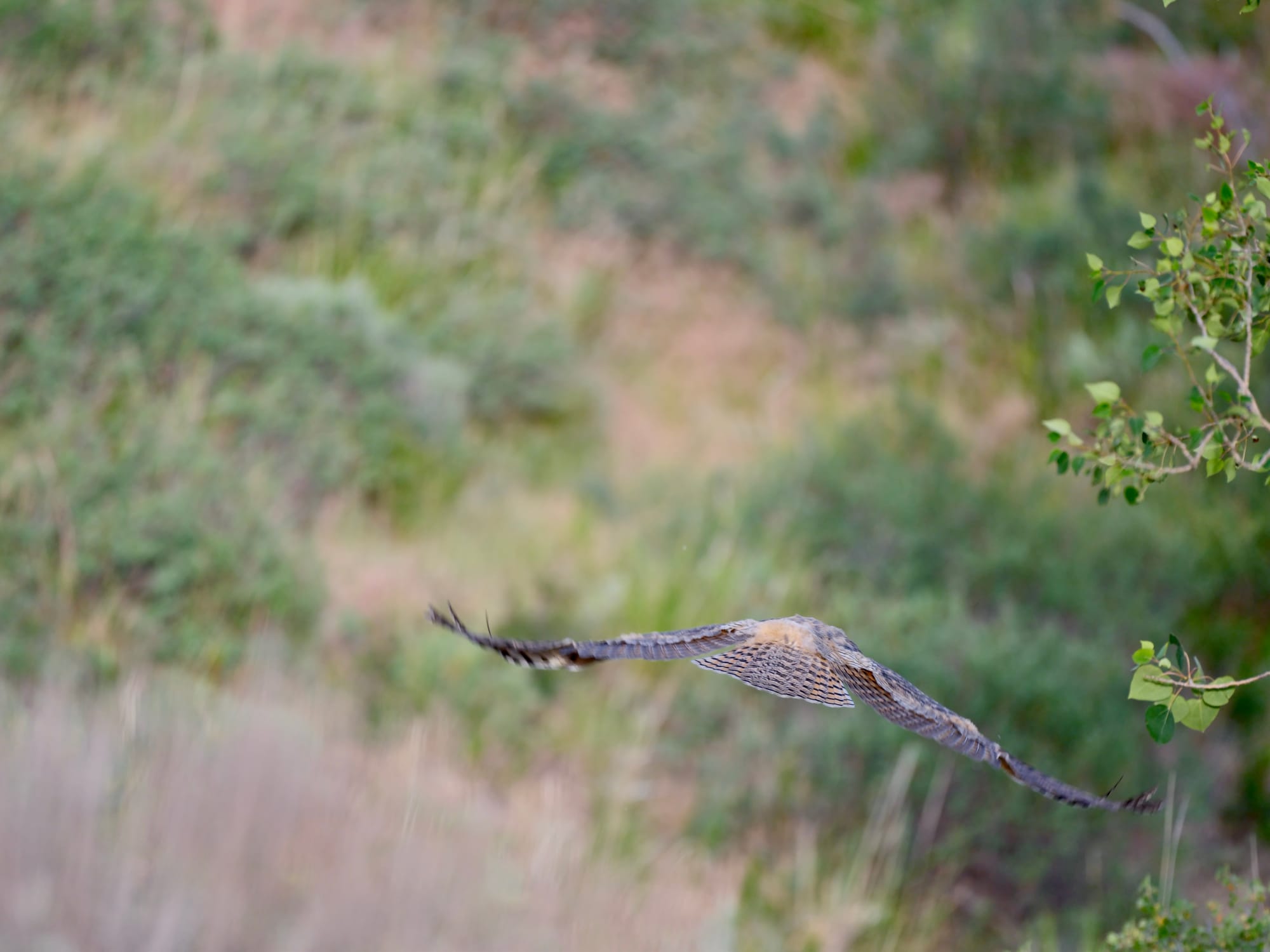
As so often happens with birds, one is unaware of their presence until they move or make a sound. I managed to photograph of one of the fleeing owls. I tried to watch where they flew to but as it would happen the activity also startled some deer below us and my poor brain became befuddled with so much movement to track.
One did fly again a little later and I was able to follow it with my eye until it perched in a small aspen tree. Creeping closer I could photograph it and found it to be a young Great Horned Owl, the other likely being a parent.
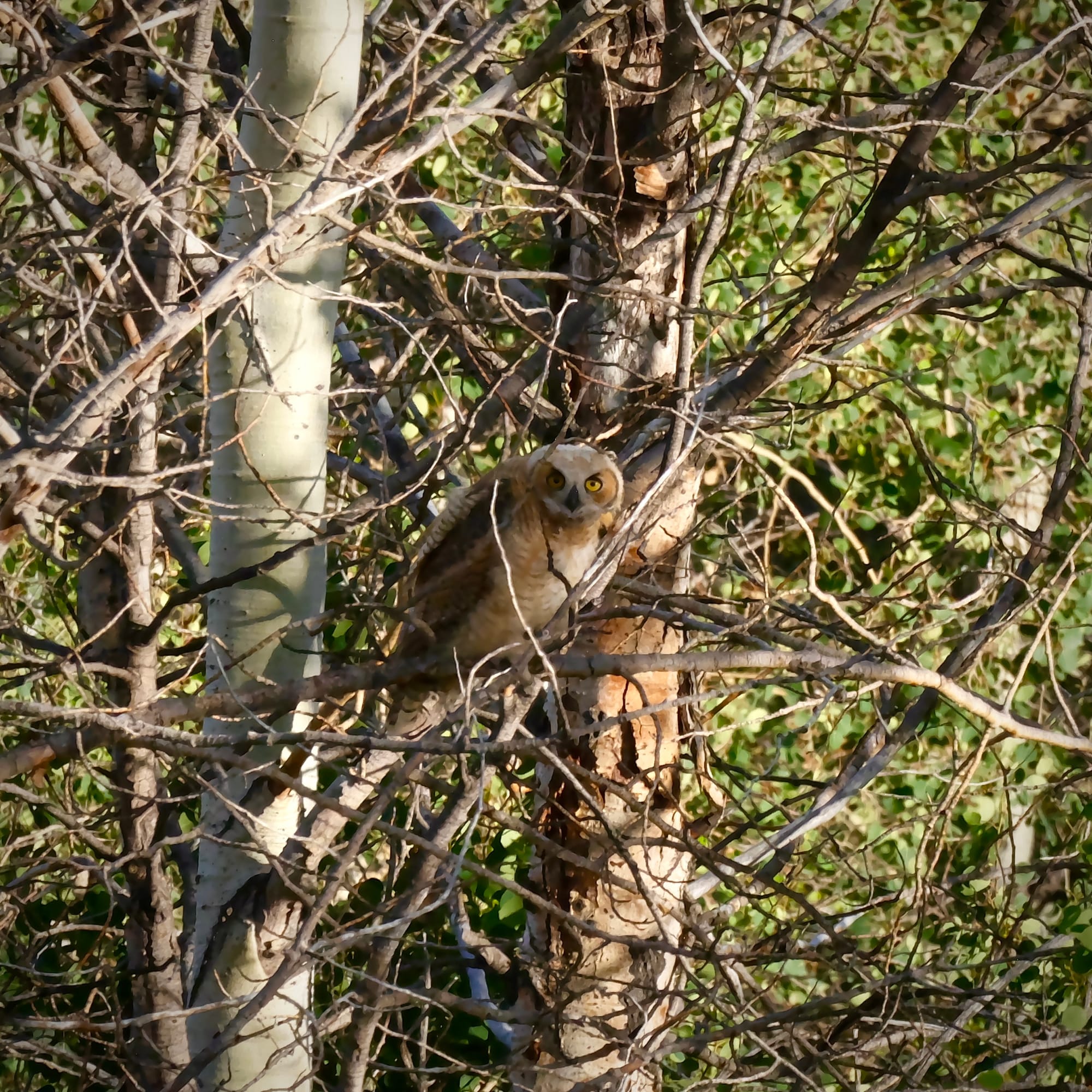
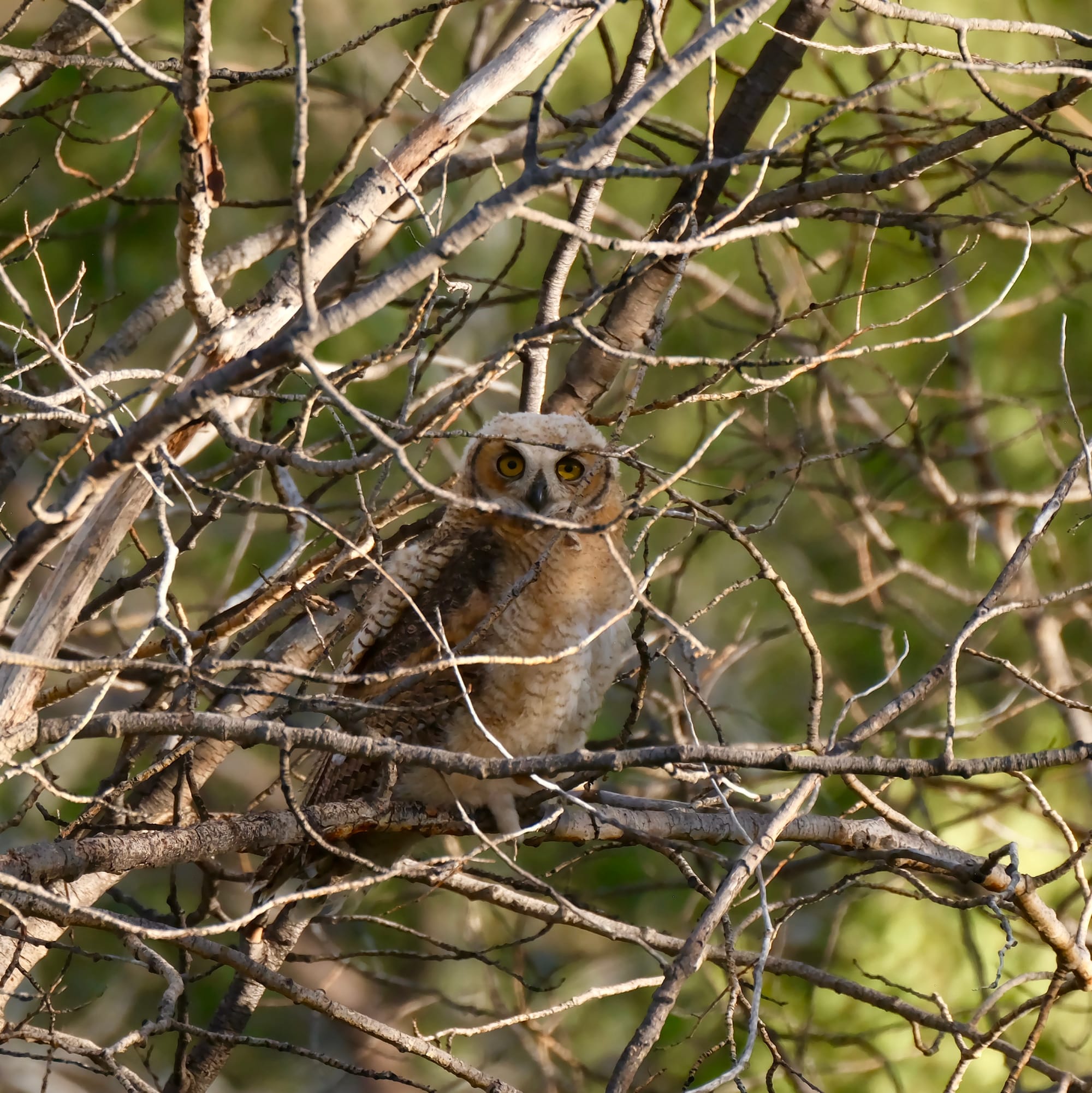
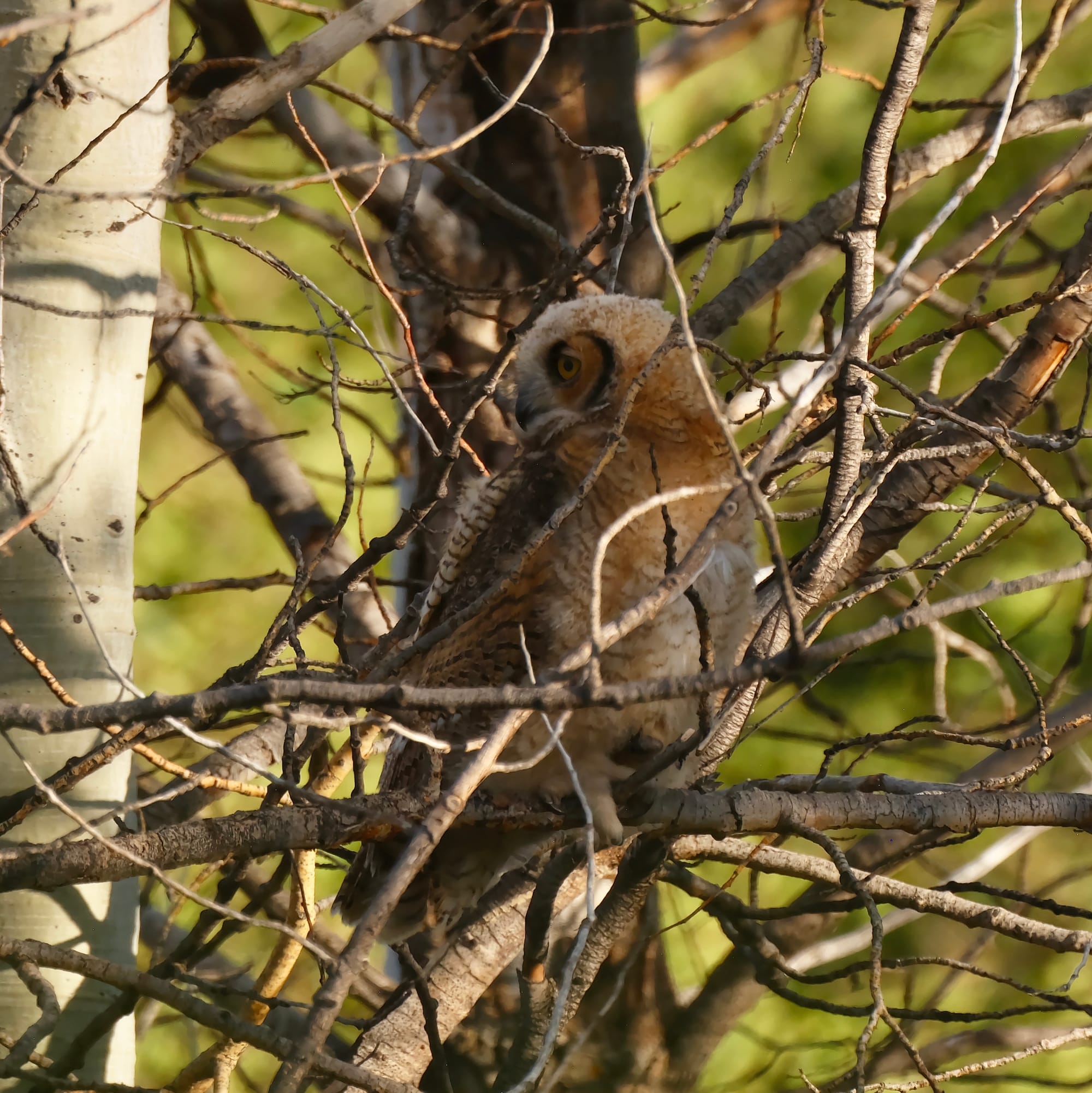
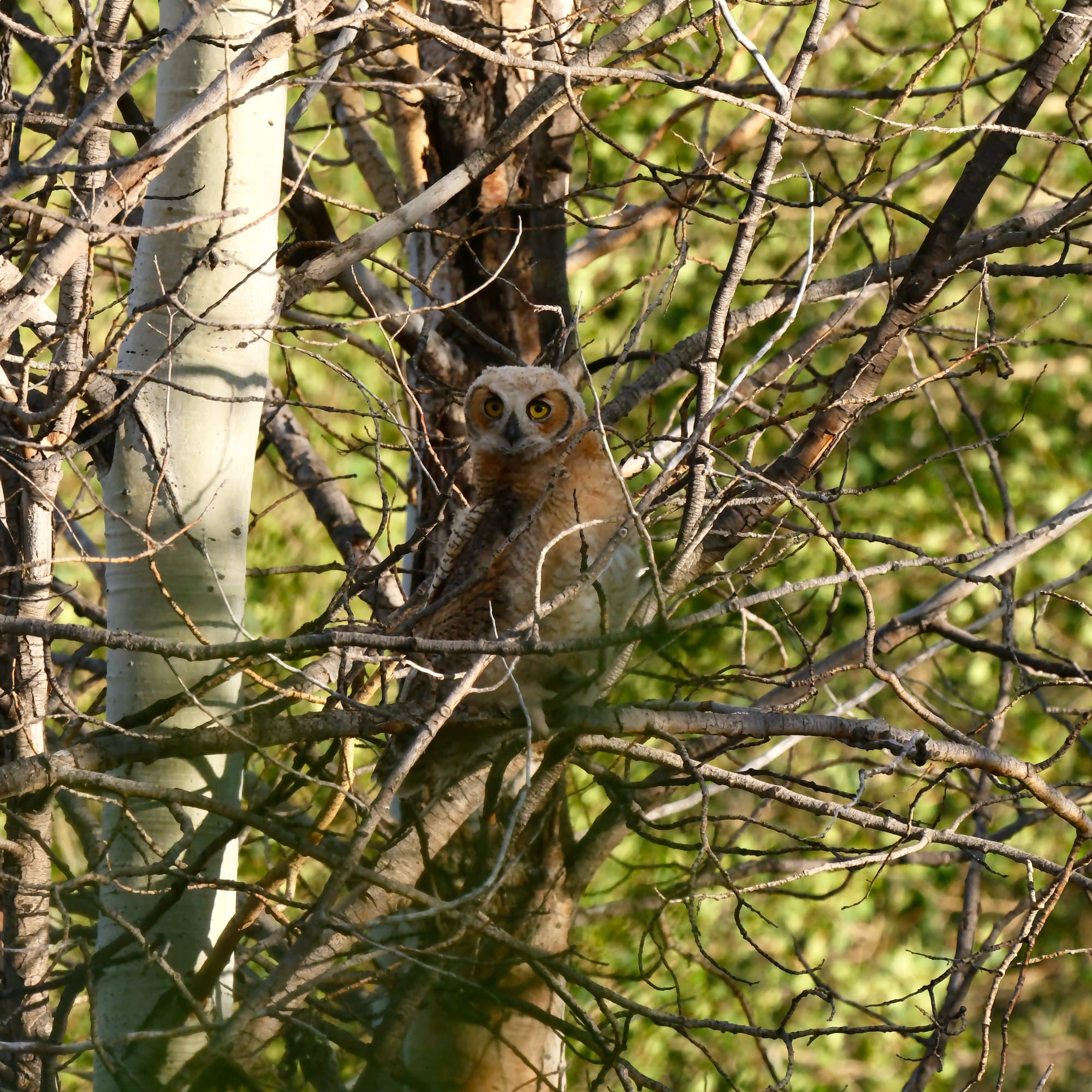
Young Owl
Additionally there are a number of hawks, Red Tailed and I believe Swainson’s though whatever species you think a hawk to be it is most likely a red-tailed (such is the state of my ability to identify birds).
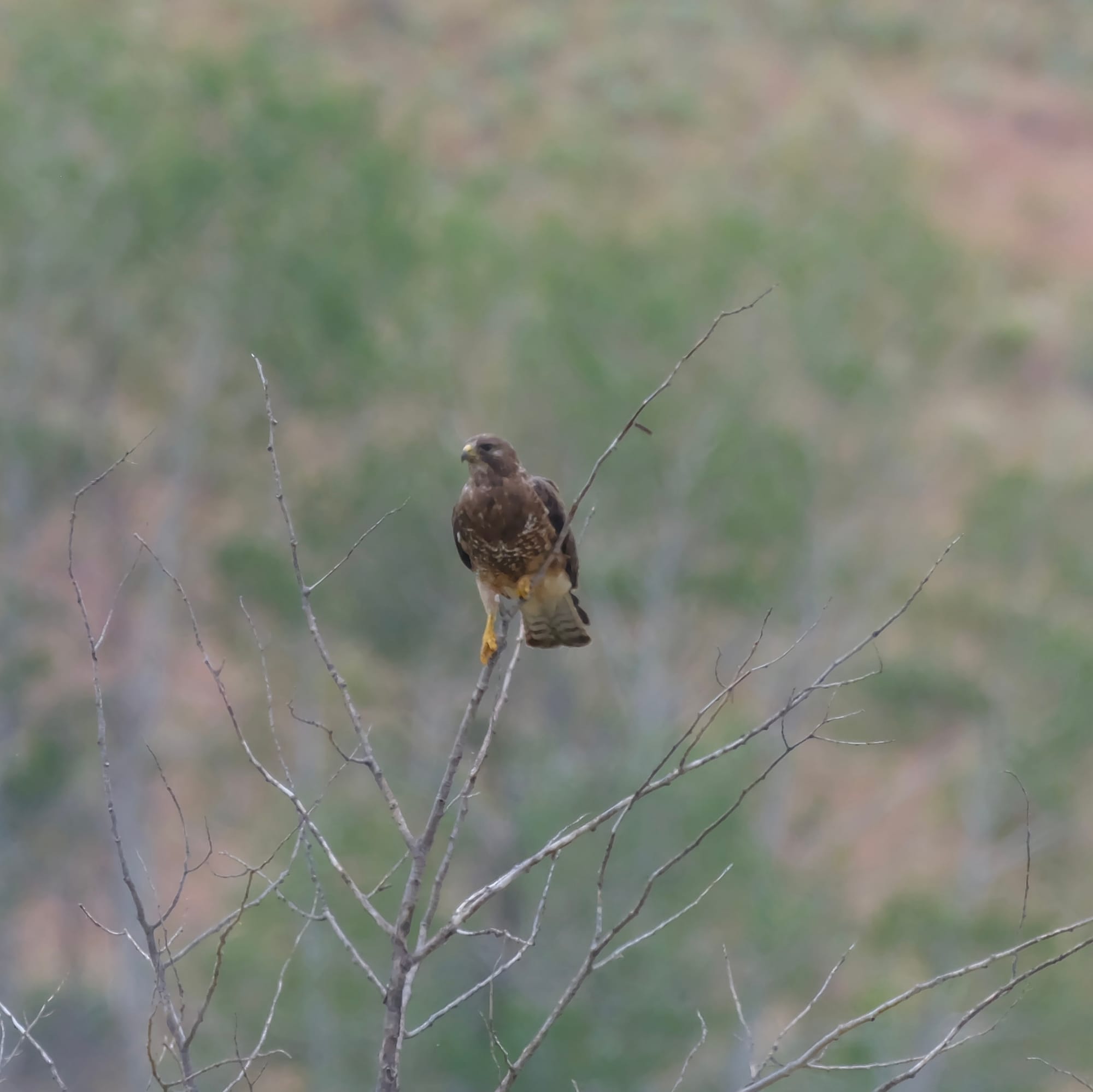
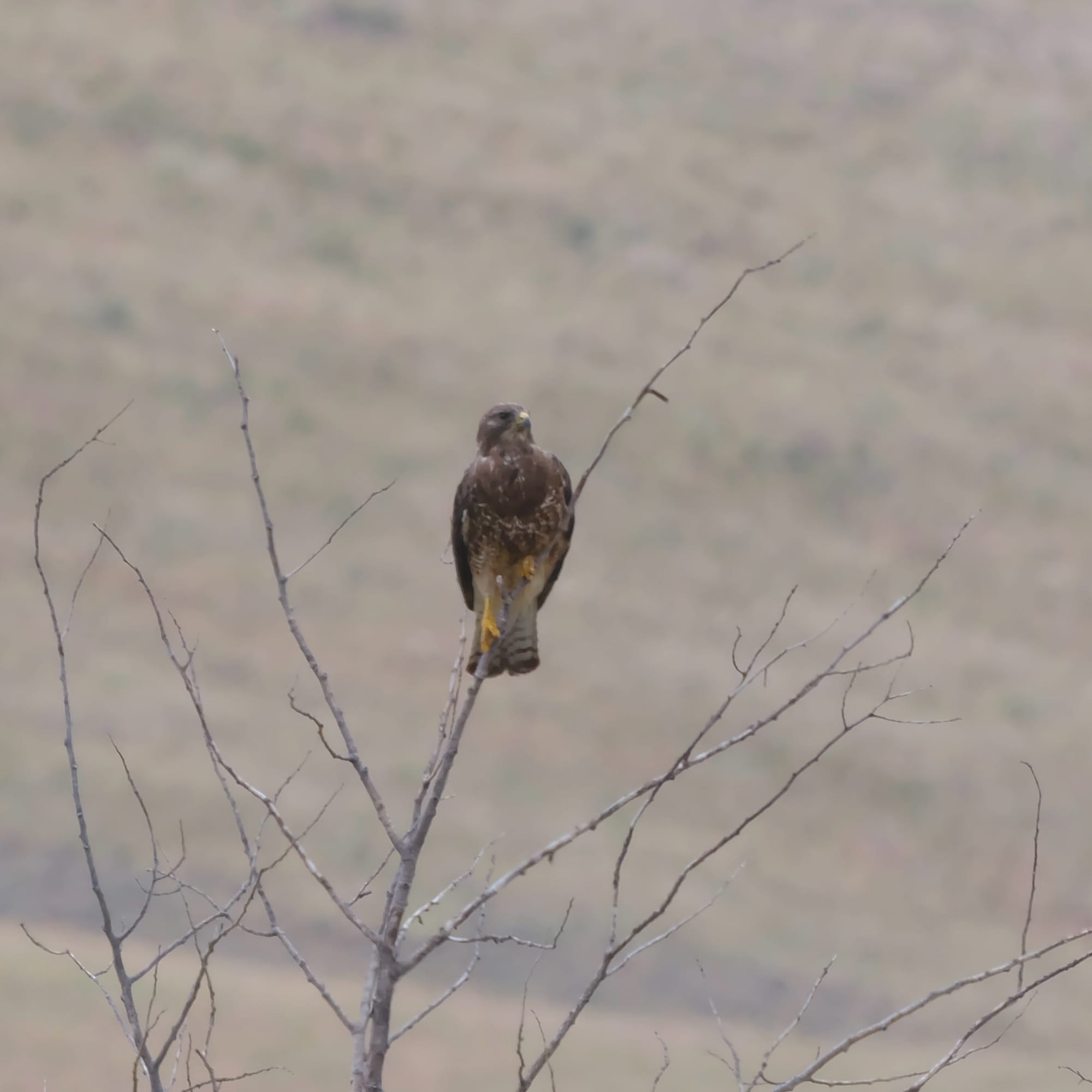
Swainson’s Hawk parent.
On our walk yesterday we saw a Swainson’s perched on a dead branch on a hillside. We approached and I photographed it at a distance. As we doubled back above an Aspen grove I found a nest high up in one of the aspens. Looking through the telephoto lens showed two nestlings eyeing me at least as intently as I was eyeing them. The parent sat unconcerned a few hundred yards away. After a couple of photos we moved along, keen not to disturb them any further.
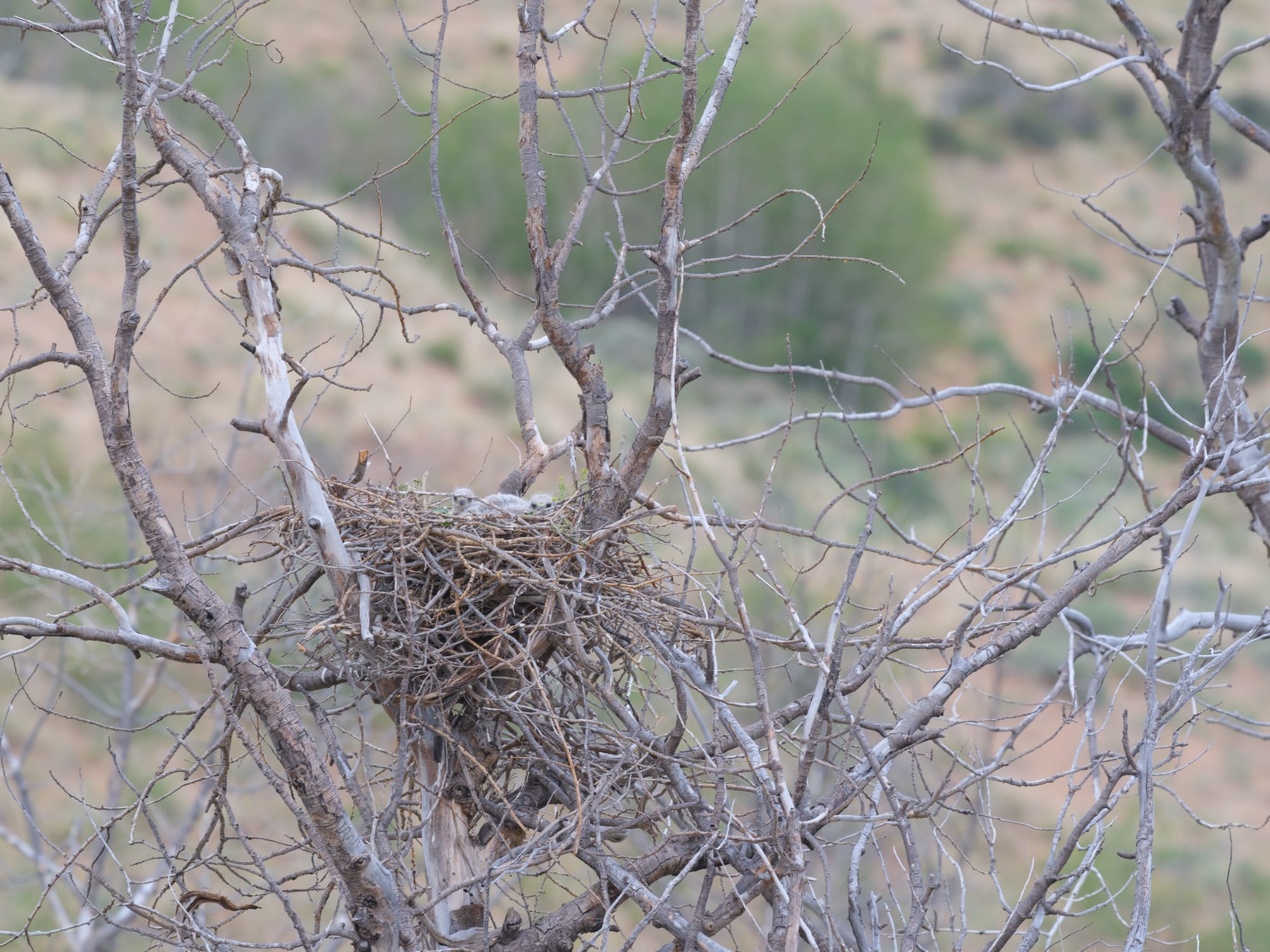
Young Hawks.
The next day I looked and saw both parents perched near each other on the same ridge as I had seen the other the day before. Soon one took off to look for food.
There are many birds of prey about. A lone red-tailed hawk sits near a nest with no occupants then moves further away in an aspen tree. It wasn’t until I saw another that I realized this was likely a young one. The parent kept delivering food and what I assumed was behavior to encourage the other to hunt. The adult even clashed with the young one on its perch the purpose of which I cannot discern. Perhaps to deliver some food or to get it to move and get out on its own. I don’t know as I lack a hawk's mind.
There were also some turkey vultures and the day warmed and the red-tailed hawks chased them away.
Mollie is half terrier and half cocker spaniel and you can see each of their respective instincts in her. When rodents are about she is chasing and digging. If there are grassy fields she is casting and jumping until she scares some large game bird.
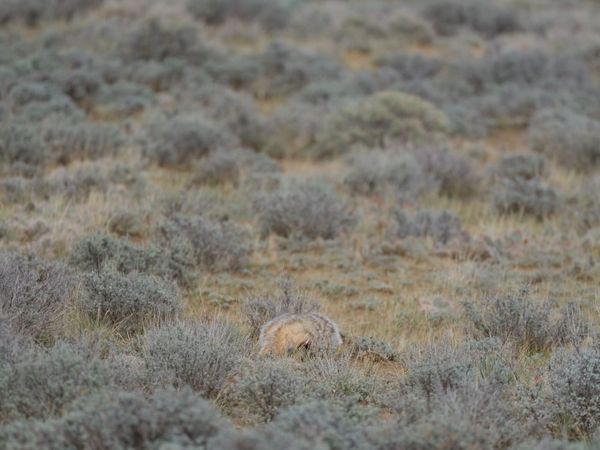
In Britain it was pheasants. Here I spied two Sage Grouse and managed a couple of photos just as I was beginning to wonder where Mollie was. Then she burst out of the tall grass and sent four birds scattering over the grass and sage. She chased a pair as they winged away and when she found where they landed eight more sprung up from the grass. They are great big birds almost the size of a turkey. Look carefully and you might see a head periscoping above the tall grass. They are magnificent.
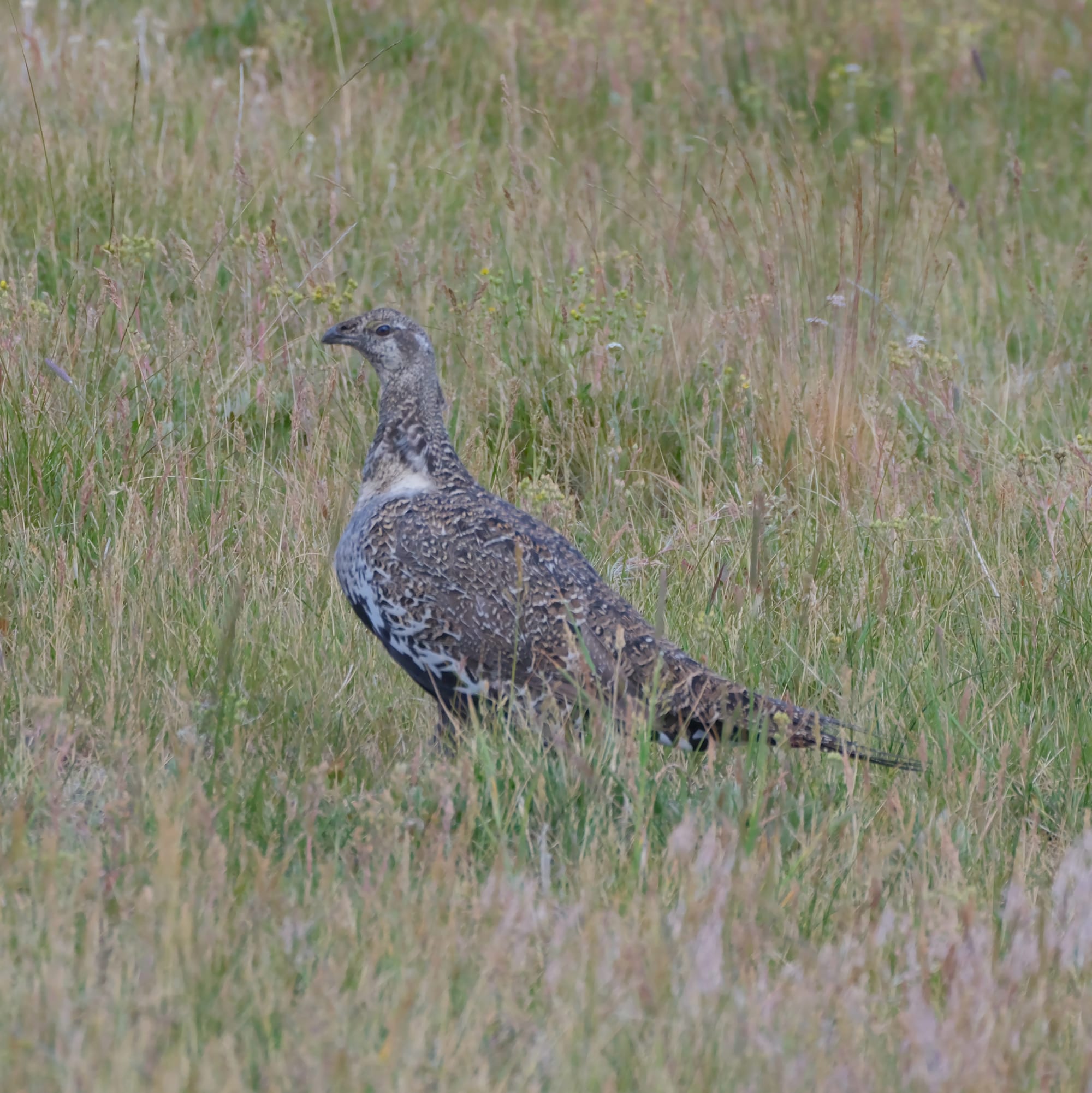
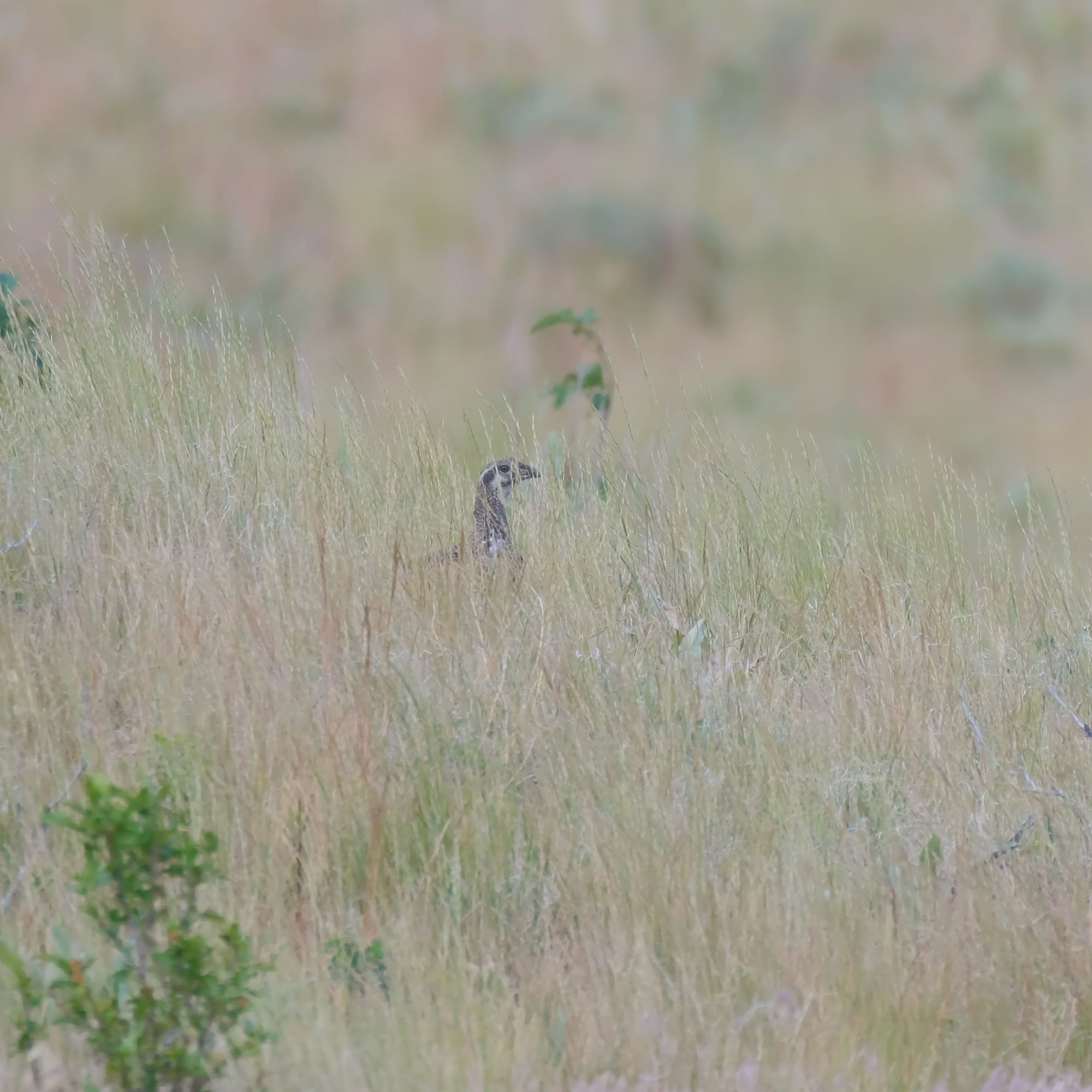
Sage Grouse one gives us the periscope look after a chase.
On the ridge above camp there were Lewis’s Woodpeckers sitting on branches alongside robins, both would pounce on bugs and flyback across the canyon to bring the food to nestlings.
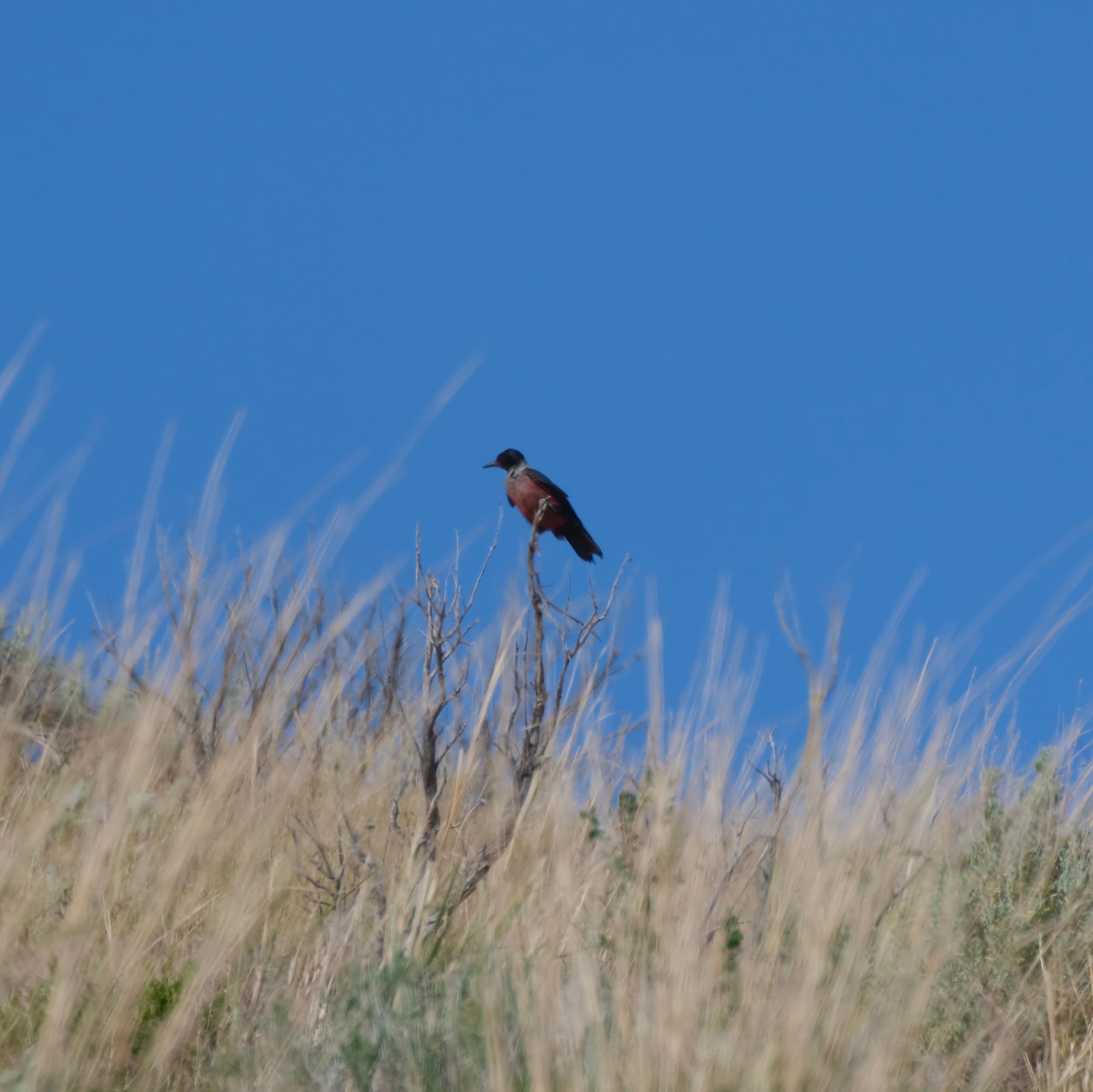
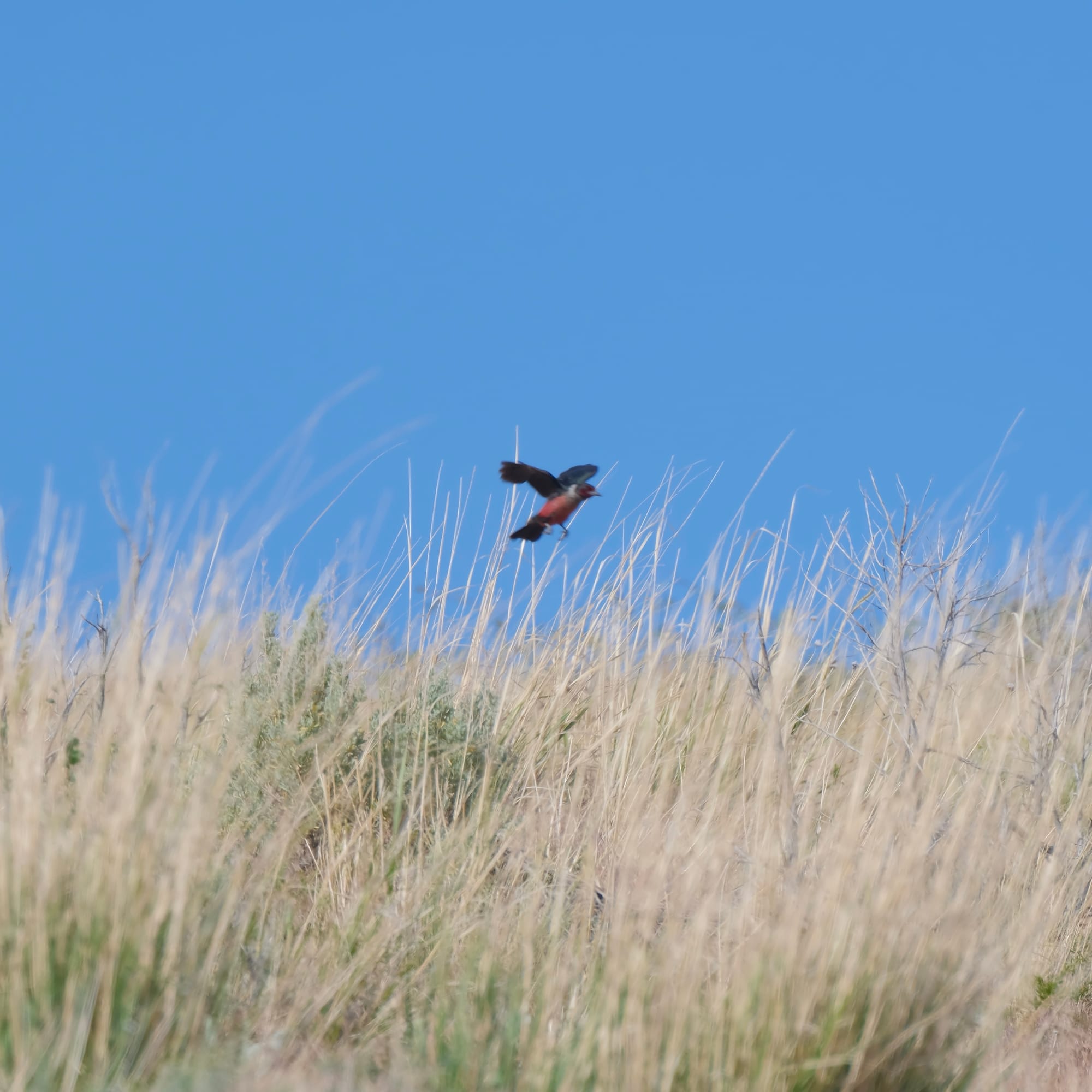
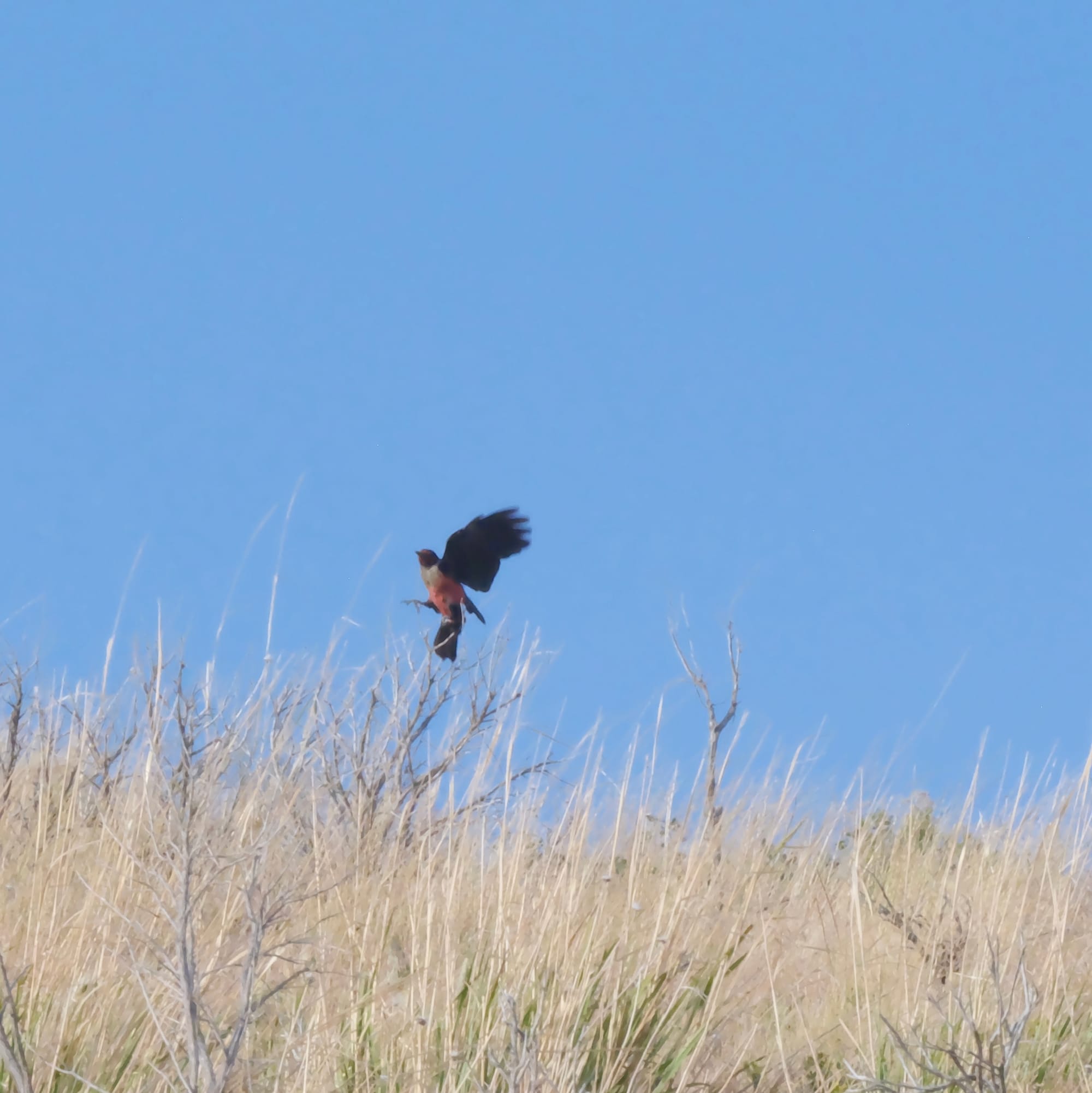
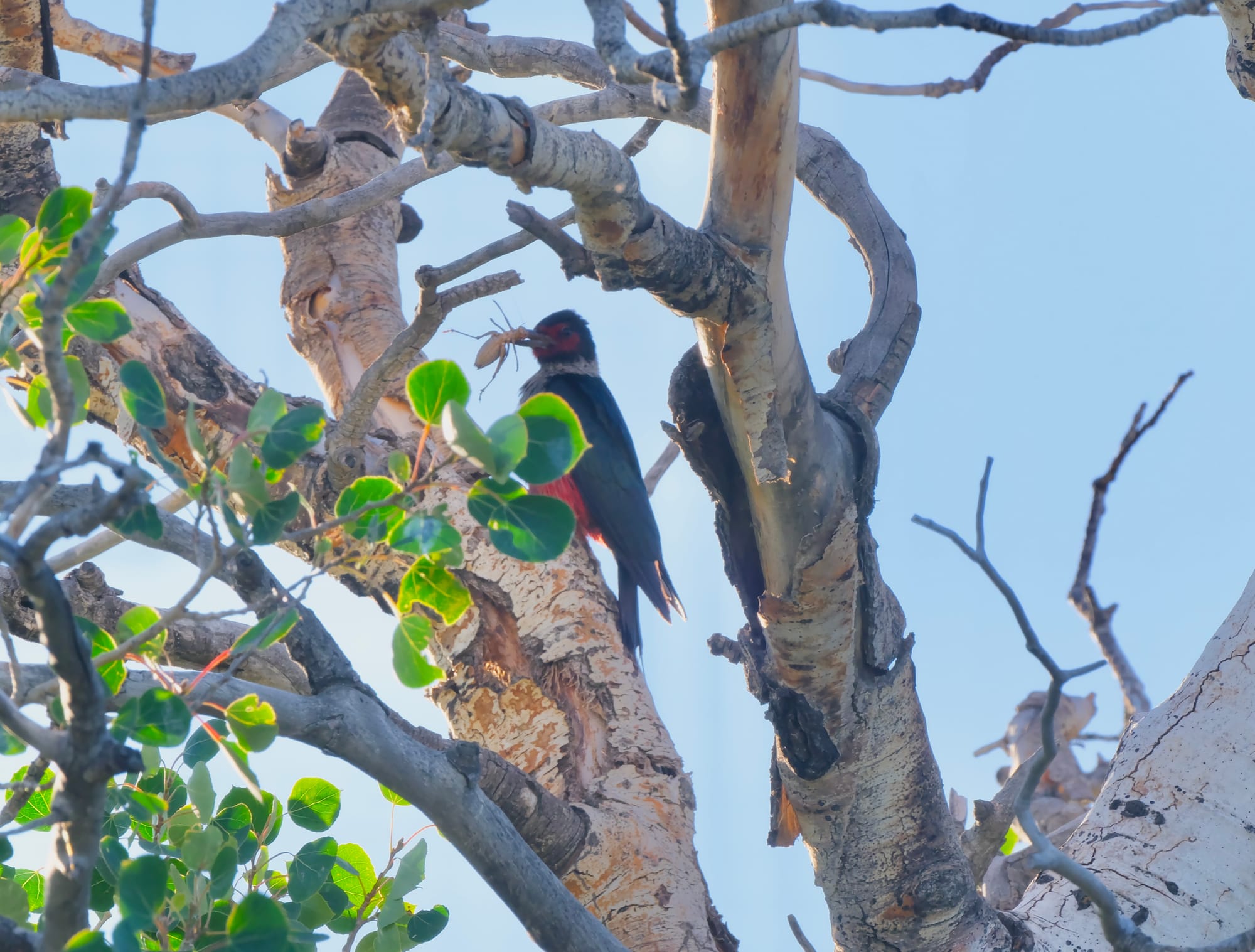
Lewis’ Woodpecker on the hunt and finally the prey!
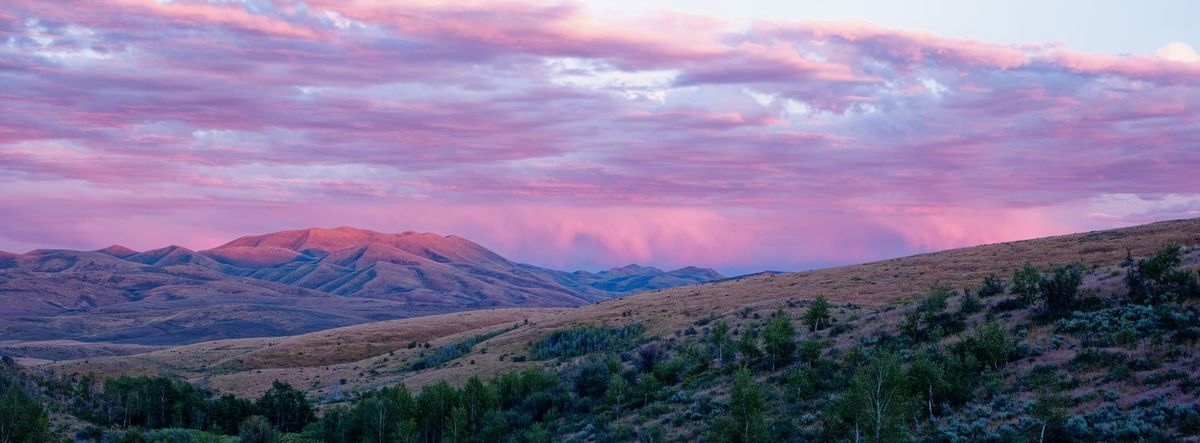
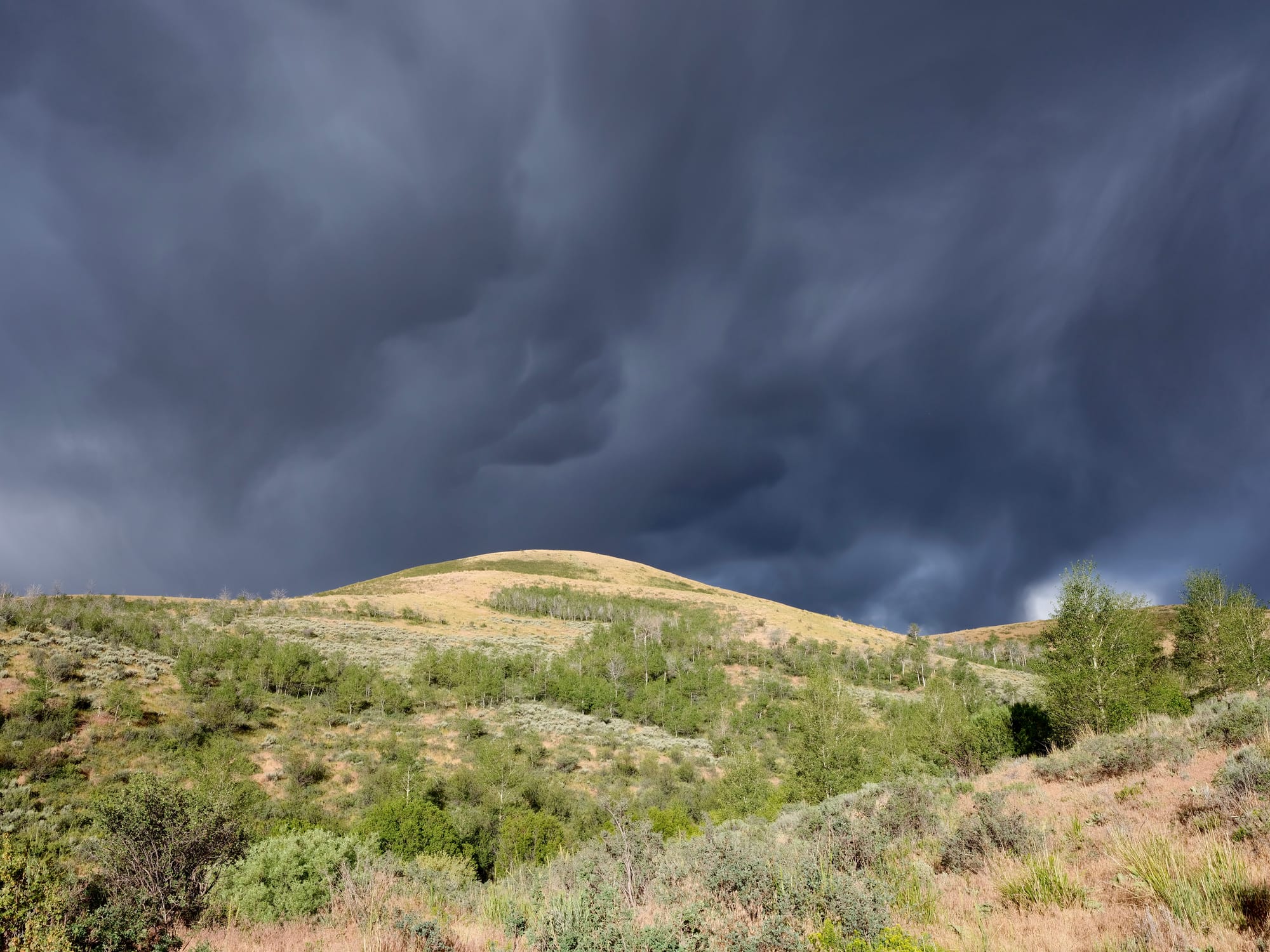
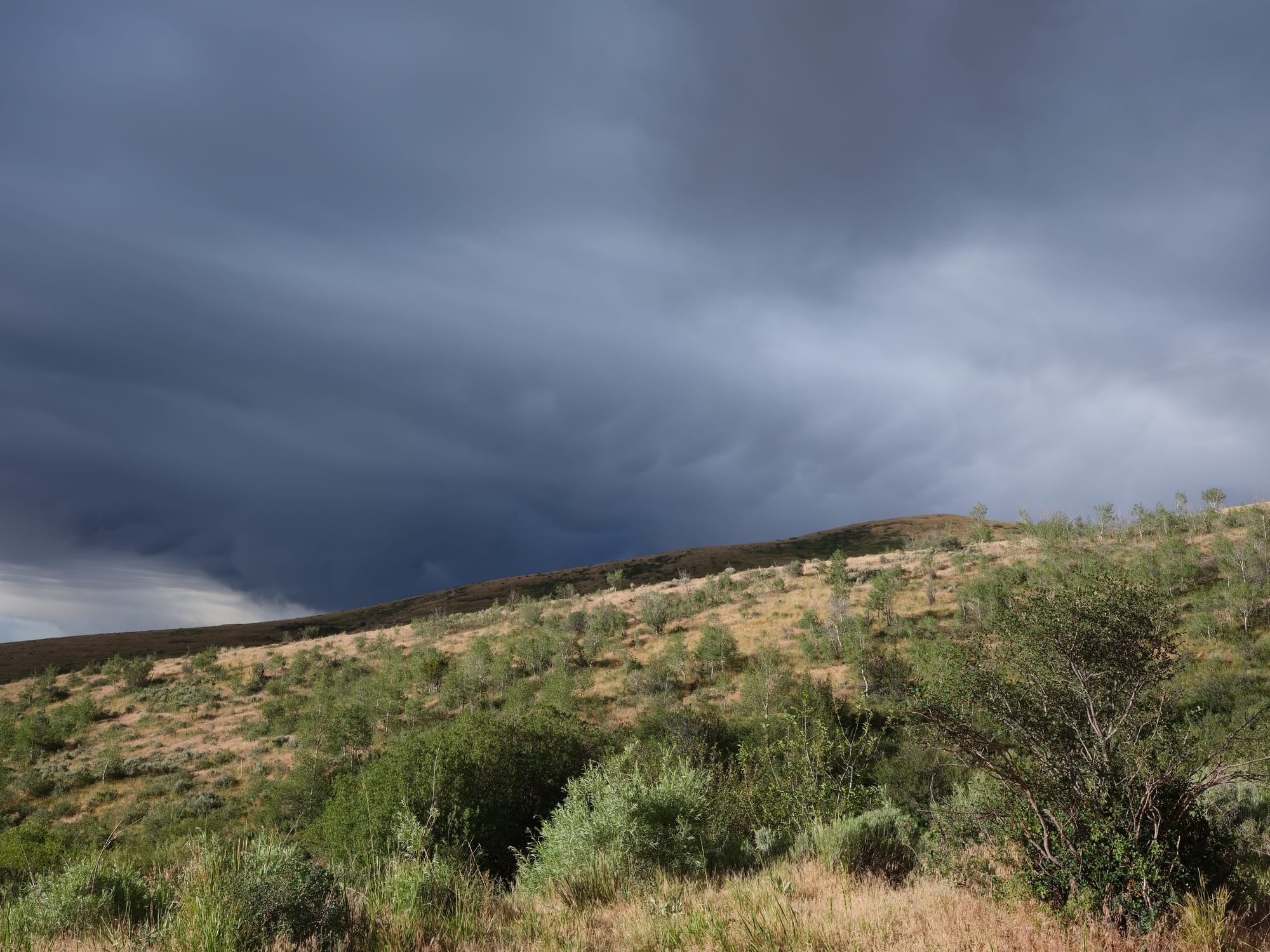
The weather was still unsettled and made for some wonderful light.
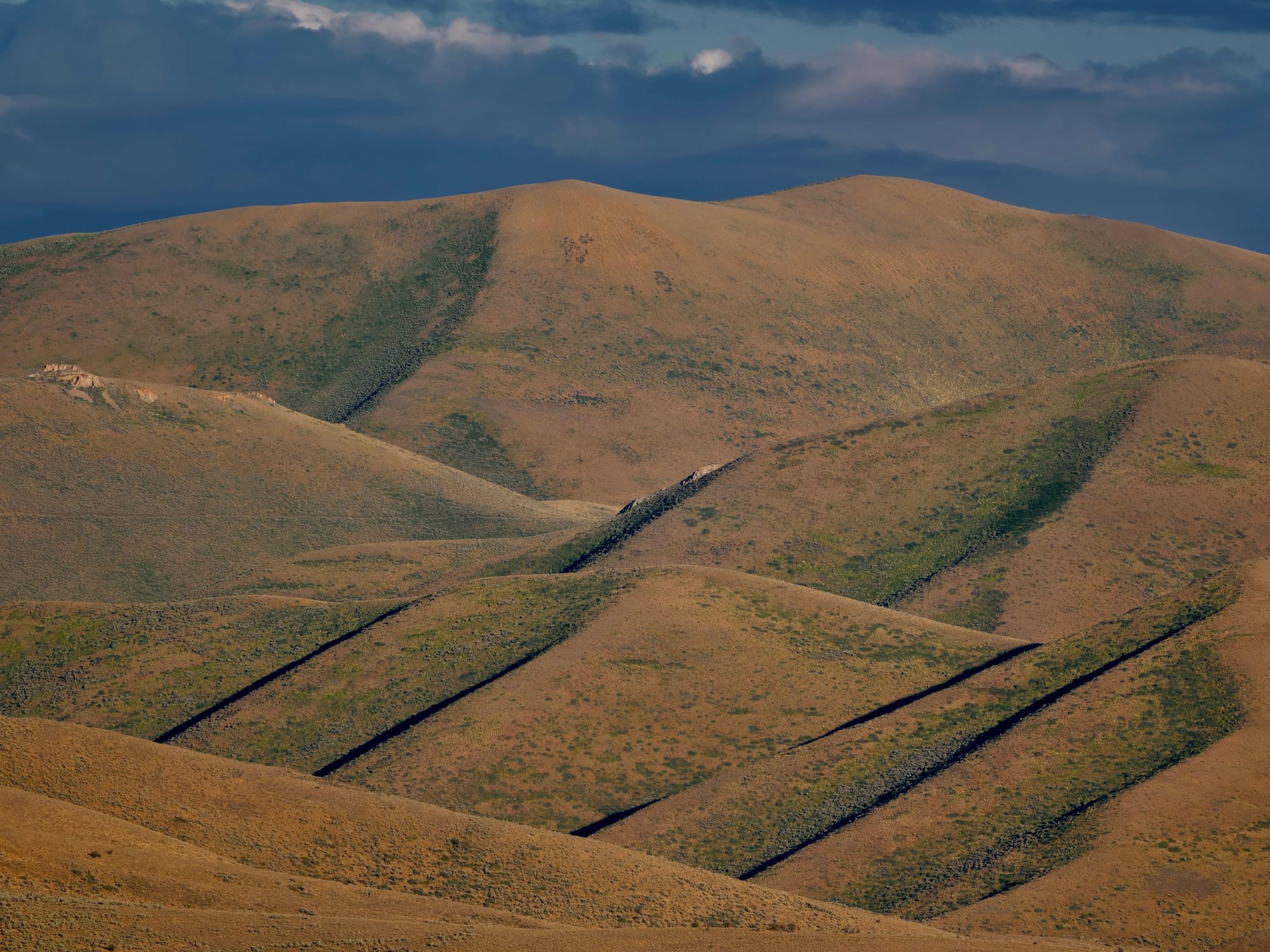
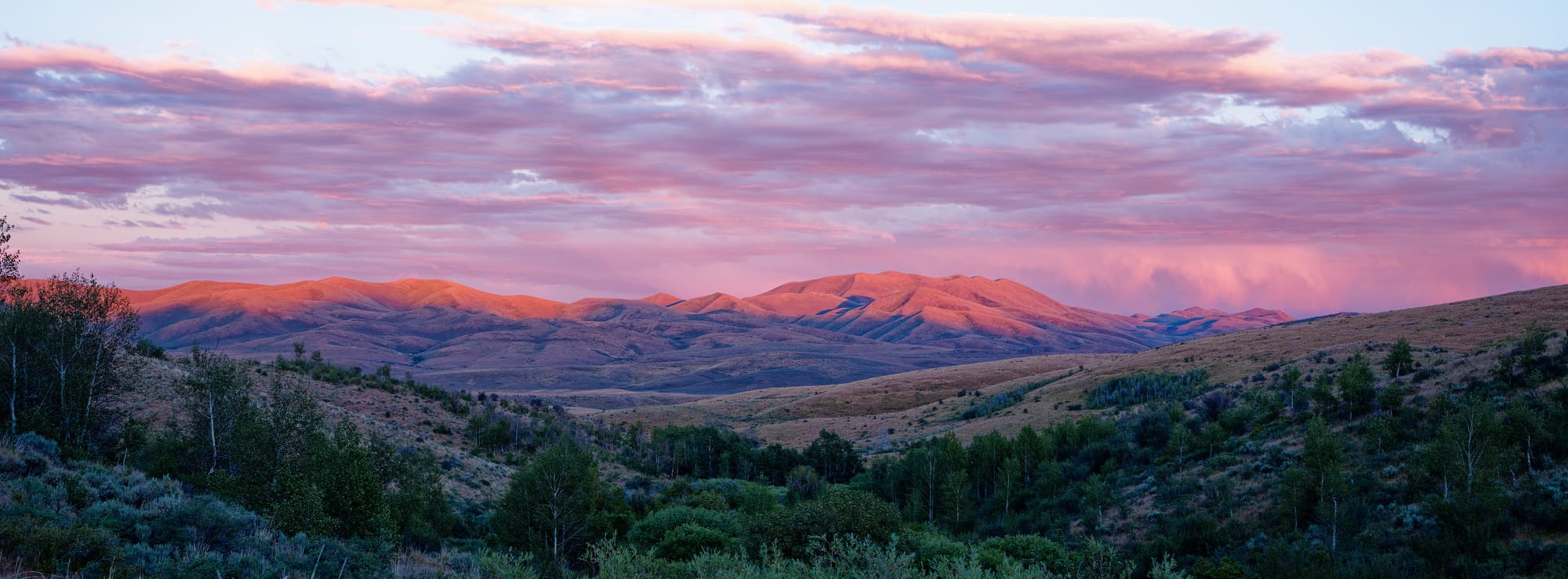
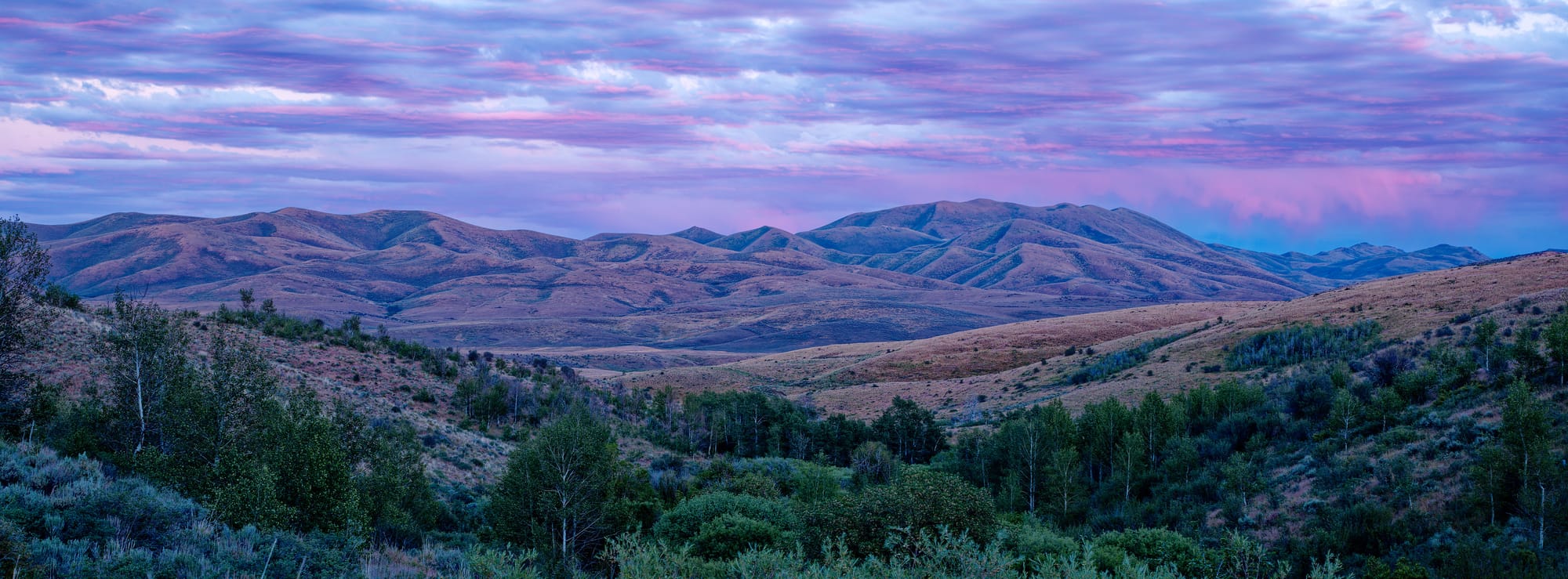
Soft hills across the valley in late afternoon sun.
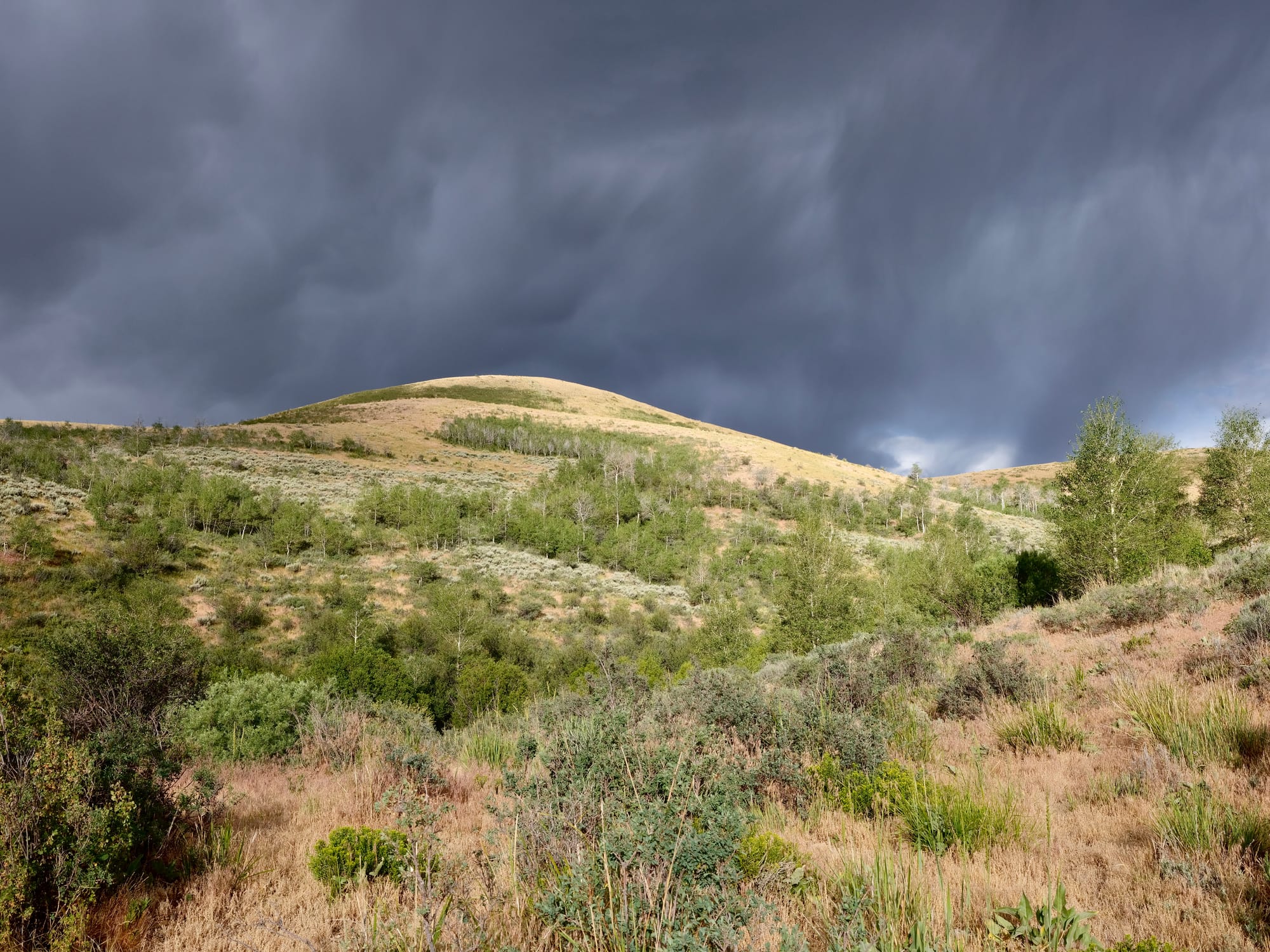
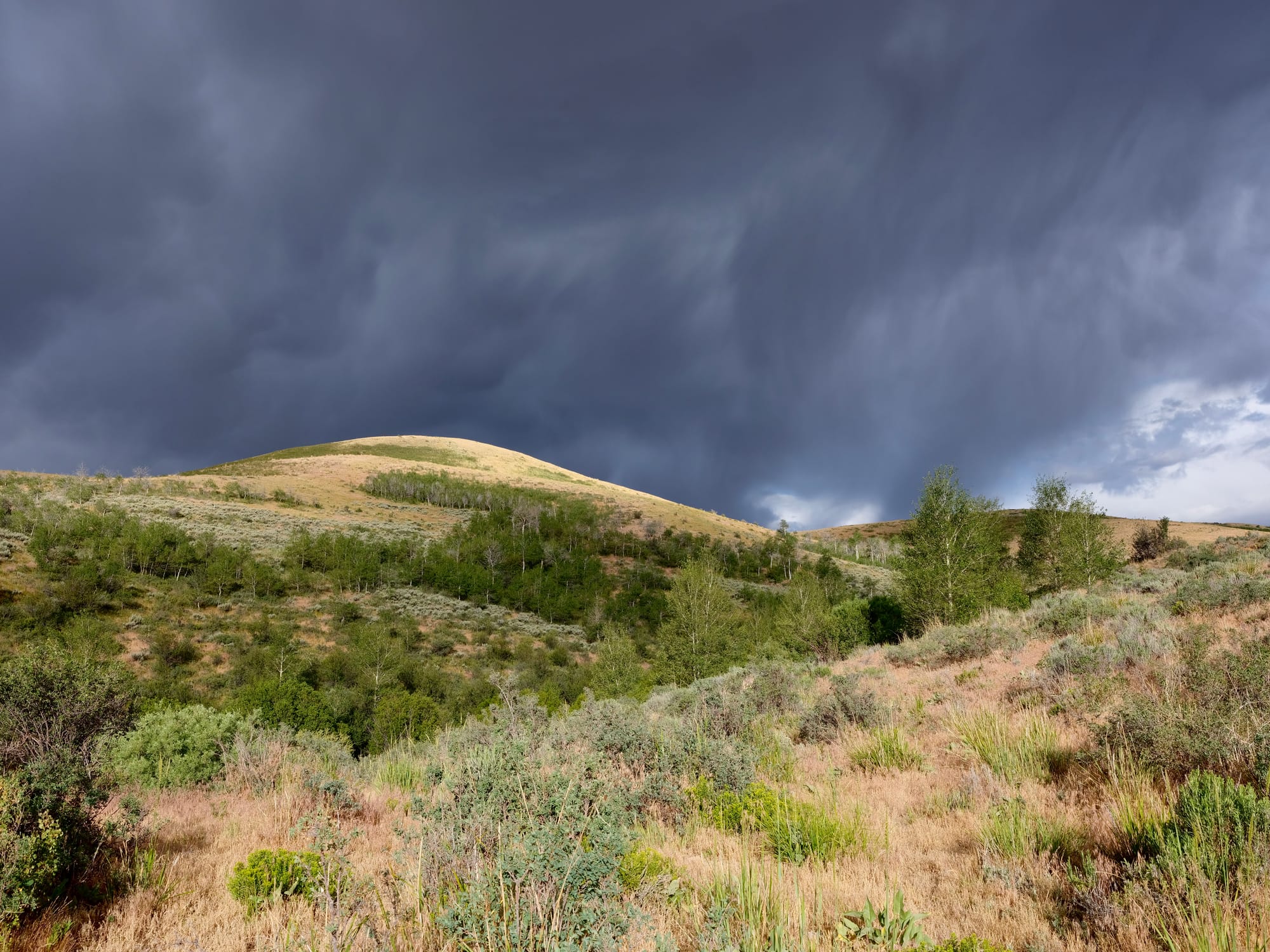
I began too call the mountain top above us ‘Cloud-splitter’, as there were repeated efforts by the weather to inundate camp. Each one parted at the top of this mountain and went around us. The bright morning sun contrasted sharply with the veils of rain from the dark clouds.
The area clearly had some mining background. In addition to a Forest Service sign warning about disturbing the heritage in the area, there were signs of excavations, piles of rock and other disturbances. It is not far from Gold Creek which says most of what you need to know.
Further research revealed some controversy in 1997 when the Forest Service closed the road by plowing up a berm after they discovered some pottery. The site they found was an old Chinese camp or town where Chinese laborers who worked at the mine lived. The Forest Service anxious to protect the site for future investigation decided to close the road on Forest Service land.
Naturally a local local resident took exception and complained to the county. The county decided to re-open the road and to cap the site with stone. This stirred up local feelings but most of it seemed like a lack of communication complicated by unclear ownership of a road that predated both entities.
What I saw however when I was there was evidence of fresh illegal excavation. Recent shovel marks and a pile of dirt indicating some screening of dirt to look for artefacts. I had seen a gentleman in a side-by-side as I arrived a couple of days earlier in this exact area who moved out as soon as I arrived.
A distant jet silently traces a fine white line. Silence envelopes the evening calm. Down in the cow-slopped valley the Greenman waits, in his patient bower, for men to return to him, he will again bestow his bounty. For now he waits, the bright candle of progress is guttering out. His time is near.
The soft hills to the east would soak up the evening light; reflect the promise, something to behold.